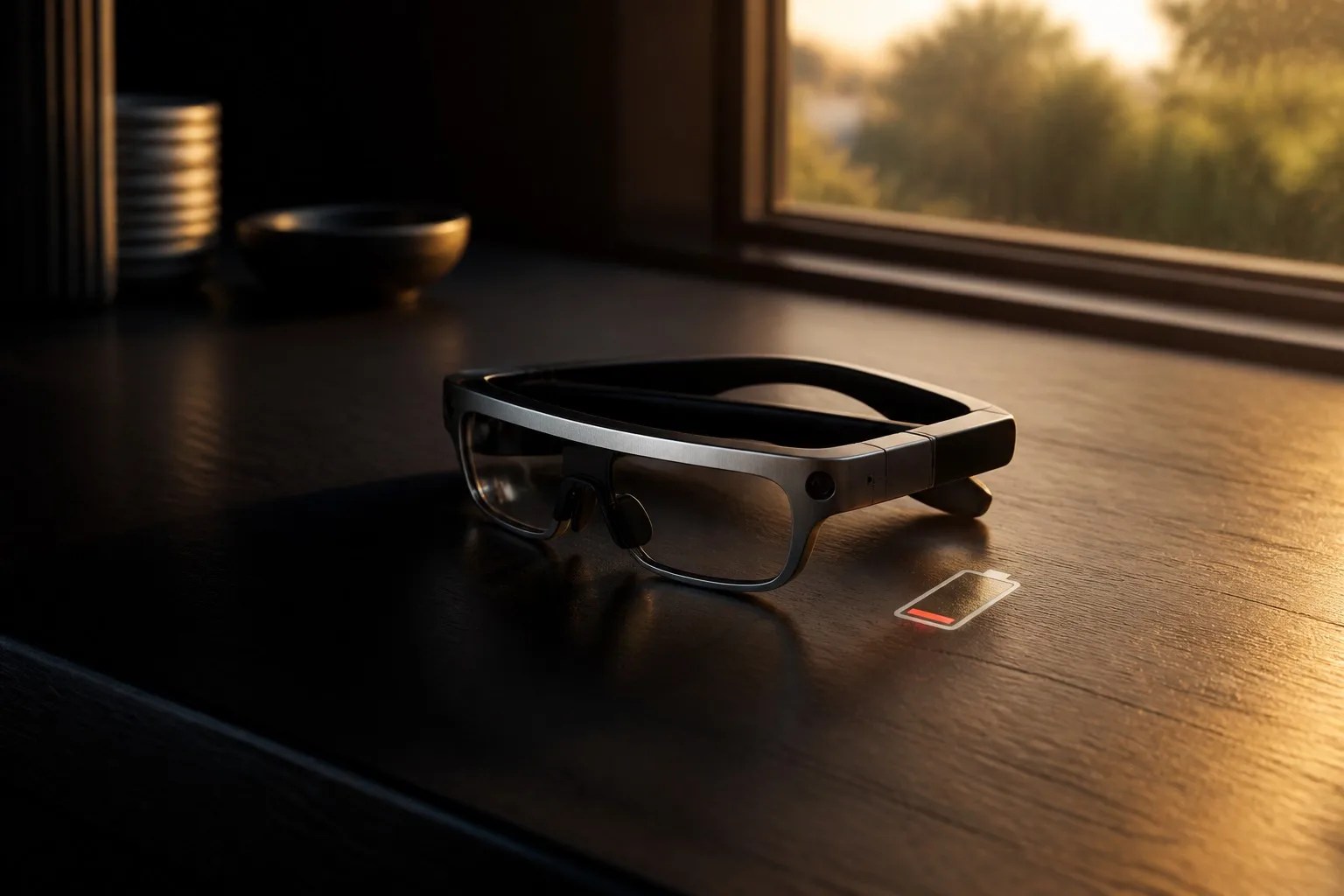
Before You Buy AI Glasses, Read the Battery Section Twice
The honest pre-purchase brief on the most hyped wearable of the decade: what the verified numbers say, what owners really report, and why the etiquette question has become a legal one.
There is a moment, somewhere between the product page and the checkout button, when every serious buyer of AI glasses hesitates. You have seen the growth charts and the keynote clips. You have watched people ask questions into the air and get whispered answers back. And still you pause. Will this thing live in a drawer by the end of the season? Will the battery survive one evening out with friends? And — let us be honest, because this is the question no marketing team will answer — will strangers quietly decide that I am the one recording them?
This guide is written for that exact moment. It is not a launch-day hype piece, and it is not a revenge review from someone who bought the wrong generation. It is the pre-purchase brief we wish someone had handed us before we started following this category: what the verified numbers actually say, what real owners report after months of daily use, where restaurants and courts are drawing lines in the sand, and why the battery section deserves to be read twice before you spend a single pound, dollar, or euro. No invented specs. No affiliate pressure. Just the record — and the questions you should be asking yourself before you buy.
The Market Is Exploding. That Is Exactly Why You Should Slow Down.
Start with the numbers, because they are genuinely remarkable. Smart glasses shipments grew 139 percent year over year in the second half of 2025, according to Counterpoint Research, and AI-equipped glasses now account for 88 percent of all smart glasses shipped. Meta holds more than 80 percent of the market. For the full year 2025, Treeview’s market statistics count 7.25 million smart glasses shipped worldwide. The category is not a fad; it is the fastest-moving hardware story of the decade so far.
The scale story goes further. Meta itself says it has sold 7 million pairs of its Ray-Ban glasses — though it is worth noting, as BBC News reported in May 2026, that this figure is the company’s own self-reported number and has not been independently audited. Researchers quoted in the same report estimate that as many as 100 million people could buy AI glasses within the next few years.
Here is what the charts do not tell you: explosive growth is how a category gets bought for the wrong reasons. When a product grows at 139 percent, the marketing machines scale faster than the honest reviews, and the gap between what ads promise and what hardware delivers widens with every headline. Momentum is not a recommendation. The numbers prove the category is real. They prove nothing about whether it is real for you — and that is what the rest of this article is for.
The Battery Section: Where the Fantasy Meets the Power Outlet
Here is the section the headline promised, and here is why it matters more than any other spec on the box. The honest summary: AI glasses are not an all-day device. They are a few-hours-a-day device with a charging case that lives in your pocket — and the numbers from independent testing and real users agree almost eerily well.
Tom’s Guide’s testing of the Meta Ray-Ban Display, summarized by the Aircaps blog, found the battery down to 40 percent after just 90 minutes. Android Central’s review, collected in Mashable’s roundup, measured roughly three to three and a half hours of battery life under calls and streaming. And the field reports match: an AppleVis forum review from a visually impaired user — for whom audio is not a gimmick but a core accessibility tool — recorded the battery falling from 98 percent to 15 percent after about three hours of listening to Audible.
None of this is a hidden defect. It is the physics of putting a battery into a frame that must still look like glasses. What it means for you: the charging case is not an accessory, it is part of the product. Moor Insights & Strategy notes total battery life with the case reaches about 36 hours — a 50 percent improvement over the previous generation. That is real progress, and it shows how fast this hardware iterates. But it also means the honest ownership model is: the glasses charge during the day, the case charges at night, and you plan around both. If your mental picture was “put them on in the morning, take them off at bedtime,” adjust it now — before you pay, not after.
And one more lesson from this section: when a vendor says “all-day battery,” translate it as “all-day battery if you use them the way our charts assume.” Real usage — calls, streaming, long audio sessions — burns the pack in hours, not days. The buyers who report the least disappointment are the ones who did this math before purchasing. That is the entire point of this section.
The Elephant in the Room: People Will Assume You Are Recording Them
Now the question the spec sheet will never answer. You will wear these in public, and the public will not know what they do. The glasses carry a small recording indicator light, but BBC News reported that the light is dim in daylight and frequently ignored. In practice, the person across the table cannot tell whether you are recording — and the uncomfortable truth is that many will assume you are.
This changes the texture of everyday life in ways you only discover after wearing them. Conversations get slightly shorter. Jokes land differently. Someone telling you something private glances at your glasses mid-sentence. You may not even have the camera on — but the friction is real, and it will not disappear until the hardware makes its intentions legible at a glance. Designers have not solved that problem yet.
None of this means you cannot wear them. It means you are buying a social device, not just a technical one, and the etiquette is still being invented in real time. The people who wear them happily are the ones who accept this and adapt: announcing when they record, taking them off in sensitive conversations, and not taking the suspicious looks personally. If that sounds exhausting to you, that is valuable information about yourself — worth more than any review you will ever read.
“Adding face recognition to smart glasses would destroy privacy for everyone.”
— Electronic Frontier Foundation · March 10, 2026
Venues Are Drawing Lines. Courts Are Confiscating.
The social question has now become a legal and commercial one. In the UK, restaurants, pubs, and theatres have banned the £359 Meta Ray-Ban glasses from their premises over privacy fears — The Guardian reported the wave of venue bans in August 2026. The signal could not be clearer: a device that was a novelty accessory yesterday is now something establishments actively refuse to admit.
The bans do not stop at hospitality. Courts in England and Wales have banned the glasses outright: visitors wearing them have them confiscated at the entrance and get them back when they leave. A courtroom is a place where the presumption of non-recording is not a courtesy but a requirement of justice. When the judiciary confiscates a wearable at the door, the etiquette debate is effectively over — the law is writing the rules now.
And the direction of travel matters. The Electronic Frontier Foundation has warned that face recognition on smart glasses would destroy privacy for everyone. The warning concerns the platform’s future, but it applies to buyers today: you are purchasing a device at the center of an active privacy controversy. Before you buy, ask where you actually spend your days — and how many of those places already treat camera glasses as contraband.
The Honest Checklist: Who Should Buy — and Who Absolutely Should Not
Based on the verified record above — and only the verified record — here is the split. Be honest about which column you fall into. Most buyer’s remorse in this category starts with skipping this exercise.
- You commute or travel with audio in your ears for hours a day. The three-to-three-and-a-half-hour window fits your routine, and open-ear listening keeps you aware of your surroundings.
- You want hands-free photography — capturing moments while your hands are full — and you accept that the recording light is hard to see in daylight, so you announce yourself out loud.
- You are comfortable planning charging: the case in the bag, a top-up during the day, and the 36-hour total runway as your real battery number.
- You buy knowing the hardware is still iterating fast — the previous generation’s 50 percent battery gain says the next one will likely be better, and you are at peace with that.
- You expect all-day battery. Independent testing shows 40 percent remaining after 90 minutes; real-world use lands around three to three and a half hours. If that disappoints you on paper, it will enrage you in practice.
- You regularly eat out, drink in pubs, or go to theatres. Venues in the UK are already banning them, and courts in England and Wales confiscate them at the door.
- You cannot handle being asked “are you recording that?” in a normal day. Because you will be asked.
- You work or live around places with camera restrictions — hospitals, courts, secure facilities — and you do not want to choose between your glasses and your access.
- Your interest is face recognition or discreet surveillance. Do not. Beyond the legal danger in most jurisdictions, EFF’s warning stands: this is the path that destroys privacy for everyone — including you.
Before You Tap Buy: What to Know and What to Never Do
The indicator light is not a protection. BBC News reported it is dim in daylight and frequently ignored. Never assume anyone can see it. If you are recording, announce it — every time.
Venue bans are spreading, not shrinking. UK restaurants, pubs, and theatres have banned the £359 glasses, and England and Wales courts confiscate them at entry and return them on exit. Check the rules of everywhere you regularly go — and re-check, because the list keeps growing.
Recording people without consent is illegal in many jurisdictions. The law is racing to catch up with the hardware, and the debate is far from settled. When in doubt, take the glasses off.
Face recognition is a hard red line. EFF’s warning — that it would destroy privacy for everyone — is not a hypothetical for the industry; it is a warning for buyers too. Do not build any use case on it.
Treat marketing claims accordingly. Meta’s 7 million sold is a self-reported figure that has not been independently audited. That does not make it false — it makes it a claim, not a fact. Read everything with that filter.
Before you close this tab, reread the battery section. That is not a headline gimmick — it is the single most useful thing this article contains. The buyers who end up happy with AI glasses are not the ones who wanted the future the most. They are the ones who knew exactly what today’s hardware can and cannot do: a few honest hours of battery, a case in the pocket, a camera you must announce, and a growing list of doors that will not let you in. Know those facts cold, and the decision makes itself.
The future does not belong to whoever buys first. It belongs to whoever buys knowing exactly what they are getting. Read the battery section twice. Then decide once.
Research Appendix — Every Source in This Article
Every data point above, with its source, date, and link. No figure appears here that does not appear in the article, and none was invented.
| Data point | Source | Date | Link |
|---|---|---|---|
| Smart glasses shipments grew 139% YoY in H2 2025; AI glasses are 88% of shipments; Meta holds over 80% share | Counterpoint Research | Feb 26, 2026 | Read |
| 7.25 million smart glasses shipped in full-year 2025 | Treeview XR Market Statistics | Aug 1, 2026 | Read |
| Meta reports 7 million units sold (self-reported, unaudited); researchers estimate up to 100 million buyers within a few years; indicator light is dim in daylight and often ignored | BBC News | May 13, 2026 | Read |
| Tom’s Guide test: Meta Ray-Ban Display battery fell to 40% after 90 minutes | Aircaps blog summary | Jun 1, 2026 | Read |
| User report: battery dropped from 98% to 15% after about 3 hours of Audible listening | AppleVis forum review | Mar 25, 2026 | Read |
| Android Central review: about 3–3.5 hours of battery with calls and streaming | Mashable review roundup | — | Read |
| About 36 hours total battery with charging case; 50% more than the previous generation | Moor Insights & Strategy review | — | Read |
| UK restaurants, pubs, and theatres ban the £359 Meta Ray-Ban glasses over privacy fears | The Guardian | Aug 6, 2026 | Read |
| England and Wales courts ban the glasses; confiscated at entry, returned on exit | The Guardian / AOL UK | Aug 12, 2026 | Read |
| EFF warns face recognition on smart glasses would “destroy privacy for everyone” | Electronic Frontier Foundation | Mar 10, 2026 | Read |
Links verified August 2026. A dash (—) in the date column means the source publishes no release date.
 Independent Intelligence on Ambient Technology
Leave a comment