SMARTS · The Connected Home
The Devices You Own Until They Decide Otherwise
The smart home industry is richer than ever — and discarding its customers’ hardware faster than ever. Here is what the fine print never tells you, and how to buy like your future self is watching.
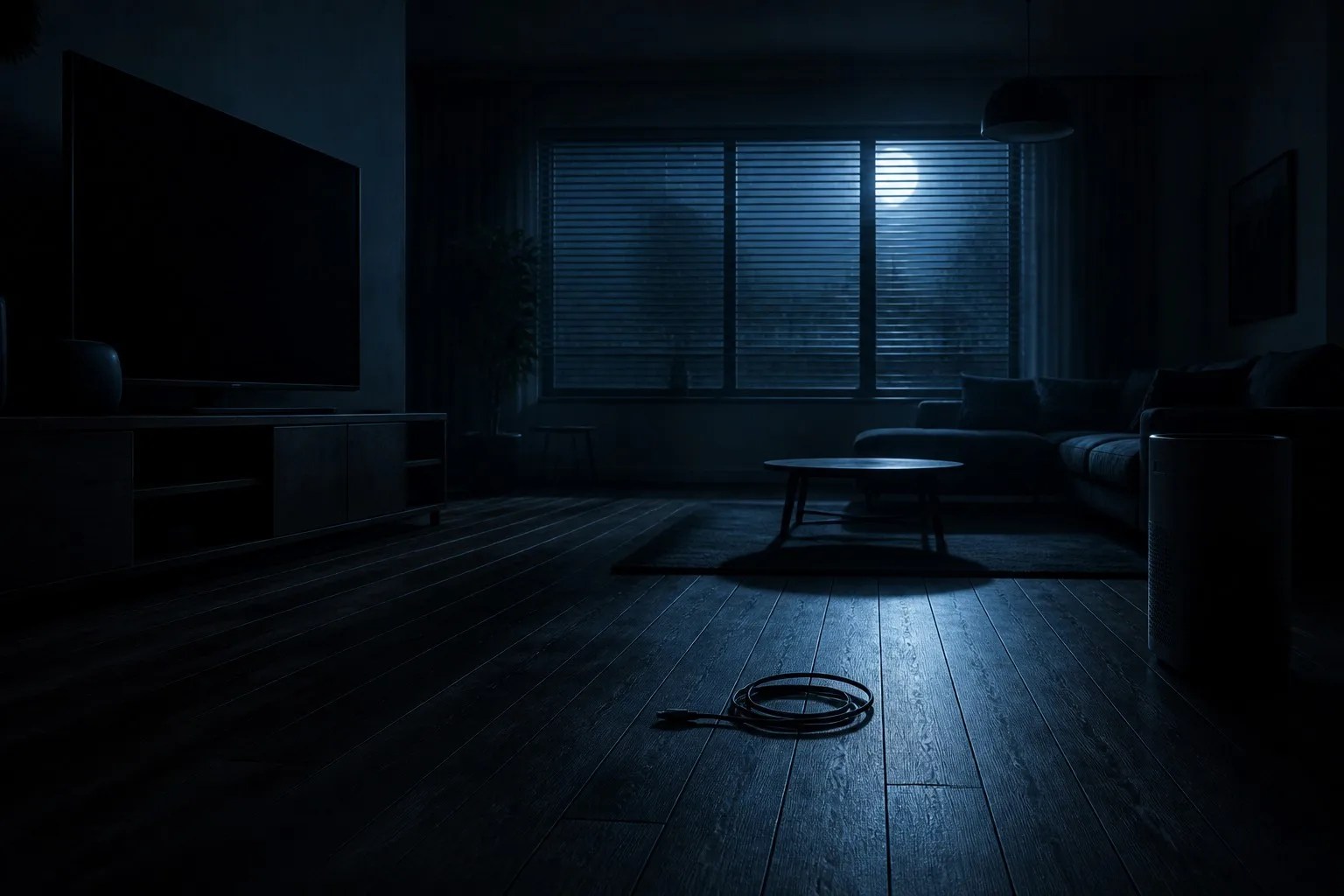
You bought it. You carried it home, unpacked it, stood on a chair to install it, and then spent an evening teaching it your routines. The lamp that greets you home. The thermostat that learned your week. The camera that watches the street while you sleep. Then one morning, without warning, the app opens to a different screen: this product has been discontinued, and service ends on a date that is already in the past tense. Your hardware — paid for in full, working perfectly — has been retired by somebody else’s decision. This is the story of how the smart home learned to kill its own devices. More importantly, it is the story of how you stop being a victim of it.
01 · The Feeling
You Own It. Until They Decide Otherwise.
The betrayal is a specific kind of feeling, and if you have felt it, you recognize it instantly. You hold the box, the receipt, the device itself — all of it real, all of it yours. And none of it matters, because the part that made the product smart never lived in your house. It lived in a server room you will never visit, behind an account page you agreed to years ago, on a roadmap you were never shown.
Ownership, it turns out, has been quietly redefined. What you bought was not a product but a permission — a temporary lease on functionality that a vendor can revoke with a single update to a support page. The switch on your wall has a co-owner, and that co-owner can go out of business, change its strategy, or simply lose interest — and take your purchase with it.
The anger is legitimate. No one tells you at checkout that your lightbulb depends on a company’s quarterly earnings report. No one explains that “smart” really means “borrowed.” And when the end comes, there is no recall, no refund, no apology — just a banner in an app you are about to delete, and a plastic husk that still glows when you press the button, waiting for instructions that will never arrive.
There is grief in it too, smaller and stranger than the anger. The routines you built — the morning scene, the away mode, the good-night sequence — are suddenly archaeology. Your house remembers things the company has already forgotten. That is the quietest theft in consumer technology: not the money, but the small future you had built around a thing that was never quite yours.
02 · The Market
A Booming Industry With a Shrinking Sense of Duty
Here is the part that makes the betrayal feel absurd: the industry is thriving. Grand View Research puts the global smart home market at $162.8 billion in 2025, with 2026 projected at $207 billion — a striking leap in a single year. This is not a struggling sector. It is one of the fastest-growing categories in consumer electronics, and it is growing on the strength of products that its own makers are willing to abandon.
2025 · Market Size
$162.8B
The global smart home market in 2025, as estimated by Grand View Research.
2026 · Forecast
$207B
The projected 2026 size of the same market — still climbing.
And yet the abandonment is accelerating in the other direction. Reporting from XDA Developers describes smart home devices being discarded faster than ever — reaching brands that people genuinely trusted, not just fly-by-night startups. The pattern is consistent across the industry: the market grows, the catalog turns over, and the devices from a few years ago quietly stop being anyone’s responsibility.
Understand the incentive structure and the mystery dissolves. Revenue comes from selling new hardware and, increasingly, from subscriptions — not from maintaining old hardware. Every additional year of support is a cost item that appears on no customer-facing document. The rational decision for the company is to end support as early as the market will tolerate. The rational decision for you is to stop pretending otherwise.
So here is the paradox of scale: the more homes fill with connected devices, the more devices sit on schedules of planned neglect. The industry is quietly building a museum of itself — a growing collection of once-loved objects that still work, in every mechanical sense, but have been sentenced to death by spreadsheet.
03 · The Evidence
The Numbers Nobody Wants You to See
The evidence that this is a structural problem — not a run of bad luck — is now on the record. In a review of connected product pages, the Federal Trade Commission found that of 184 products surveyed, only 21 — 11.4 percent — disclosed how long software support would last or when it would end. In other words, 88.6 percent of the products examined told buyers nothing at all about the lifespan of the software inside them.
Ask the obvious question before you pay — how long will this work? — and the industry’s answer, in nearly nine cases out of ten, is silence. Not a long warranty. Not a support window. Not a date. Silence. The single most important fact about a connected device — the fact that determines whether it will be a tool or a paperweight in a few years — is the fact vendors most consistently refuse to print.
Customers have noticed. In a survey of Americans who own smart devices, 72 percent said manufacturers should be required to disclose how long they will support their software. Three out of four owners — people who have already bought into the smart home — want the law to force the answer the market will not give willingly.
Put the two numbers side by side and the whole story fits between them: the public demands transparency, the industry supplies almost none, and a market worth $162.8 billion and climbing still cannot bring itself to say how long its products will live. When an industry that large is that quiet, the silence is not an oversight. It is a strategy.
04 · The Cases
The Graveyard Has Names
Abstract arguments are useful; concrete names are better. In April 2022, Insteon — a long-established name in home automation — shut down its cloud service. Devices that depended on that service lost functionality, in many cases becoming permanent paperweights, while owners were left staring at a support page that no longer answered. It was not a bankruptcy that killed them, exactly. It was the end of a business decision.
Belkin’s Wemo line tells the same story in a different font: the company has ended support for most of its older Wemo devices, including smart plugs — among the most basic, least exotic objects in the connected home. A smart plug is not cutting-edge technology. It is a switch with a network chip. And yet it too has a death date, set not by physics but by policy.
Notice what these cases have in common. The failures are not acts of God, or even acts of insolvency — they are acts of management. A product line ends, a cloud contract lapses, an app is pulled from the store, and the hardware — perfectly functional, faithfully installed — is retired by decree. Nobody offers to buy it back. Nobody offers a trade-in. The device has no resale value because the device has no future, and the company loses nothing by turning it off. You lose everything you paid.
And the pace is quickening. The XDA report’s most unsettling observation is not that devices die — everything dies — but that they are being abandoned faster than before, by brands whose names once meant something. Trust, it turns out, is not a contract. It is a marketing asset, and it is spent like one.
“Every connected product sold today is a promise about the future. The industry has spent years demonstrating that it can break that promise at will. The question is no longer whether your devices can be bricked. It is whether you will choose ones that can survive it.”
05 · The Law
The Right to Know Is Becoming the Law
The good news is that the fight is no longer just yours. In California, SB 898 — legislation requiring transparency about support timelines for connected consumer products — is advancing through the state’s legislature, with support from Consumer Reports. If it passes, “how long will this work?” stops being a question you ask a chatbot and becomes a fact a manufacturer must print.
The federal push is running in parallel. In March 2025, Consumer Reports, the U.S. Public Interest Research Group, and the Secure Resilient Future Foundation jointly proposed the Connected Consumer Products End-of-Life Disclosure Act — a framework that would make support-period disclosure the rule rather than the exception across the country.
The direction of travel is unmistakable. Regulators, consumer advocates, and statehouses are converging on a simple idea: a buyer’s right to know how long a product will keep working is as fundamental as a warranty or an expiration date. The connected product is being pulled, slowly but steadily, out of the legal gray zone where “smart” simply meant “we decide.”
But laws take time, and your bulbs are aging now. Until the statutes catch up with the shelf life, the burden of due diligence sits exactly where it always has: on you. The encouraging part is that self-defense is easier than the industry would like you to believe.
06 · The Buyer’s Playbook
How to Buy Like the Cloud Will Disappear Tomorrow
None of this means you should abandon the smart home. It means you should stop renting it. The rules below cost nothing, require no technical degree, and will spare you the exact heartbreak described above.
01
Buy Local-First
Choose devices that can function without the vendor’s cloud — hub-based systems, local control, offline capability. A device that still works when the internet goes down cannot be bricked by a shutdown notice. The best support policy is the one you never have to ask about.
02
Prefer Open Standards
Matter, and the ecosystem of open protocols growing around it, gives your devices a future beyond any single company’s roadmap. Open standards are the difference between owning a platform and renting a feature. When the vendor moves on, the standard — and the community — remains.
03
Read the Support Policy Before You Pay
Check whether the vendor publishes a software support end date. If the answer is written down, you are dealing with a company that treats customers as owners. If the answer exists nowhere — not on the box, not on the product page, not in the terms — treat that silence as the answer it is.
04
Spread Your Bets
Do not put every room of your house on one vendor’s cloud. Diversity is not just for portfolios. If a single announcement can dim your entire home at once, your home has a single point of failure — and it is not a circuit breaker.
05
Assume Every Device Dies
Buy for today’s function and plan for tomorrow’s replacement. Before any purchase, ask: if this product were discontinued tonight, what would I lose? If the honest answer is “everything,” the product is not smart. It is a hostage situation.
07 · Read Before You Buy
The Fine Print Nobody Reads, Read Here
1. Cloud-dependent devices can stop working without notice, regardless of what you paid. Support ending is not a defect — it is a schedule.
2. “Lifetime” promises are not contracts. Features can be removed, changed, or moved behind a paywall with an update you never explicitly accepted.
3. Unsupported devices stop receiving security patches. A bricked device is an insult; a device that keeps running but stops being patched is a risk — especially cameras, locks, and sensors at your perimeter.
4. Community rescues exist, but they are not a plan. Open-source firmware and hobbyist projects have saved specific devices, yet they require skill, void warranties, and cover only a fraction of the catalog.
5. Do not panic-replace. Before buying anything new, check which of your current devices has a local mode or a community alternative. The most sustainable upgrade is the one you don’t make.
6. For anything safety-critical — locks, cameras, smoke detection — never depend on a single vendor’s cloud. Redundancy is not paranoia; it is architecture.
The smart home was sold as a place that anticipates you. The least it owes you is a future. You do not need to abandon the technology — you need to stop being the only party in the transaction without a contract. Buy devices that respect the difference between a customer and a subscriber. Buy devices that can survive their maker. And when a company announces an end-of-life date for something you already own, let that be the last thing it ever sells you.
“Own your devices before they decide who owns what. The smartest home is the one that still works the day after its maker stops caring.”
Appendix
Research Appendix
Every figure cited in this article, and the source behind it, is listed below. If you are going to argue with a vendor’s support page, bring receipts.
| Data Point | Organization | Date | Source |
|---|---|---|---|
| Of 184 connected product pages reviewed by the FTC, only 21 (11.4%) disclosed a software support period or end date — 88.6% disclosed nothing. | Federal Trade Commission (FTC) | — | FTC report: “Smart Device Makers’ Failure to Provide Software Updates May Leave You Smarting” |
| 72% of Americans who own smart devices believe manufacturers should be required to disclose software support duration. | Consumer Reports / U.S. PIRG / Secure Resilient Future Foundation | March 12, 2025 | Joint press release proposing the Connected Consumer Products End-of-Life Disclosure Act |
| Global smart home market: $162.8 billion (2025), projected $207 billion (2026). | Grand View Research | — | Grand View Research — Smart Homes Industry Analysis |
| Insteon shut down its cloud service in April 2022, disabling devices that depended on it. | HowToGeek | April 22, 2026 | HowToGeek: “7 Smart Home Brands That Bricked Their Own Products” |
| Belkin Wemo ended support for most older Wemo devices, including smart plugs. | HowToGeek | April 22, 2026 | HowToGeek: “7 Smart Home Brands That Bricked Their Own Products” |
| California SB 898 would require transparency on support timelines for connected consumer products; Consumer Reports supports it. | Consumer Reports | April 6, 2026 | Consumer Reports: support for California’s SB 898 |
| Smart home devices are being abandoned faster than before, including by once-trusted brands. | XDA Developers | — | XDA Developers: smart home devices being abandoned faster |
SMARTS · The Connected Home · End of Report
 Independent Intelligence on Ambient Technology
Leave a comment