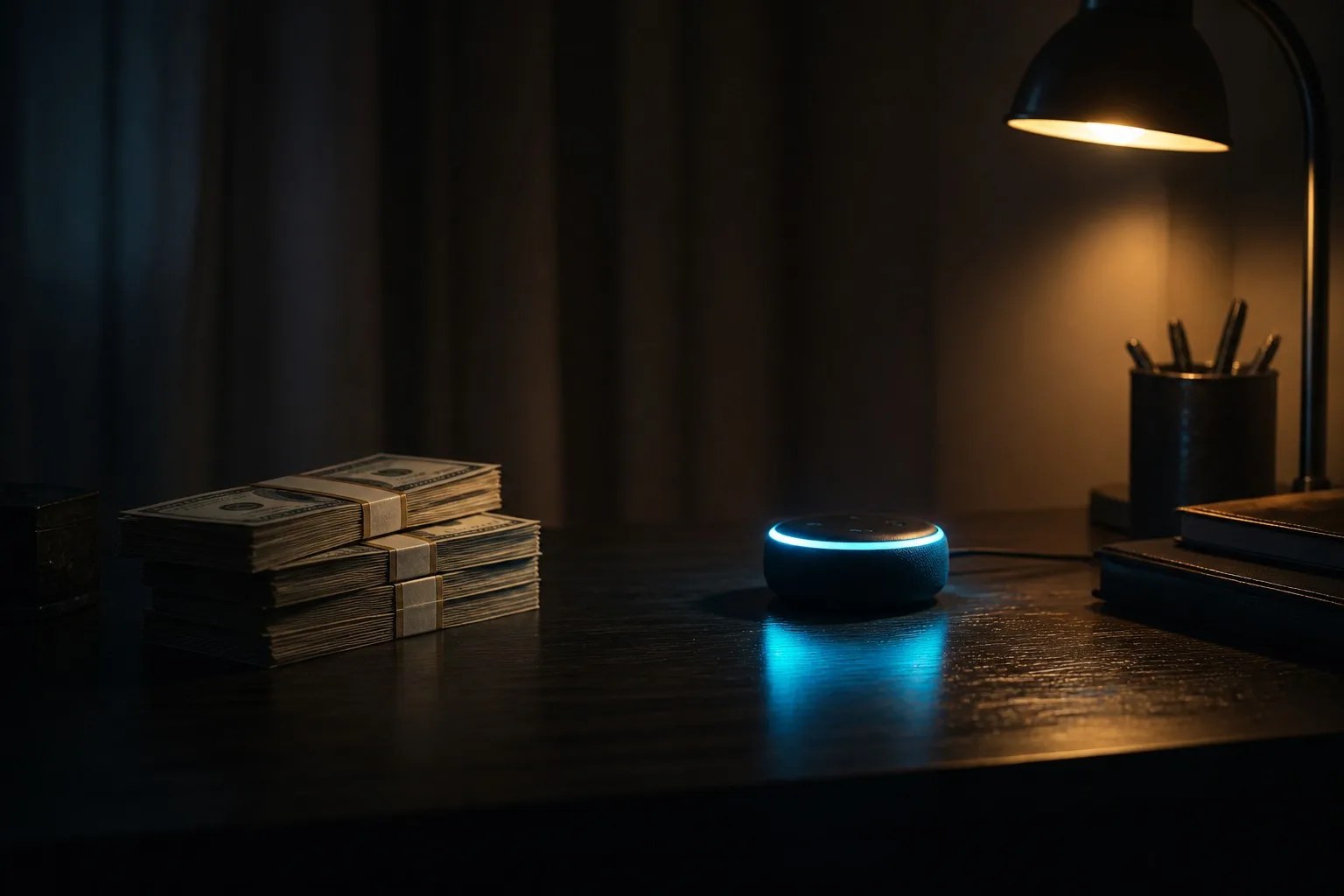
The Hardware Was Never the Product. You Are.
It starts with a doorbell camera and a ten-minute install. The device itself is priced almost apologetically, and the app walks you through a free trial so smooth it barely registers. Thirty days later the trial converts, the card on file is charged a single-digit sum, and a new line appears on your statement. No friction. No decision. No moment in which you actually agreed to anything. That is how the smart home became the most politely engineered monthly bill most households never notice — until, five years in, they finally add it up and discover the subscription has cost more than every device hanging on their wall.
The Frog in the Pot
Every recurring charge in the smart home is engineered to feel small. Three dollars here, eight dollars there — each fee individually defensible, each cancellation individually not worth the hassle. That is the mechanism. Subscription pricing was never meant to be evaluated as a whole; it was designed to be evaluated as pocket change, one transaction at a time.
Nothing grows, exactly — it accumulates. A single camera at four dollars a month is invisible. Four cameras, a doorbell, and a brand-tier plan at market rates are a different animal. Add automatic renewal switched on by default and a free trial that converts without a reminder, and the frog in the pot never feels the water heating — a pattern that Automated Home’s August 2026 audit of household accounts calls a quietly worsening budget problem for most families.
The sting when you finally look is not the amount. It is the recognition: the product you bought was priced to be forgotten, because the business model was never the box on the wall. It was the standing charge attached to the box. The hardware was never the product. You are — your card on file, your inertia, your attention, your data. The frustration is not paranoia. It is accurate perception.
A Market Built on Recurring Revenue
Grand View Research puts the smart home at $162.8 billion in 2025 and forecasts $207 billion in 2026 — a jump of roughly 27% in a single year. Hardware headlines that growth; subscriptions supply the margin. Cloud storage is the category’s most common recurring charge, running about $3 to $20 per device per month, according to an Arekore Shop analysis published on 20 July 2026. The major brands — Ring, Nest, Arlo, Wyze, Blink, Eufy — all operate paid tiers, priced between $3 and $25 per camera per month in 2026, per PVR Blog’s breakdown.
The structural logic is easy to see: when a device sits on a wall for five years, the profitable asset is not the silicon — it is the plan. That is why so little of the marketing talks about the subscription at all. The price on the box is the entry ticket; the price you pay is everything the box asks for afterward.
The Small Print That Adds Up
The pain points are never dramatic. They arrive, in order of how often they surface: automatic renewal that nobody switched on; free trials that convert to paid plans without an event worth remembering; and plan overlap — a per-device plan, a per-home plan and a per-brand plan from different manufacturers, all covering roughly the same cameras. Automated Home’s report of 6 August 2026 on subscriptions quietly draining household accounts calls this combination worse in 2026 than it has ever been, precisely because the ecosystem keeps adding tiers faster than households keep auditing them.
TechTimes’ coverage of 31 July 2026 found connected-home subscription spend of $60 to $240 per household per year, with Ring’s plans at $4.99 to $9.99 a month. Notice the shape of that: even the cheapest mainstream plan is a bill with no end date. Multiply it across five years and the small print stops being small. The frustration is legitimate — the fees are individually reasonable and collectively unreasonable, and almost nothing in the purchase journey ever shows you the collective number.
What the Numbers Actually Say
Set the anecdotes aside. The published ranges are consistent across independent sources:
▸ Cloud storage, the most common recurring fee in the category: $3–$20 per device per month (Arekore Shop, 20 July 2026).
▸ Per-camera plans: $4–$18 per month, or $240–$1,080 of cumulative subscription per device — a total that frequently exceeds the price of the camera itself, per True Love Security’s analysis of 28 July 2026.
▸ The average smart-home user: $300–$600 per year in subscription fees, which Leios Consulting puts at $1,500–$3,000 over five years — more than a complete system of devices.
▸ Brand tiers across Ring, Nest, Arlo, Wyze, Blink and Eufy: $3–$25 per camera per month (PVR Blog).
▸ Household-level spend: $60–$240 per year, with Ring at $4.99–$9.99 monthly (TechTimes, 31 July 2026).
Read those ranges side by side and one conclusion writes itself: for a normal, unremarkable setup, the subscription column is the same order of magnitude as the hardware — and in many configurations, larger. The counter-trend is already visible: more homeowners are abandoning cloud-monitoring plans that require monthly fees, as CamCamp Tech reported on 16 April 2026 — a shift the industry is visibly responding to.
The Five-Year Ledger
Now the arithmetic, worked openly so you can check every step. This is a simple extrapolation from the cited ranges — multiplication you can reproduce on a napkin, not a survey and not a study, and it should not be mistaken for a finding from any research firm.
Take a normal four-camera household — front door, back door, garage, garden. Use the midpoint of True Love Security’s $4–$18 per-camera range: $11 per camera per month.
4 cameras × $11 × 60 months = $2,640 in subscription fees over five years.
Stretch to the range’s bounds: 4 × $4 × 60 = $960 on the cheap end; 4 × $18 × 60 = $4,320 on the premium end.
Use the wider brand range from PVR Blog ($3–$25, midpoint $14): 4 × $14 × 60 = $3,360.
Or just one Ring plan at the top tier: $9.99 × 60 = $599.40 — roughly $600 of cloud fees for a single camera.
Now the independent cross-check: Leios Consulting’s $1,500–$3,000 over five years for the average user, a sum its guide notes exceeds the price of a full set of devices. The ranges triangulate: a mid-range household’s subscriptions alone can cost about as much as a second set of hardware every five years — and, per True Love Security, per-device subscription totals routinely exceed the hardware’s own price.
Mid-range verdict: roughly $2,600 over five years for four cameras — a bill that, in the cited analyses, often matches or beats the hardware itself.
If a salesperson offered that trade at the register — pay us more than the device’s price, again, every five years, for the privilege of viewing your own recordings — you would walk away. The subscription desk is simply the version of that offer that nobody shows you.
“No single fee is expensive. That is exactly the point — and exactly why five years can pass before anyone adds it up.”
The Zero-Subscription Path
None of this requires living in a technological time capsule. The zero-subscription route is not a deprivation diet; it is a purchasing discipline. Six habits, in roughly the order you should apply them:
Prefer cameras with on-device storage — microSD slots, local recording — over cameras whose only recording option lives in the cloud. A card you own costs nothing per month, forever.
Many brands ship genuinely useful free tiers or one-time-pay models. The question at checkout is not “how good is the camera?” but “what does the free tier keep, permanently?”
Device price + (monthly fee × 60). If the subscription column beats the hardware column, the box is a loss leader — and you are the product it is leading toward.
For cameras and doorbells that support open recording standards or network storage, point your recordings at a drive you own. A real up-front cost; a zero monthly cost, permanently.
The moment you accept a free trial, set a reminder for the day before it converts — and cancel in advance. Trial-to-paid conversion is among the least-noticed drains in 2026 household budgets.
Once a year, read the recurring-charge lines on your statement and cancel every plan you cannot name on sight. One overlap found usually pays for a month of hardware.
Watch the Fine Print
▸ Default-on renewal. Assume every plan auto-renews unless you prove otherwise. Cancellation is not where the business wants your energy.
▸ Trial conversion is the silent upgrade. Automated Home’s 2026 analysis flags trial-to-paid conversion among the least-noticed drains in household budgets. Treat every trial as a bill with a deadline.
▸ Plan stacking. Per-device, per-home and per-brand tiers from different vendors can overlap on the same cameras. Nobody merges them into one invoice, because the overlap is the revenue.
▸ Free tiers can shrink. The plan you decline today may be the feature your device depends on tomorrow. Before you buy, check what happens to recordings and features if you never subscribe.
▸ Cheap hardware, expensive plan. When a camera’s price looks suspiciously low, the business model is usually in the plan. Read the pricing page the way you would read a contract — because it is one.
“Buy the box. Keep the keys. Do the multiplication once, before you connect anything.”
The smart home industry will not stop asking for monthly payments — the fees are small, the trials are smooth and the statements are easy to ignore. That is the entire design. But the design only works while the numbers stay invisible, and the numbers stop being invisible the moment you write them down. The hardware was never the product. You are — but only for as long as you leave the bill unread.
Research Appendix: Sources
Every figure cited above, with publication dates where the source provides them (“n.d.” = not dated in the source). The five-year multiplication examples in “The Five-Year Ledger” are arithmetic extrapolations from these ranges, performed for this article; they are not findings from any of the organizations listed.
| Data point | Source | Date | Link |
|---|---|---|---|
| Cloud storage is the most common recurring smart-home fee: $3–$20 per device per month | Arekore Shop | 20 Jul 2026 | arekoreshop.com |
| Average user pays $300–$600 per year; $1,500–$3,000 over five years, exceeding the price of a full device set | Leios Consulting | n.d. | leios.consulting |
| $4–$18 per camera per month; $240–$1,080 cumulative per device, often exceeding the hardware price | True Love Security | 28 Jul 2026 | truelovesecurity.com |
| Ring, Nest, Arlo, Wyze, Blink, Eufy paid tiers: $3–$25 per camera per month (2026) | PVR Blog | n.d. | pvrblog.com |
| Connected-home subscriptions: $60–$240 per household per year; Ring $4.99–$9.99 per month | TechTimes | 31 Jul 2026 | techtimes.com |
| Auto-renewal, trial conversion and plan overlap make subscription creep a worse 2026 budget problem than ever | Automated Home | 6 Aug 2026 | automatedhome.com |
| More homeowners abandoning cloud-monitoring plans that require monthly fees | CamCamp Tech | 16 Apr 2026 | camcamptech.com |
| Smart home market: $162.8 billion (2025) → $207 billion (2026 forecast) | Grand View Research | n.d. | grandviewresearch.com |
 Independent Intelligence on Ambient Technology
Leave a comment