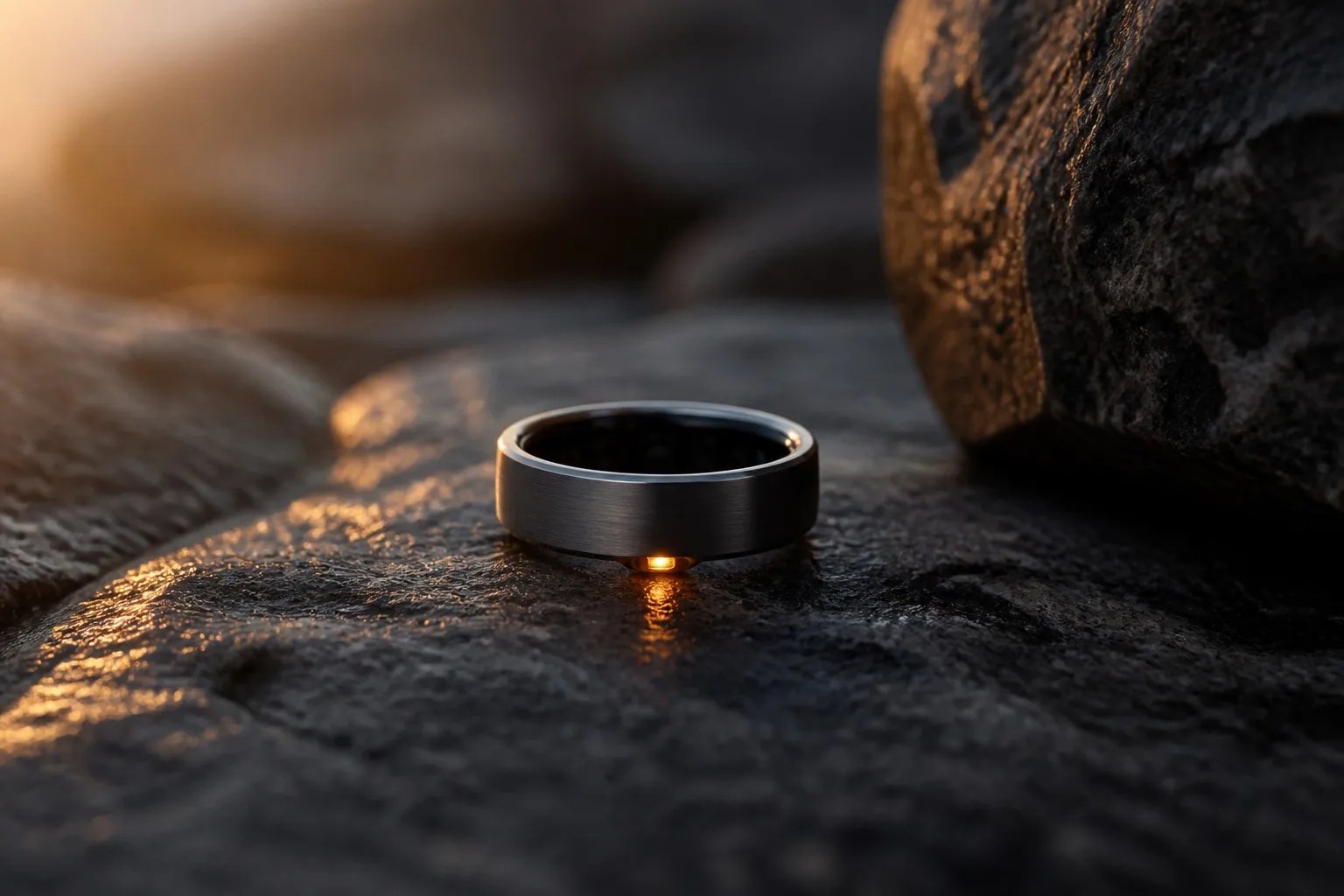
The Wearable That Wins by Doing Less
Something strange happened to wearables in 2025, and it did not happen on anyone’s wrist. For a decade the smartwatch was the story: the glowing screen, the vibrating alerts, the step counts and sleep scores delivered hourly to your skin. The category is still enormous. But the momentum has moved to a much smaller, much quieter object. Smart ring shipments grew 49 percent in 2025 while smartwatches managed roughly 6 percent growth, according to IDC data reported by Bloomberg on 5 January 2026, and echoed the same day by the Los Angeles Times and PYMNTS. The fastest-growing wearable of the moment is the one that does the least. That is not a marketing accident. It is a verdict on how we actually want to live with technology — and a warning about what we expect from it.
You Wanted to Know Your Body. You Ended Up Servicing a Gadget.
Consider what a modern smartwatch actually costs you per day. Not in dollars — in attention. An email buzzes. A step-goal celebration vibrates. A heart-rate alert appears, and you stop what you are doing to interpret it, because the watch has trained you to. Then there is the charger: the second charger, the one by the nightstand, plugged in every single night because an always-on screen and a cellular radio drain a battery that is expected to last a day or two.
And here is the cruelest loop in modern consumer tech: to charge the watch at night is to abandon the sleep tracking you bought it for. Wear it, and you wake to a dead battery. Charge it, and you lose the data. Either way, the device wins and you lose. Millions of people have quietly concluded that the price of “knowing your body” is servicing a demanding roommate that interrupts dinner, meetings, workouts and, at 3 a.m., your dreams.
The smart ring was engineered against that entire list of annoyances. No screen, so there is nothing to glance at. No notification engine, so there is nothing to interrupt you. No haptic buzz, so there is nothing to demand you. It sits on your finger like jewelry and does its measuring in the background. The category’s entire philosophy can be compressed into one sentence: the device should notice you — not the other way around.
The Market Answered the Philosophy With Money
According to IDC data reported by Bloomberg on 5 January 2026, smart ring shipments grew 49 percent in 2025, against roughly 6 percent growth for smartwatches. The same figures were independently reported the same day by the Los Angeles Times and by PYMNTS. Whatever the sampling differences between trackers, the direction is unambiguous: a category that barely registered a few years ago is growing about eight times faster than the one that was supposed to own our wrists.
The base is still small, and the analysts say so themselves. On 23 October 2024, IDC noted that Oura alone held roughly 80 percent of the smart ring market, and projected global shipments growing from 1.7 million units in 2024 to 3.2 million by 2028. For scale, consider the wearable mainstream: hearables — earbuds and their kin — are projected to ship 407.6 million units in 2026, up 4.0 percent year over year, according to the IDC Worldwide Wearables Tracker. Rings will not outsell earbuds this decade. That misses the point: a 49 percent growth rate on a small base is precisely how large categories are born.
The contrast deserves one more beat of attention. Smartwatches grew roughly 6 percent because they are a mature habit; rings grew 49 percent because they are a new answer to an old complaint. When a product outgrows the incumbent eightfold while doing visibly less, the market is not being whimsical. It is being articulate.
Why Doing Less Feels Like More
The emotional logic of the ring is rarely discussed in product reviews, which is strange, because it is the entire product. A smartwatch is a demanding roommate: it wants your attention, it wants your wrist, it wants to be charged, updated, swiped and silenced. A ring is closer to a good therapist — present, quiet, and in the room only when you want it. The pitch was never “more.” The pitch was “less,” and less turns out to be exactly what exhausted people buy.
Take sleep, the most purchased feature in modern wearables and, until recently, the most abandoned. People stop tracking sleep because the watch is uncomfortable, or needs charging, or lights up the bedroom at 3 a.m. The ring solves the hardware problem — it is small and light enough to forget — and the emotional problem — there is no screen to catch your eye. People who never managed a week of continuous watch wear report wearing a ring for months on end. That is the metric that matters, and no spec sheet captures it.
There is a jewelry dimension too, and it is not frivolous. A watch is a piece of technology you wear; a ring is a piece of you that happens to be technology. People choose a metal, not a materials menu. The ring sits where a wedding band or a signet ring sits — in the psychological territory of identity rather than utility. It is no coincidence that Oura, the market leader with roughly 80 percent share per IDC, treats design as a first-class feature. Nobody falls asleep in a device they are embarrassed to wear at dinner.
Two Institutions, Two Forecasts, One Honest Take
Now the part most trend articles skip: nobody agrees on how big this market is. We are going to show you the disagreement, because pretending it does not exist is how fake consensus gets manufactured. Fortune Business Insights projects the smart ring market at $518.9 million in 2026, growing to $3,772.4 million by 2034 — a compound annual growth rate of 29.30 percent. Persistence Market Research projects $502.7 million in 2026, growing to $2,506.5 million, a CAGR of 25.8 percent.
Read those side by side and two things are true at once. The near-term numbers are remarkably close — $518.9 million versus $502.7 million, a spread of roughly 3 percent — which is a decent sign that the 2026 baseline is real. The long-term projections diverge dramatically: more than a billion dollars apart by the early 2030s. That gap flows from different definitions of what counts as a smart ring, different product scopes, different base-year models, and different assumptions about how fast a nascent category matures.
Neither firm is wrong, and we will not average them into a fiction. When institutions disagree, we name the institutions and let the range speak. The honest summary: both houses agree growth is steep, so expect a market that at least doubles over the next several years — and treat any single long-term number as a scenario, not a fact.
“The ring’s promise was never more information. It was less noise — and less noise, it turns out, is what tired people buy.”
— SMARTS Editorial
Six Questions Nobody Puts on the Ring Box
The category deserves its enthusiasm. But enthusiasm is not a purchasing strategy. A smart ring is a sealed, non-repairable, subscription-adjacent purchase with a fit problem no watch ever had. Walk through these six before you check out.
A ring cannot be resized. Use the sizing kit and wear the trial piece through a full day and a full night before you commit — fingers swell with heat, hydration and sleep position. If it annoys you at 2 a.m., the sleep data dies with the habit.
Several rings gate their detailed scores behind a monthly or yearly subscription. Ask two questions before checkout: is the subscription mandatory, and does the free tier actually cover what you want? Hardware is only half the price of ownership — the recurring bill is the other half.
The cell is sealed inside the ring. Like every lithium battery it degrades over the years, and when it does there is no battery door — manufacturers typically offer replacements at a cost approaching a new device. Ask about their battery policy before you buy, not in year two.
Nickel and cobalt sensitivity is common, and a ring touches skin 24/7. If costume jewelry has ever left a rash on your finger, verify the material composition before ordering and prefer hypoallergenic options. A red, itchy ring is abandoned faster than any software bug.
Knurled barbells, kettlebells and even a careless car door will scar a polished ring fast. Many owners simply remove it for lifting and other metal-on-metal work. Decide where it lives during workouts before the first scratch — or before the first loss.
Rings trip metal detectors more often than you might expect. The fix is trivial — take it off and tray it — but have a plan for where it goes. A tiny, expensive object in a security bin is one forgotten step away from a lost one.
Sensors Are Not Diagnoses
The most important paragraph in any honest smart ring article is the one about what the device cannot do. A ring is a wellness device. It is not a medical device. It is not approved to diagnose conditions, and no app-store algorithm changes that.
The sensors are genuinely capable — heart rate, heart-rate variability, skin temperature, oxygen saturation, and in some models rhythm sensing. But capability is not diagnosis. If the ring flags something, an irregular rhythm reading, a persistently elevated resting heart rate, repeated oxygen dips, the correct response is not a forum thread and it is not self-treatment. It is a clinician. Atrial fibrillation and other conditions are diagnosed by doctors with clinical tools and judgment; a ring can be a useful diary to bring to the appointment, and it can never be the doctor in it.
The inverse matters just as much: a clean ring report is not a clean bill of health. Sensors miss things, algorithms average things, and sleep staging is approximate even on good nights. If you feel unwell, the ring’s green checkmark means nothing. Symptoms trump sensors — always.
And one more boundary, the one nobody sells at the counter: your data. Sleep, heart rhythm, temperature and cycle data are among the most intimate information a person produces, and it is stored, synced and processed by a company whose business model you should understand before the ring goes on your finger. The privacy policy is part of the product. Read it like one.
This article is journalism, not medical advice — and nothing a smart ring tells you is medical advice either. If you experience chest pain, palpitations, fainting or any concerning symptom, seek medical care directly, regardless of what your ring says. A device that measures you can never replace the person who examines you.
The smartwatch won the argument about features. The ring is winning the argument about life.
The best wearable of this decade will not be the one that monitors you most — it will be the one you forget you are wearing. The ultimate measure of technology is how much of your attention it gives back.
Every Number in This Story, With Its Source
All figures above are drawn exclusively from the sources below. Where institutions disagree, we present the disagreement rather than a manufactured average.
| Data Point | Institution | Date | Source |
|---|---|---|---|
| Smart ring shipments grew 49% in 2025 vs. ~6% for smartwatches | IDC, via Bloomberg | 5 Jan 2026 | Bloomberg |
| Same IDC figures, independent report | Los Angeles Times | 5 Jan 2026 | LA Times |
| Same IDC figures, independent report | PYMNTS | 5 Jan 2026 | PYMNTS |
| Oura held ~80% of the smart ring market; shipments projected 1.7M (2024) to 3.2M (2028) | IDC | 23 Oct 2024 | IDC blog |
| Smart ring market $518.9M (2026) to $3,772.4M (2034); CAGR 29.30% | Fortune Business Insights | n/a | Fortune Business Insights |
| Smart ring market $502.7M (2026) to $2,506.5M; CAGR 25.8% | Persistence Market Research | n/a | Persistence Market Research |
| Hearables to ship 407.6M units in 2026, +4.0% YoY | IDC Worldwide Wearables Tracker | 2 Jul 2026 | IDC Wearables Tracker |
Note: Fortune Business Insights and Persistence Market Research publish their projections on public market-research pages; our source materials did not state publication dates for those pages, so we list them as “n/a” rather than guess. Market-size figures from the two firms differ in scope and methodology — we present both rather than averaging them.
 Independent Intelligence on Ambient Technology
Leave a comment