SMARTS · Privacy Deep Dive
Your Doorbell Joined a Network You Never Agreed To
18 August 2026 · 11 min read · SMARTS Desk
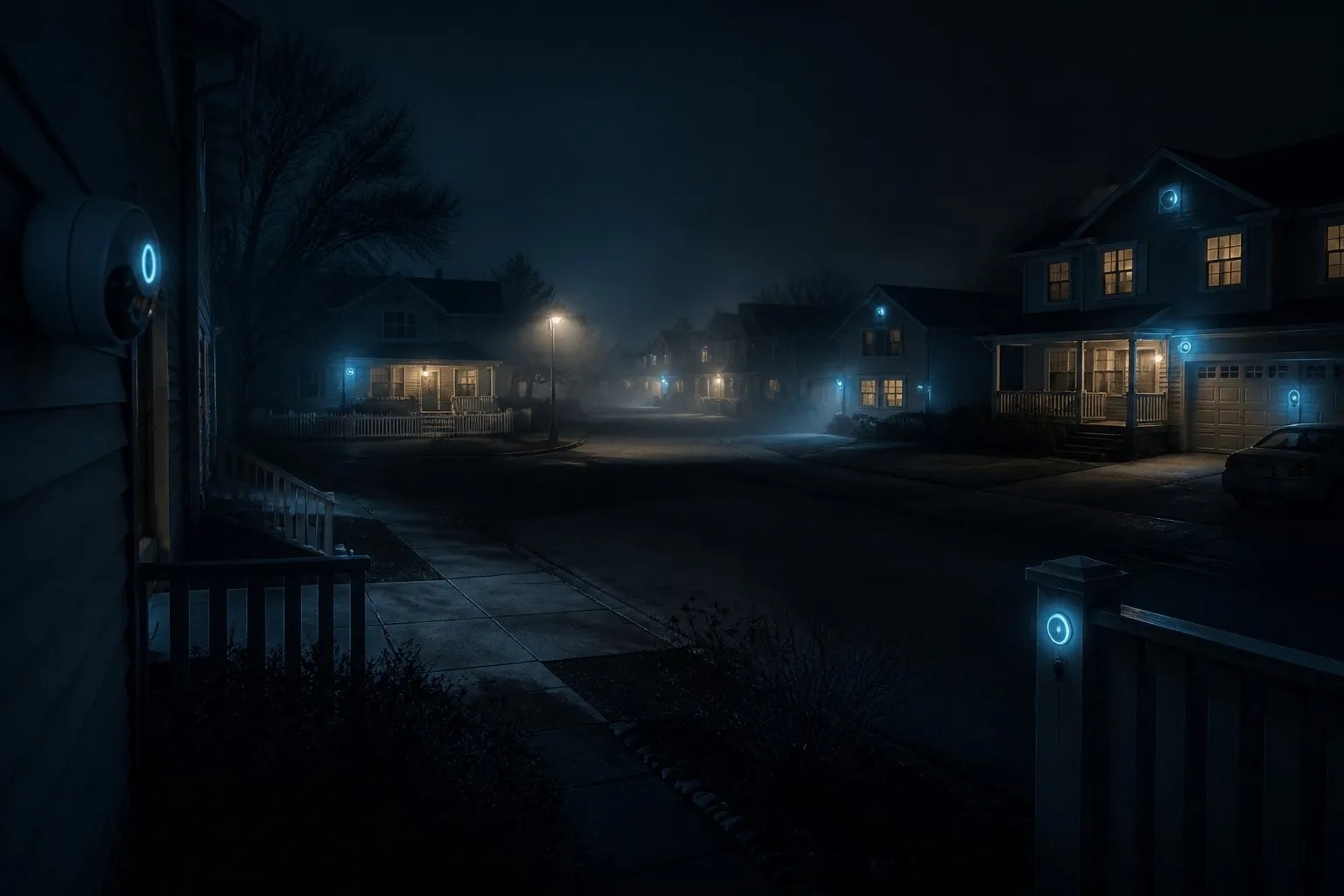
You installed it to protect your family. A doorbell lens above the porch, a floodlight camera over the driveway — a small sentinel that watches the front step at two in the morning so you don’t have to. It felt like a private act of care. But here is what the box never told you: that same device may have quietly joined a network you never agreed to — a web of shared footage, crowdsourced alerts, and biometric analysis that turns your neighbors, your mail carrier, and every stranger on the sidewalk into entries in somebody else’s database. A bill now moving through the New York legislature, S.9267, the Consumer Camera Privacy Act, is the first serious attempt to force the industry to admit this arrangement exists — and to hand the switch back to you. This is what the bill says, what it means for your doorbell, and what you can do about it before the law even arrives.
01 · The Vote You Didn’t Hear About
Five Weeks, Forty-One Votes, and Your Front Porch
On 28 April 2026, the New York Senate’s Consumer Protection Committee voted on S.9267: five votes in favor, two “yes with reservations,” zero against. Five weeks later, on 2 June 2026, the full Senate passed the bill 41 to 20, with one senator absent and one excused, and sent it to the Assembly, where it now sits with the Assembly Consumer Affairs and Protection Committee — alongside its companion bill A10687. The sponsor, Senator Rachel May (D, WF, 48th District), first introduced the legislation on 19 February 2026.
Why does a bill about doorbell cameras deserve this kind of attention? Because the market it regulates has quietly become one of the largest private surveillance deployments in American life — and the transparency around it has not kept pace. The testing consensus is instructive: smart home cameras genuinely enhance security, but they also erode privacy. CNET’s 2026 review of home security cameras is blunt on exactly this point — cameras can make your home safer while making everyone else’s privacy thinner — and the reviewers went so far as to decline to recommend models with recent privacy incidents. The capability is the problem and the promise at once. A device that can tell you a package was stolen is the same device that can tell a stranger on the internet that you limp, that your daughter walks home at 4:10, that the delivery driver always rings twice.
02 · The Word the Industry Hates
Your Doorbell Doesn’t Just Watch. It Reports.
The bill’s central concept is a phrase you will start hearing everywhere: coordinated surveillance feature. The statute defines it as any function that transmits, shares, or aggregates imagery — or data derived from that imagery — to anyone other than the device’s owner. The bill makes the scope unmistakable: this includes networked search, crowdsourced tracking systems, biometric analysis, and community alert features — see the full statutory definition.
And “biometric analysis” is defined with unsettling precision: it covers facial geometry, gait — the way you walk — and voice recognition. A camera that merely records is a diary. A camera that feeds into face-matching, gait analysis, or neighborhood alert threads is a broadcast. The line the bill draws is simple: if the imagery leaves your device and enters a shared system, that is coordinated surveillance — and it should be your choice, not the manufacturer’s default.
03 · What the Law Would Forbid
No More Pre-Checked Boxes
If S.9267 becomes law, the industry’s favorite defaults become illegal. The core prohibitions:
- No coordinated surveillance feature may be enabled by default. Consent must be explicit and separate — independent of the general terms of service, not buried in paragraph 47 of a scrollable agreement.
- User footage may not be used for algorithm training or product development without a separate, specific consent.
- For devices without an active paid subscription, footage may not be retained for more than 72 hours.
- Participation in coordinated surveillance may not be made a condition of using the device’s basic functions.
Read that last one again. Today, some cameras withhold core features — smart alerts, clip history, even two-way talk — unless you accept cloud processing and community sharing. Under the bill, that bundling would be illegal. Your camera would have to work as a camera first, and as a surveillance node only if you separately say yes.
04 · What You Are Owed
The Truth, at the Point of Sale
At the moment of purchase, sellers would be required to disclose, prominently: whether footage is stored locally or on remote servers; whether the device transmits data to the manufacturer or third parties when you do nothing at all; whether coordinated surveillance features exist and what their default state is; and the data retention policy — the full disclosure requirements are spelled out in the bill.
And once you own the device, the bill grants rights with hard deadlines: you may demand all of your footage within 72 hours — regardless of subscription status; you may demand deletion of all footage and derived data within 30 days; and you may withdraw consent to coordinated surveillance within 24 hours. Notice what “derived data” means: the gait profile, the face template, the soundprint. The bill forces companies to be able to delete the inferences as well as the images — see the user rights provisions.
05 · The Warrant Requirement
Your Footage Is Not Free Real Estate
One of the most significant provisions: law enforcement may obtain coordinated surveillance footage only with a warrant based on probable cause — unless the device owner gives voluntary, informed consent. And vendors would have to publish annual transparency reports documenting how the state asks for footage. The law-enforcement access rules matter because the alternative — the status quo — is a patchwork of vendor discretion: some companies hand over footage on a phone call, some demand a subpoena, and none of it is visible to the person whose porch is in the frame.
06 · The Price of Getting It Wrong
Fines That Change Corporate Math
The enforcement architecture is unusually muscular. The state attorney general may fine a company up to $10,000 per violation — and up to $25,000 for willful violations. Individuals get a private right of action: actual damages or $500 per violation, whichever is greater, plus reasonable attorney’s fees. A company that processes millions of doorbell feeds knows exactly what that arithmetic costs when the defaults are wrong — the penalty provisions are the reason this bill scares the industry more than most.
07 · Not Law Yet — and That’s the Point
Read This Before the Lobbyists Do
The bill has not passed. It sits in the Assembly’s Consumer Affairs and Protection Committee, and the industry is already organized against it: the New York Electronic Life Safety Association has filed a memorandum of opposition — the clearest signal yet that the fight over the bill’s core architecture is live. The stakes are concrete. If enacted, the law takes effect one year later, giving vendors a full year to re-engineer defaults, rewrite disclosures, and build deletion pipelines. Opponents will call that expensive. Privacy advocates will call it overdue. Either way, the Assembly version of the text is what gets negotiated next — and the CNET verdict remains the consumer’s most useful yardstick: some camera makers have recent privacy incidents on the record, and reviewers simply declined to recommend their hardware.
“Any function that transmits, shares, or aggregates imagery — or data derived from it — to anyone other than the device’s owner: networked search, crowdsourced tracking systems, biometric analysis, and community alert features.”
— Definition of “coordinated surveillance feature,” S.9267, Consumer Camera Privacy Act, as defined in the bill text
08 · Buyer’s Guide
Six Ways to Take the Network Back
You do not have to wait for Albany. Every one of the following moves is derived directly from the bill’s definitions and requirements — the rights it would create are worth practicing now.
Card 01
Buy Local-First
Ask the one question the bill would make mandatory: where does the footage live? A camera that works with local storage — SD card or a network video recorder — keeps your porch off third-party servers entirely. Cloud-only devices are, by design, someone else’s data center with your doorbell attached.
Card 02
Audit the Defaults
Assume every sharing toggle is on. Before the law would ban default-on coordinated surveillance, the default is whatever the manufacturer chose. Walk the settings at setup: community feeds, crowdsourced alerts, cloud person detection, biometric tagging. Turn off everything you didn’t consciously choose — then re-read what’s left.
Card 03
Aim Like a Lawyer
Field of view is a legal decision. A lens that sweeps a neighbor’s windows or the public sidewalk captures people who consented to nothing. The bill’s definitions make the problem visible; positioning solves it. Point the camera at your door — not at everyone else’s life.
Card 04
Export, Then Delete
Save what matters, delete the rest. The rights the bill would create — all footage within 72 hours, deletion within 30 days, consent withdrawn within 24 — are most useful to people who already have a habit of asking. Set a monthly reminder: export the clips you need, wipe the cloud, note the date.
Card 05
Read the Transparency Report
When annual transparency reports arrive, they become the best spec sheet in the industry: how many law enforcement demands, how many warrants, how many times the company handed over footage. The number that matters is the one that never fits in the marketing copy.
Card 06
Watch the Subscription Math
The 72-hour retention cap applies to devices without an active paid subscription — which means the subscription tier is where longer retention lives. Read what your plan actually retains, and remember: “free cloud” is a product with a price, and the bill’s definitions tell you exactly what that price is.
Caution · Read This First
What the Law Does Not Do
- The bill is not law yet. It sits in the Assembly’s Consumer Affairs and Protection Committee. Text can change, deadlines can move, and the one-year clock starts only if and when it is enacted.
- The 72-hour retention cap applies to devices without an active paid subscription. Subscribed devices follow the vendor’s disclosed retention policy — which is exactly why the bill’s disclosure requirements matter.
- A warrant requirement is not a prohibition. Police can still reach your footage on probable cause, and the voluntary-consent path means a knock at the door can still work.
- This is New York, not everywhere. If you live elsewhere, treat the bill’s definitions as a yardstick for your own questions — not as protection you already have.
- The industry is organized. The New York Electronic Life Safety Association’s memorandum of opposition shows the fight is live, and the final text may look different from what the Senate passed.
- Disclosure shifts the burden to you. The law can force information onto the box; it cannot make you read it. The defaults of next year’s cameras will be shaped by how many owners act like this matters.
“A camera that watches is a tool. A camera that reports is a witness. No law can choose which one sits on your porch — but now that you know the difference, you can.”
Research Appendix
Sources & Data
Every figure, date, name, and provision in this article traces to the sources below. No data beyond these has been used. All links retrieved 18 August 2026.
| Data point | Source / Institution | Date | Link |
|---|---|---|---|
| S.9267 introduced; sponsor Senator Rachel May (D, WF, 48th District) | New York State Senate | 19 Feb 2026 | nysenate.gov |
| Consumer Protection Committee vote: 5 yes, 2 “yes with reservations,” 0 no | New York State Senate | 28 Apr 2026 | nysenate.gov |
| Senate passage: 41 yes / 20 no / 1 absent / 1 excused; sent to Assembly Consumer Affairs and Protection Committee | New York State Senate | 2 Jun 2026 | nysenate.gov |
| Definition of “coordinated surveillance feature” (networked search, crowdsourced tracking, biometric analysis, community alerts) | S.9267, Consumer Camera Privacy Act | 2026 | nysenate.gov |
| Definition of “biometric analysis” (facial geometry, gait, voice recognition) | S.9267, Consumer Camera Privacy Act | 2026 | nysenate.gov |
| Core prohibitions: no default-on sharing, separate opt-in, no training without consent, 72-hour retention cap (no active subscription), no conditioning basic functions | S.9267, Consumer Camera Privacy Act | 2026 | nysenate.gov |
| Point-of-sale disclosures: storage location, background transmission, coordinated surveillance features and default state, retention policy | S.9267, Consumer Camera Privacy Act | 2026 | nysenate.gov |
| User rights: footage within 72 hours (any subscription status), deletion within 30 days, consent withdrawal within 24 hours | S.9267, Consumer Camera Privacy Act | 2026 | nysenate.gov |
| Law enforcement access: warrant on probable cause, voluntary informed consent exception; annual vendor transparency reports | S.9267, Consumer Camera Privacy Act | 2026 | nysenate.gov |
| Penalties: up to $10,000 per violation, $25,000 willful; private action of actual damages or $500 per violation (greater) plus attorney’s fees | S.9267, Consumer Camera Privacy Act | 2026 | nysenate.gov |
| Effective one year after enactment | S.9267, Consumer Camera Privacy Act | 2026 | nysenate.gov |
| Assembly companion bill | LegiScan (NY A10687) | 2026 | legiscan.com |
| Industry opposition memorandum | New York Electronic Life Safety Association | 2026 | nyelsa.org |
| 2026 smart home camera testing: security gains vs. privacy erosion; no recommendation for models with recent privacy incidents | CNET | 2026 | cnet.com |
SMARTS — independent technology journalism. All links retrieved 18 August 2026.
 Independent Intelligence on Ambient Technology
Leave a comment