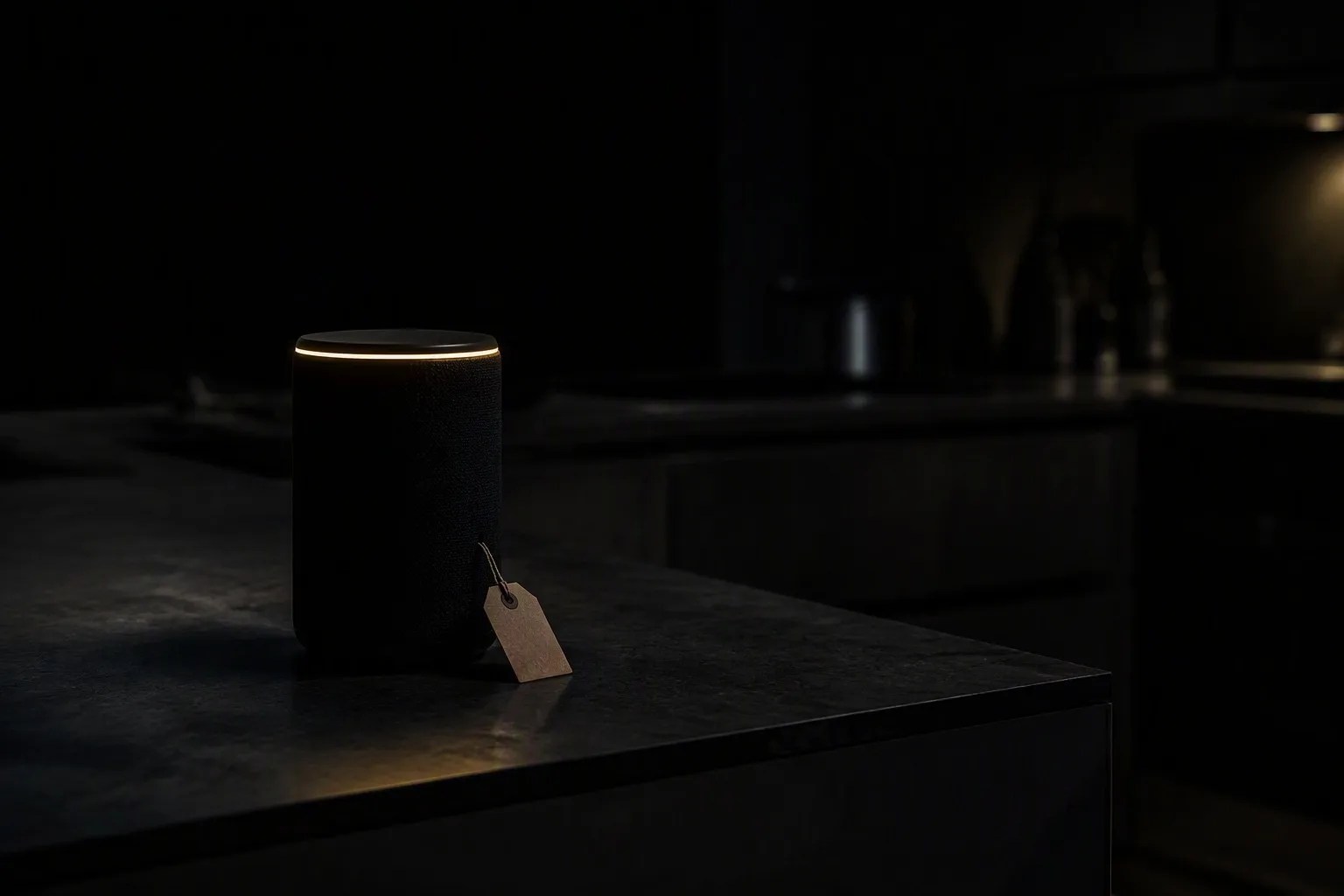
Voice · Subscription · Smart Home
The Assistant in Your Kitchen Now Has a Price Tag
SMARTS · 19 August 2026 · 11 min read
On 4 February 2026, Amazon began charging $19.99 a month for Alexa+ to customers who do not pay for Prime, per CNBC. For a product category that spent a decade being sold as a free butler — a speaker you bought once and talked to forever — that date is a quiet watershed. The voice assistant has crossed from bundled feature to subscription tier, and the speakers already sitting on kitchen counters have become what they secretly always were: the delivery mechanism for a recurring bill that nobody budgeted for when the box was carried in.
The Feeling First
The Voice That Started Asking for Money
Of everything in the smart home that has tried to charge us over the years — camera cloud plans, app fees, doorbell subscriptions — the assistant always felt like the one relationship that was not transactional. It answered at two in the morning. It told you the weather without asking who you were. It never sent an invoice, and so it felt like the only piece of the connected house that belonged to you rather than to the company that made it. That is precisely the feeling that has now been priced.
The change arrived without anyone buying anything. Prime members were upgraded to Alexa+ automatically, with an opt-out available, as ABC10 reported in January. Nobody visited a store. Nobody signed anything. The billing decision was made for you by default, inside an account you already had, which is how modern pricing works best: quietly, at the level of a checkbox. The discomfort is not the sum of money. It is the recognition that the free decade was the marketing phase, and that the product was never the speaker — the product was the arrangement, and the arrangement has been renegotiated while you were making dinner.
The Market
Two Giants Converge on the Same Toll Booth
The Amazon timeline is now legible in full. Alexa+ was announced on 26 February 2025 at $19.99 a month, free for Prime members and available to all customers in the United States and Canada, per Amazon’s own announcement. Nearly a year later, on 4 February 2026, it reached general availability: included at no additional cost to Prime members, $19.99 a month for everyone else, as GeekWire and Mashable reported, with Amazon’s February page describing the same split and a free tier for non-Prime customers. Non-Prime users who want the full assistant can subscribe at $19.99 a month after a free trial, per Reviewed.
Google is running the same play from the other side of the house. Gemini for Home launched as an AI upgrade replacing Google Assistant in the home on 1 October 2025, per Google, and is rolling out in early access, with the Home Mini and Nest Hub supporting fluid back-and-forth voice, per Google’s support pages. Note what is absent from the record: no price for Gemini for Home appears in anything we track. That is not an oversight in this article; it is the story. Amazon has posted a number, Google has not, and the consumer is being asked to buy hardware whose assistant economics are still undecided.
The market context is worth holding in view: the smart home was worth roughly $162.8 billion in 2025 and is forecast at about $207 billion in 2026, per Grand View Research. The fastest-growing part of that market is no longer the hardware; it is the recurring fee attached to the hardware. And the two assistant giants are converging on the same toll booth. As Regent5’s analysis puts it, Alexa+ and Gemini for Home are trying to solve the same coordination problem that Matter solves from the standards side — the problem of many devices behaving as one system. Matter 1.5 added cameras and video doorbells as native device types, per Matter Smarthome and CE Pro, and Samsung Research called camera support a milestone for interoperability. Two routes lead to the integrated home: the concierge, which bills you monthly, and the standard, which does not. The industry has chosen to sell the concierge.
26 FEB 2025
The Price Is Announced
Alexa+ at $19.99 a month, free for Prime members, US and Canada, per Amazon.
1 OCT 2025
Google Replaces Its Assistant
Gemini for Home launches as the AI upgrade that replaces Google Assistant in the home, per Google.
13 JAN 2026
The Default Flips to Yes
Prime members are upgraded to Alexa+ automatically, with an opt-out available, per ABC10.
4 FEB 2026
The Meter Starts
Amazon begins charging non-Prime customers $19.99 a month, per CNBC; the free tier for non-Prime customers is described on Amazon’s February page.
The Pain
Your Speaker Is Now a Delivery Mechanism
1. The recurring bill you never budgeted for. The hardware purchase was one-time; the assistant is rent. At $19.99 a month, per CNBC, a single assistant costs $239.88 a year — simple arithmetic on the published price — and unlike the speaker, the subscription never depreciates, never goes on sale, and never stops. The smart home was sold as a set of objects; it is being repriced as a set of obligations.
2. The free tier is now a question, not a given. Amazon’s February announcement describes a free tier for non-Prime customers, per Amazon — but the boundary between what is free and what is gated is the seller’s to draw and the seller’s to move. The question “what does my speaker still do without a payment?” now has an answer that can change on a quarterly basis, which is not how a household appliance is supposed to behave.
3. The quiet switching cost of Prime. “Free for Prime members” is Amazon’s own language, per Amazon, and it is accurate as far as it goes. But free is not the same as unbundled. Prime already bundles shipping, video and music; the assistant is now folded into that bundle, which means leaving Prime means losing the assistant along with the rest. Every feature folded into the membership raises the price of leaving by exactly that feature, and the auto-upgrade reported by ABC10 makes the enrollment part of the default. You are not being given a gift; you are being handed a reason to stay, and it is attached to the device you already own.
4. The coordination tax. The deepest pain is architectural. The subscription assistants and the open standard are aimed at the same outcome — devices that behave as one system — as Regent5 observes, with Matter refining camera performance and multi-stream video in its 1.5.1 update, per the Connectivity Standards Alliance. If you buy the concierge’s version of integration, you rent it. If you buy the standard’s version, you own it. The industry would prefer you not notice that the choice exists.
The Numbers
Twenty Dollars a Month, and Everything Behind It
The number itself is simple: $19.99 a month, or included with Prime, per Amazon and CNBC. The same structure holds for the Google side of the industry — an AI assistant replacing the old one in the home, per Google — with the crucial difference that no price has been published, per Google’s rollout notes. What the market has priced is the pattern: the smart home is expected to grow from roughly $162.8 billion in 2025 to about $207 billion in 2026, per Grand View Research, and a growing share of that value will be collected monthly rather than at the register.
The disclosure machinery that would let a buyer price this correctly barely exists. The Federal Trade Commission audited 184 connected-product pages and found that only 21 of them — 11.4 percent — disclosed how long software support would last; 88.6 percent did not, per the FTC’s own report. Meanwhile 72 percent of Americans with smart devices say they want mandatory support-duration disclosure, per Consumer Reports, US PIRG and the Secure Resilient Future Foundation. The market is being re-plumbed for recurring revenue while the paperwork that would make the transaction honest is still missing.
“You did not buy a speaker. You bought the delivery mechanism for a bill that had not been written yet.”
The Buy
How to Value a Speaker Whose Best Self Is on Lease
1. Price the subscription, not the hardware. The correct purchase question is no longer “how good is the speaker?” It is “what is the total cost of ownership over the life of the device?” A speaker that costs $50 plus $239.88 a year in assistant fees — the arithmetic of the published $19.99 price per CNBC — is not a $50 product. If the subscription is the product, the speaker is the terminal, and terminals should be priced like terminals.
2. Check what still works without a subscription — before you buy. Amazon describes a free tier for non-Prime customers, per Amazon, and non-Prime users can subscribe at $19.99 after a free trial, per Reviewed. Ask what the device does on day 366 with no payment attached, and treat the answer as a specification. If the seller cannot answer, note that most connected-product pages do not disclose even software-support duration, per the FTC.
3. Treat “free with Prime” as a bundle price, not a gift. Amazon’s language is “included at no additional cost to Prime members,” per Amazon. That is true and incomplete: the marginal cost of the assistant inside Prime is zero, but the moment you leave Prime it becomes $19.99 a month, per CNBC. Count the assistant as part of the switching cost of the Prime decision, the same way you count shipping. That is the honest ledger.
4. Know where the opt-out lives before you need it. The auto-upgrade of Prime members is reversible — an opt-out exists, per ABC10 — but the default was yes, and defaults are policy. If you did not choose the upgrade, decide now whether you want it, rather than discovering the decision was made for you at renewal time.
5. If you want the coordination without the concierge, buy the standard. The subscription assistants and Matter are solving the same problem from opposite ends, per Regent5. Matter 1.5 brought cameras and video doorbells into the standard, per Matter Smarthome, and the 1.5.1 update refined camera performance and multi-stream video, per HowToGeek. A device that speaks Matter keeps speaking Matter whether or not any assistant subscription is ever renewed. That is the closest thing the smart home currently offers to ownership.
The Fine Print
What “Free” Actually Meant
1. Prime bundling is not the same as free. Amazon says the assistant is “included at no additional cost to Prime members,” per Amazon — accurate phrasing, and worth being precise about. A zero marginal price inside a bundle is not a gift; it is an inducement to remain in the bundle. The bill is not itemized, but it is real, and it is paid in the currency of reduced freedom to leave. Do not let the word “free” do the thinking for you.
2. The opt-out exists; the default is enrollment. Prime members were upgraded automatically, per ABC10. Whatever your view of the upgrade itself, the mechanism matters: the company decided for you, and you must actively decide back. An arrangement that requires you to opt out is an arrangement that is counting on your inertia.
3. Google’s assistant has no published price — buy accordingly. Gemini for Home is rolling out in early access, per Google’s support pages, and no price appears in any source we track. That means a Google speaker bought today is hardware whose assistant economics are undecided. Do not pay today for a future bill; buy the hardware for what it does today, and treat any assistant capability as provisional until it has a stated price.
4. Disclosure is the exception, not the rule. The FTC found that 88.6 percent of connected-product pages it audited did not disclose software-support duration, per the FTC, and 72 percent of smart-device owners want that information mandated, per Consumer Reports and partners. Your speaker’s capabilities — free or paid — are not contractual. They are a roadmap that can be revised.
5. The assistant was the thin end of the wedge. If the voice assistant — the most personal interface in the home — can become a subscription, every other smart-home feature can. The question is not whether your speaker will bill you; it is which feature will be next, and the honest buyer assumes the pattern rather than the exception.
The Last Word
The voice assistant was the first piece of the smart home that felt like a person: patient, available, never billing. It is now a line item. The industry’s argument is that the value was always there and was merely collected late; the buyer’s job is to decide whether that is true before the free trial ends. The honest answer to “should I pay $19.99 a month?” is not yes or no — it is to write down what the assistant actually did for you last month, and then decide. And for those who never wanted a concierge in the first place, the alternative still exists. The standards ask nothing monthly. Matter’s cameras and doorbells arrive through the standard, per CE Pro, and keep working regardless of which assistant you decline. The concierge and the standard are both trying to run your home, per Regent5. Only one of them sends a bill.
— THE SMARTS DESK
Sources
Research Appendix
Every statistic in this article links to its primary source. Full list, as of 19 August 2026:
| Data point | Institution | Date | Source |
|---|---|---|---|
| Alexa+ costs $19.99/month; free for Prime members; available in US and Canada | Amazon (About Amazon) | 26 Feb 2025 | Announcement |
| Amazon began charging $19.99/month for Alexa+ for non-Prime customers on 4 Feb 2026 | CNBC | 4 Feb 2026 | Report |
| Prime members automatically upgraded to Alexa+; opt-out exists | ABC10 | 13 Jan 2026 | Report |
| Non-Prime users can subscribe to Alexa+ at $19.99/month after a free trial | Reviewed | 2 Jul 2026 | Explainer |
| Alexa+ available to all US customers 4 Feb 2026; free for Prime members | GeekWire / Mashable / About Amazon | 4 Feb 2026 | GeekWire · Mashable · Amazon |
| Gemini for Home launched as AI upgrade replacing Google Assistant in the home | Google Blog | 1 Oct 2025 | Launch post |
| Gemini for Home in early access; Home Mini and Nest Hub support fluid back-and-forth voice; no price published | Google Support | 2026 | What’s new in Google Home |
| Alexa+ and Gemini for Home solve the same coordination problem Matter solves from the standards side | Regent5 | 2 Aug 2026 | Analysis |
| Matter 1.5 adds cameras and video doorbells as native device types | Matter Smarthome / CE Pro | 20 Nov 2025 | Matter Smarthome · CE Pro |
| Matter 1.5.1: camera performance, multi-stream video and audio | Connectivity Standards Alliance / HowToGeek | 31 Mar – 1 Apr 2026 | CSA · HowToGeek |
| Smart home market ~$162.8B (2025), forecast ~$207B (2026) | Grand View Research | — | Market analysis |
| FTC audit: 184 connected-product pages, only 21 (11.4%) disclosed software-support duration; 88.6% did not | Federal Trade Commission | — | FTC report |
| 72% of Americans with smart devices want mandatory support-duration disclosure | Consumer Reports / US PIRG / Secure Resilient Future Foundation | 12 Mar 2025 | Press release |
 Independent Intelligence on Ambient Technology
Leave a comment