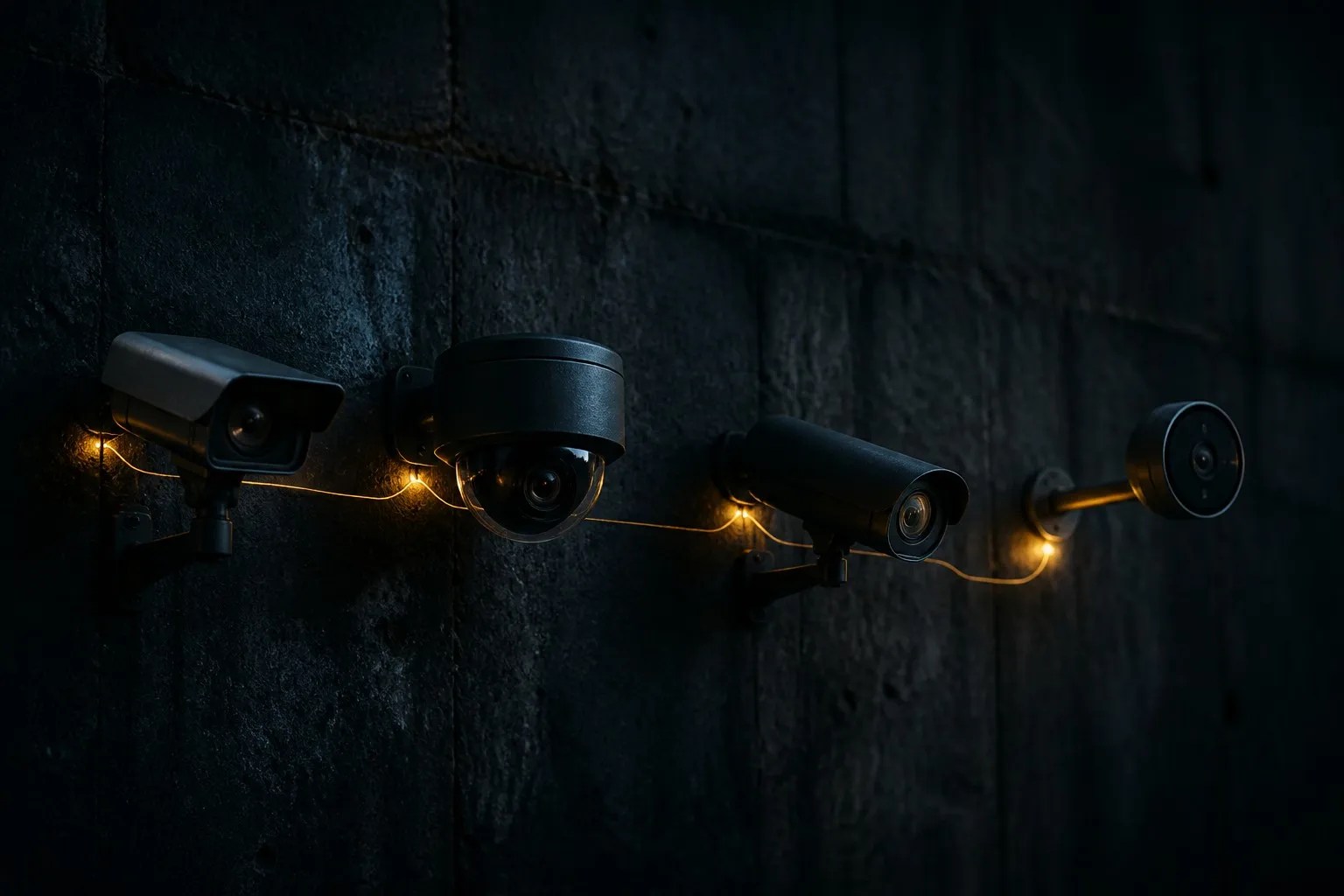
Smart Home · Interoperability · Buyer’s Guide
Your Camera Finally Speaks a Language Other Cameras Understand
SMARTS · 19 August 2026 · 11 min read
Your camera has never spoken to your other cameras. The doorbell at the front of the house answers only to its own app, its own account, its own cloud, and its own monthly fee; the camera over the garage answers to a different company, with a different app and a different bill. For a decade, that fragmentation was simply the shape of the market — a row of walled gardens, each with its own subscription gate. Then the standard moved. Matter 1.5, finalized in November 2025, added cameras and video doorbells as native device types speaking a common transport language based on standard WebRTC, and this spring Matter 1.5.1 refined how those camera feeds are delivered, including multi-stream video and audio. The first certified cameras are on shelves now. The exit route from vendor lock-in has opened — and this article is about what it actually buys you, what it does not fix, and how to buy during the transition, when most of the certified products are still arriving.
The Feeling First
The Contract You Never Signed
Start with the feeling, because the feeling is doing the real work of the subscription economy. Somewhere in your house is a camera you have stopped trusting and cannot bring yourself to remove: the app is clunky, the alerts are useless, the footage is stranded in a cloud you will never export, and the annual renewal lands like clockwork. You did not choose any of it deliberately. You chose a camera, and the contract arrived with it, unsigned and unread.
That is the emotional core of the camera market: a slow-burning resentment of dependency. The trade press says it in passing — The Gadgeteer’s 2026 doorbell guide observes that “a cheap doorbell with a pricey, required subscription is not really cheap.” The category has been engineered so that the hardware is the down payment and the subscription is the product. Which is why the arrival of Matter cameras matters beyond the technical: for the first time, the language of your cameras is a public standard rather than a private dialect. A door is opening, and the draft feels like relief.
The Market
A Standard Finally Reached the Doorstep
The technical facts are straightforward. Matter 1.5, released by the Connectivity Standards Alliance on 20 November 2025, adds cameras and video doorbells as native device types, with standard WebRTC used for interoperable video transport, as CE Pro reported, while Matter Smarthome called cameras the long-awaited addition and The Verge framed it as the boost the standard needed. Matter 1.5.1, released 31 March 2026, goes further: the CSA says it enhances camera performance and expands device flexibility with multi-stream video and audio, and HowToGeek described it as a small update with big smart-home fixes that changes how camera feeds are delivered.
The first certified hardware followed quickly. Aqara’s Camera Hub G350, shown at CES 2026 and covered by ABI Research, shipped in March 2026 as the first camera certified under Matter, according to AppleInsider and Matter Smarthome; AppleInsider notes the company’s G400 video doorbell went on sale at the same time. The momentum is real but early. Both outlets report that, so far, only Samsung’s SmartThings platform has added support for Matter 1.5 cameras, and The Gadgeteer’s mid-2026 buying guide observes that no wired video doorbell is Matter-certified yet. Samsung’s own research arm calls the camera support a milestone for interoperability — a notable judgment from the company whose platform is, for now, the only one ready to use it, per Samsung Research.
The market context explains the stakes. The smart home is roughly a $162.8 billion market in 2025, heading toward $207 billion in 2026, per Grand View Research. Doorbell cameras alone were a $2.3 billion market in 2025, projected at $2.6 billion for 2026 and $6.8 billion by 2033, per Grand View Research; Fortune Business Insights puts the same category at $2.69 billion in 2026, growing to $8.09 billion by 2034. The two firms use different scopes and methodologies, so treat both figures as directional. A standard that breaks the lock-in of a market that size is not a footnote. It is a business-model event.
The Pain
Name the Three Pains
The lock-in. Every camera family speaks its own dialect. Migrating from one ecosystem to another means re-buying hardware, not just changing apps, because the cameras themselves do not understand each other. The Verge’s framing of Matter 1.5 captured why this is the category’s central wound: camera support could be the boost Matter needs, precisely because cameras are the device class where lock-in has been most absolute.
The subscription trap. The trap has a price. Camera cloud storage runs roughly $3 to $20 per camera per month, per Arekore Shop’s 2026 fee analysis; across a whole home, smart-home subscriptions run $300 to $600 a year — $1,500 to $3,000 over five years — per Leios Consulting. The trap’s mechanism is the gate: without a plan you still get a live view and alerts, but the footage you actually need stays behind the paywall — the pattern The Gadgeteer documents across Ring’s and Google’s current plans, where recording history, search, and AI features sit in tiers from roughly $5 to $20 a month.
The surveillance default. Your footage lives in clouds you do not control, and the defaults have already drawn regulators. New York’s Senate passed S.9267 in June 2026, requiring opt-in for coordinated monitoring and capping footage retention at 72 hours for non-subscription devices, per the New York State Senate — a legislative admission that the default settings of connected cameras had become a problem. New York’s attorney general secured a $450,000 settlement over eufy’s home security cameras, per Hunton. And the FTC found that 88.6 percent of the connected-product pages it audited never disclosed how long software support would last. The pain is documented. The question was always whether the market would offer a way out.
The Numbers
The Arithmetic of Escape
Run the numbers on the trap and the case for a common standard becomes arithmetic. Three cameras at the middle of the $3-to-$20 range: roughly $35 a month, $414 a year, about $2,070 over five years — squarely inside the $300-to-$600 annual band, and the $1,500-to-$3,000 five-year total, that Leios Consulting estimates for typical smart-home users once doorbells, storage tiers, and AI features are included. Now add the retention math from New York’s S.9267: for non-subscription devices, footage is capped at 72 hours, per the New York State Senate. The state has written into law a world in which the subscription is the only road to a history. That is not a neutral design choice; it is the business model, codified.
The standard’s technical content is where the escape is engineered. Matter defines a family of video device types — camera, snapshot camera, intercom, video doorbell, floodlight camera — and requires WebRTC transport for real-time streaming, with SFrame end-to-end encryption of media frames, per Matter Alpha’s explainer of the specification; Granite River Labs confirms cameras can stream video and audio over WebRTC with both local-network and remote access. Privacy modes, pan-tilt-zoom controls, snapshots, and even watermarks are standardized — which means the features you paid for in one ecosystem are defined to survive a move to another. The first certified camera shows the shape of it: Aqara’s G350, a 4K dual-lens indoor camera with a microSD slot, a physical lens cover, and on-device processing, certified for Matter 1.5, per Matter Smarthome.
The Exit Route
What Interoperability Actually Buys You
Four things, concretely. Everything else in the marketing is decoration.
01
One camera, any controller
A certified camera can be driven by any Matter controller — today that means SmartThings, with other platforms following, per AppleInsider. Your camera stops being married to its vendor app.
02
A standard transport
Live streams ride standard WebRTC with SFrame encryption, and recorded-clip uploads follow a defined protocol with secure URLs, per Matter Alpha. The plumbing is public, not proprietary.
03
Features that survive migration
Pan-tilt-zoom, snapshots, and privacy modes are part of the specification. Move ecosystems and the camera does not lose its vocabulary.
04
An exit from the subscription
With local storage and multi-platform support, the monthly plan stops being structural and becomes optional — which is where it belongs.
“Interoperability does not make a camera trustworthy. It makes it replaceable — and replaceability is the beginning of leverage.”
The Buy
How to Buy During the Transition
The transition period has its own rules. Certified products are arriving one by one; the marketing is arriving faster. Six rules.
1. Buy certification, not marketing. “Matter compatible” is not the same as certified camera support. Look for the certification itself — and note the counter-example: Aqara’s own G400 doorbell shipped in March without Matter certification, per The Gadgeteer, even as the G350 camera beside it carried the standard. Marketing language will not tell you the difference. The certification will.
2. Check which platforms can actually drive it today. Only SmartThings has added Matter 1.5 camera support so far, per AppleInsider and Matter Smarthome. If your home runs on Apple Home or Google Home, the Matter path may not be open to you yet — the traditional “works with” badges still matter, and on some platforms video is capped at 1080p for now, per Matter Smarthome.
3. Keep local storage as the baseline. A microSD slot or RTSP to your own storage means the feed is yours regardless of the standard, the platform, or the vendor’s mood. The G350’s microSD slot and physical lens cover are the shape of a responsible purchase, per Matter Smarthome’s review of the device.
4. Treat the subscription as optional, not default. Price the device as if the plan will double, and ask what happens when it does. A camera that works without its subscription is a camera you own. A camera that requires one is a rental.
5. Ask what requires the vendor account. A Matter camera can still require a cloud account for its own features. The standard covers interoperability — how devices talk — not business models — how vendors bill. Ask the question out loud before checkout.
6. If you want a doorbell, you may still be waiting. No wired video doorbell is Matter-certified as of mid-2026, per The Gadgeteer. The doorbell is the last mile of this transition. Plan accordingly.
The Fine Print
What the Standard Does Not Fix
1. Interoperability is not privacy. A Matter camera can still send footage to its vendor’s cloud, still process it on vendor servers, still hand it to a subscription AI. The eufy settlement — $450,000 with the New York attorney general, per Hunton — is a reminder that defaults matter, and the ADT breach, which exposed the data of 5.5 million people, per BleepingComputer, is a reminder that the cloud is a concentration risk no standard can eliminate.
2. “Matter compatible” is not certified. The certification mark is a fact; the marketing phrase is a hope. If a product does not carry certification for camera support, treat its Matter claims as decorative. The G400 doorbell, shipped without certification even as its sibling carried it, is the object lesson, per The Gadgeteer.
3. The standard does not govern business models. A certified camera may still arrive with a mandatory account or features that only unlock with a subscription. Certification says the device speaks the language. It does not say the conversation is free.
4. Platform support is thinner than the hype. Only SmartThings can drive Matter cameras so far, per AppleInsider. Buying a certified camera today means buying into a standard that is ahead of its controllers. The honest framing: you are buying the future, and the future is not finished.
5. The transition will outlast the hype. Certified products are arriving product by product, and the first certified doorbell has not shipped. The next full checkpoint is CES 2027, where The Gadgeteer expects the doorbell gap to begin closing.
6. Regulation is moving alongside the standard. New York’s 72-hour retention cap and the FTC’s finding that 88.6 percent of products hide their support durations are reminders that the state steps in where the market does not. Buy as if the rules will tighten — because they will.
The Last Word
For a decade, the camera market was a row of walled gardens sharing a single subscription model. The walls were the business. Matter does not tear them down — it teaches your cameras a common language, and languages are harder to demolish than walls. The first certified camera is on shelves; the first certified doorbell is still coming; only one platform can drive them so far. Buy the language, not the brand, and the garden you live in stops mattering.
— THE SMARTS DESK
Sources
Research Appendix
Every statistic in this article links to its primary source. Full list, as of 19 August 2026:
| Data point | Institution | Date | Source |
|---|---|---|---|
| Matter 1.5 adds cameras as a new device type; first Matter cameras expected in H1 2026 | Matter Smarthome | 20 Nov 2025 | Article |
| Matter 1.5 adds native camera + video-doorbell support with standard WebRTC interop | CE Pro | 20 Nov 2025 | Report |
| Matter 1.5 adds all types of video cameras; “camera support could be the boost Matter needs” | The Verge | 20 Nov 2025 | Report |
| Matter 1.5.1 released: enhancing camera performance, multi-stream video and audio, expanding device flexibility | Connectivity Standards Alliance | 31 Mar 2026 | Newsroom release |
| Matter 1.5.1 changes how camera feeds are delivered; “small update with big smart home fixes” | HowToGeek | 1 Apr 2026 | Article |
| Aqara Camera Hub G350 supporting Matter 1.5 shown at CES 2026 | ABI Research | 26 Jan 2026 | Insight |
| Matter 1.5 camera support called a milestone for interoperability | Samsung Research | 1 Dec 2025 | Blog post |
| G350 shipped March 2026 as the first Matter-certified camera; G400 doorbell also on sale; only SmartThings supports Matter 1.5 cameras so far | AppleInsider | 17 Mar 2026 | Article |
| G350 certified for Matter 1.5; combines indoor camera, Zigbee hub, Matter bridge and controller; 1080p cap on some platforms | Matter Smarthome | 17 Mar 2026 | Product report |
| No wired video doorbell Matter-certified as of mid-2026; G400 shipped without certification; Ring plans $4.99–$19.99/mo, Google Home Premium $10–$20/mo | The Gadgeteer | 18 Jun 2026 | Buying guide |
| Matter camera spec: WebRTC transport required, SFrame end-to-end encryption, standardized privacy modes and PTZ, secure clip-upload protocol | Matter Alpha | 20 Nov 2025 | Explainer |
| Matter 1.5 cameras stream video and audio over WebRTC with local-network and remote access | Granite River Labs | 25 Nov 2025 | Technical blog |
| Camera cloud storage roughly $3–$20 per camera per month | Arekore Shop | 20 Jul 2026 | Fee analysis |
| Smart-home subscriptions $300–$600/year; $1,500–$3,000 over five years | Leios Consulting | — | Guide |
| NY S.9267 passed Senate 41–20: opt-in for coordinated monitoring; 72-hour retention cap for non-subscription devices | New York State Senate | 2 Jun 2026 | Bill page |
| NY AG secured $450,000 settlement over eufy home-security camera concerns | Hunton | 4 Feb 2025 | Analysis |
| FTC audit: only 11.4% of 184 connected-product pages disclosed software-support duration; 88.6% did not | FTC | — | Report (PDF) |
| Smart-home market ~$162.8B (2025), ~$207B forecast (2026) | Grand View Research | — | Market report |
| Doorbell camera market: $2.3B (2025) → $2.6B (2026) → $6.8B (2033) | Grand View Research | — | Market report |
| Doorbell market: $2.69B (2026) → $8.09B (2034), CAGR 14.73% (differing methodology from Grand View) | Fortune Business Insights | — | Market report |
| ADT breach exposed data of 5.5 million people | BleepingComputer | 27 Apr 2026 | Report |
 Independent Intelligence on Ambient Technology
Leave a comment