Access · Standards · Smart Locks
Your Front Door Is About to Stop Caring Which Phone You Own
SMARTS · 19 August 2026 · 12 min read
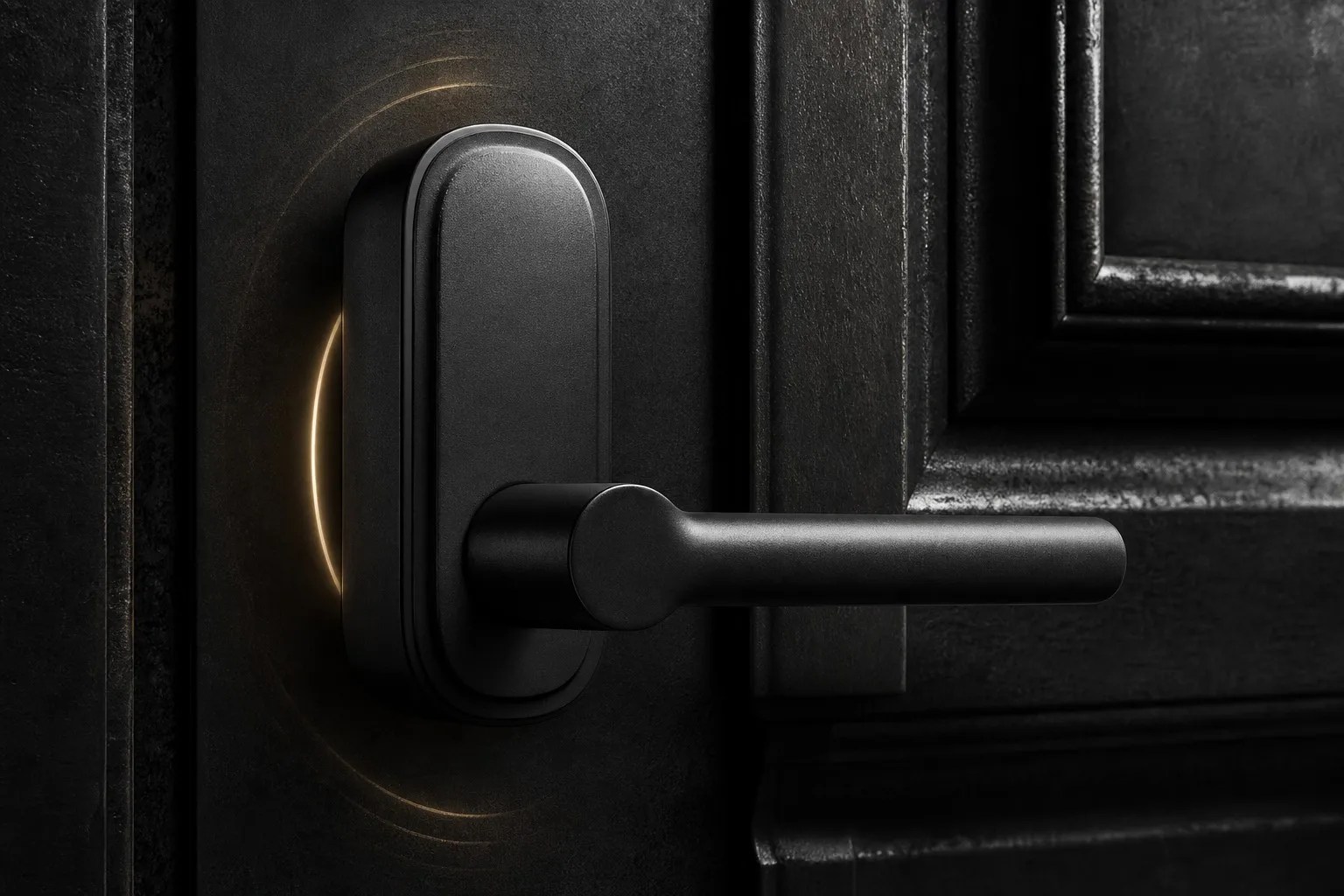
The front door is the last device in the house that still runs on brass and gravity. A speaker that loses its connection mumbles. A light that loses its connection stays dark. A thermostat that loses its connection keeps the house merely warm or merely cold. None of those failures leaves anyone standing in the rain. A lock that will not open is different: it is a person on the porch at eleven at night with groceries and a phone at four percent, or an elderly parent waiting for a daughter who cannot get through, or a guest handed a key that a platform decided not to honour. That asymmetry is why the door has resisted the smart home for so long, and it is why the industry has finally agreed on a way to make the key portable. Aliro, version 1.0 of which was released on 26 February 2026 by the Connectivity Standards Alliance — the same body that runs Matter — is built to unify smart lock access within the Apple, Google and Samsung wallets, using NFC and Bluetooth Low Energy, per Matter Alpha. The key is about to stop being a piece of brass, or a piece of one company’s software. It is about to become something that lives in the wallet you already carry, and it will no longer matter whose name is on the back of your phone.
The Feeling First
The One Device That Cannot Fail Quietly
Every other device in a smart home fails into inconvenience. The door is the single device that fails into exposure. When a lock stops working, the failure is not a notification; it is a body standing outside, in weather, at an hour when the phone number of a locksmith is the most important thing in the world. That is the emotional core of this story, and it is the reason the smart-lock category has spent twenty years promising more than it delivered. The lock is the one piece of the smart home where a bad integration is not an annoyance but a small crisis, and the industry’s answer has always been the same: another app, another account, another key that only works if everyone involved owns the right phone.
What Aliro offers, in human terms, is the removal of that condition. The digital key lives in the wallet you already use for cards and boarding passes, and it opens the door whether you hold an iPhone, a Pixel or a Galaxy, per Matter Alpha. Early coverage of the standard described the everyday shape of the promise: opening doors by tapping phones and watches, per Forbes. The door stops caring which platform you chose, which means the most important lock in your life is finally decoupled from the most replaceable fact about you: which phone you happen to own. For the person who has stood in the rain holding a dead phone, that is not a convenience feature. It is the difference between a door that knows you and a door that is merely waiting for a signal.
The Market
The Standards Body Behind Matter Turns to the Door
The authority behind Aliro is the Connectivity Standards Alliance, the organisation that produced Matter, and the new standard comes from that same lineage, per AppleInsider. Aliro is an open CSA standard whose stated aim is to make digital door keys work across different manufacturers and platforms, per Matter Smarthome. The alliance itself describes Aliro as the new industry standard for mobile access credentials, per the CSA. The three companies named in the release — the three wallet operators whose phones most people in the West actually carry — are the reason this is a market story and not a standards footnote.
The run-up was public and unusually long. Forbes explained why the standard mattered in December 2025, per Forbes. AppleInsider reported in early January 2026 that Aliro was launching in the first quarter of the year for iPhone and Android users, per AppleInsider. The launch was discussed on the Privacy Guides community forum in January. Then, on 26 February 2026, Aliro 1.0 arrived, per Matter Alpha, and the same day the Hubitat community forum, a home-automation user community, noted that Aliro-certified locks would let people use whatever platform they prefer. The enthusiasm in those threads is the market telling the truth: the current state of smart locks is exactly the fragmentation Aliro exists to end.
The money context is large. The smart home market was worth roughly $162.8 billion in 2025 and is projected at about $207 billion in 2026, per Grand View Research. The door is the emotional anchor of that market — the device with the strongest daily stakes — and retailers have noticed. The lock retailer Keyzoo published a buyer-facing analysis in July 2026 on what Aliro means for 2026 and whether to buy a smart lock now; as a retailer blog it has a commercial interest, but its framing of the buy-now-or-wait question is exactly the one buyers are asking, per Keyzoo. And the alliance has already shown the pattern with its own Matter protocol, which continues to arrive in numbered releases — Matter 1.5 added cameras in March 2026, per the CSA. Standards are published; hardware follows at its own pace.
The Pain
The Key That Decided Which Phone You Own
The pain Aliro answers has a name: platform lock-in, and the front door is where it hurts most. Four distinct versions of that pain are worth naming, because they are the reasons the standard exists.
1. The ecosystem hostage. A lock chosen for one ecosystem is a dumb deadbolt for every other phone. The Hubitat community’s framing — that Aliro-certified locks will let people use whatever platform they prefer, per the Hubitat forum — is a polite way of saying that today, in most homes, they cannot. The lock quietly becomes the most expensive loyalty program you never joined.
2. The guest with the wrong phone. Kids, cleaners, dog walkers, the neighbour who waters the plants: every one of them arrives with a phone you did not choose. Today that means app accounts, temporary codes and instruction texts. The friction is precisely what Aliro targets, because the wallet key is designed to work across the Apple, Google and Samsung wallets, per Matter Alpha.
3. The update treadmill. A smart lock is a computer bolted to a door, and computers stop being supported. A federal audit by the FTC of 184 connected-product pages found that only 21 — 11.4 percent — disclosed how long software support would last, per the FTC. For a speaker, the end of support is a nagging pop-up. For a lock, it is the slow erosion of the thing that lets you into your own house.
4. The failure modes nobody demos. Dead batteries, lost phones, a wallet provider that changes its terms, a firmware update that bricks the firmware. The wishlist tone of the community threads around Aliro, from the Privacy Guides forum to the Hubitat forum, is a record of people who have already been locked out by software once and do not want to be again.
The Numbers
One Standard, Two Radios, and the Support Question
The load-bearing numbers are few, and they should stay few. Aliro 1.0 was released on 26 February 2026, per Matter Alpha, a date corroborated by the Hubitat community forum on the same day. The standard standardizes two radios — NFC and BLE — for wallet-based unlocking, per Matter Alpha, which is the technical way of saying tap-to-unlock, per Forbes.
The support-duration numbers deserve a stricter reading than they usually get. The FTC audited 184 connected-product pages and found that only 21 disclosed how long software support would last, while 88.6 percent did not, per the FTC. Separately, 72 percent of Americans with smart devices say support-duration disclosure should be mandatory, per Consumer Reports, US PIRG and the Secure Resilient Future Foundation. The two figures measure different things — the FTC audited what manufacturers disclose; the consumer groups polled what people want — and they should not be averaged. What they agree on is the shape of the problem: the industry does not say how long its locks will be kept alive, and the public wants it said.
01
26 February 2026
Aliro 1.0 released by the Connectivity Standards Alliance, per Matter Alpha; noted the same day by the Hubitat forum.
03
11.4 percent
Of 184 connected-product pages audited by the FTC, only 21 disclosed software-support duration, per the FTC.
“The door is the only device in the house where a failed connection is not an inconvenience but a person standing outside in the rain.”
The Buy
Buy the Door, Not the Hype
The honest advice in August 2026 is that the standard is real and the hardware is the question. Four rules govern the purchase until the certified wave is on shelves.
1. Decide whether you can wait for certified hardware. A release date is not a shipping date. Aliro 1.0 arrived on 26 February 2026, per Matter Alpha, but the specification and the product shelf are different places, and the retailer blog Keyzoo — which sells locks and so is not a neutral party — has framed 2026 as exactly this decision. If you need a lock this month, buy for the ecosystem you live in today. If you can wait, the certified generation is the moment the standard becomes a feature rather than a promise.
2. Keep the mechanical key. When the battery dies, when the phone dies, when a wallet provider changes its terms, the brass key still turns. A lock without a physical fallback is a door that can fail closed on its own owner. No standard changes this; Aliro makes the key portable, not immortal.
3. Put the firmware commitment in writing. Ask the vendor how long the lock will receive security and compatibility updates — a date, not “for the life of the product.” The FTC found that only 21 of 184 product pages disclosed support duration, per the FTC, and 72 percent of Americans with smart devices want such disclosure to be mandatory, per Consumer Reports and partners. If a vendor cannot answer the question, you are buying a door that will one day be smarter than the company that made it.
4. Plan the lockout before it happens. Battery schedule, spare key location, a neighbour with a code, a fallback you have actually tested. The standard will not save you from an empty battery; it only makes the key portable. The person standing in the rain is the one who skipped this paragraph.
The Fine Print
What Aliro Does Not Promise
1. A standard’s release date is not a shipping date. Aliro 1.0 was published on 26 February 2026, per Matter Alpha; certified hardware arrives at each manufacturer’s own pace. One company, ULTRALOQ, announced in May 2026 that it had achieved Aliro certification — a company-reported claim, per ULTRALOQ. Treat vendor announcements as vendor announcements, and treat the absence of a named, shipping certified product in this article’s research as the honest state of the record.
2. “Aliro-ready” is marketing, not certification. The word “ready” binds no one. Certification is what makes the cross-wallet promise real, and the difference between the two words is the difference between a lock that works with your wallet and a lock that merely mentions it in the brochure.
3. Aliro is not a promise of security, longevity, or support. Interoperability is a feature, not a warranty. The standard does not obligate a vendor to update anything for any length of time, and the support-duration problem the FTC documented applies to Aliro locks exactly as it applies to every other connected product. A certified lock can still be an abandoned lock.
4. Watch the source hierarchy. Much of the early coverage is enthusiast and commercial by nature: the Keyzoo blog is a retailer selling locks; the Privacy Guides and Hubitat threads are community forums; the CSA is a standards body with a stake in adoption. None of them is neutral research, and none of them is wrong. Read them as what they are.
The Last Word
The front door is the oldest security device in the house, and Aliro’s real achievement is not a new lock. It is the decoupling of the key from the platform — the same move the Connectivity Standards Alliance made for the rest of the house with Matter, and now applied to the one device where a failed integration is a person standing in the weather. But standards solve platform problems; they do not solve human ones. Who gets a key, when it expires, whether the door still opens when the network is gone — those questions are still yours, and they were never a radio protocol’s job. Buy the lock that answers them, keep the brass key that outlives every update, and let the standard do the smaller, harder thing it was built for: making sure the person on your porch is let in by the phone in their hand, whatever it happens to be.
— THE SMARTS DESK
Sources
Research Appendix
Every statistic in this article links to its primary source. Full list, as of 19 August 2026:
| Data point | Institution | Date | Source |
|---|---|---|---|
| Aliro 1.0 released to unify smart lock access within Apple, Google and Samsung wallets; uses NFC and BLE | Matter Alpha | 26 Feb 2026 | Report |
| Aliro is an open CSA standard aiming to make digital door keys work across manufacturers and platforms | Matter Smarthome | 6 Jan 2026 | Explainer |
| Aliro, from the body behind Matter, to launch in Q1 2026 for iPhone and Android users | AppleInsider | 5 Jan 2026 | Article |
| CSA launches Aliro standard for smart locks (community discussion) | Privacy Guides (community forum) | 7 Jan 2026 | Thread |
| Why Aliro matters: opening doors by tapping phones and watches | Forbes | 31 Dec 2025 | Analysis |
| Buyer-facing analysis: what Aliro means in 2026 and whether to buy a smart lock now (retailer blog) | Keyzoo (retailer blog) | 16 Jul 2026 | Analysis |
| Aliro released 26 Feb 2026; certified locks will let people use whatever platform they prefer (community forum) | Hubitat community | 26 Feb 2026 | Thread |
| Aliro described as the new industry standard for mobile access credentials | Connectivity Standards Alliance | — | Official page |
| ULTRALOQ announces Aliro certification, tap-to-unlock across mobile wallets (company-reported) | ULTRALOQ | 4 May 2026 | Announcement |
| FTC audit: of 184 connected-product pages, only 21 (11.4%) disclosed software-support duration; 88.6% did not | FTC | — | Audit |
| 72% of Americans with smart devices want mandatory support-duration disclosure | Consumer Reports / US PIRG / SRFF | 12 Mar 2025 | Release |
| Smart home market ~$162.8B (2025) projected ~$207B (2026) | Grand View Research | 2026 | Market report |
| Matter 1.5 added cameras; CSA continues numbered releases of its Matter protocol | CSA | 31 Mar 2026 | Newsroom |
 Independent Intelligence on Ambient Technology
Leave a comment