Baby · Health · Regulation
Peace of Mind Comes With an Alarm Threshold
SMARTS · 26 August 2026 · 13 min read
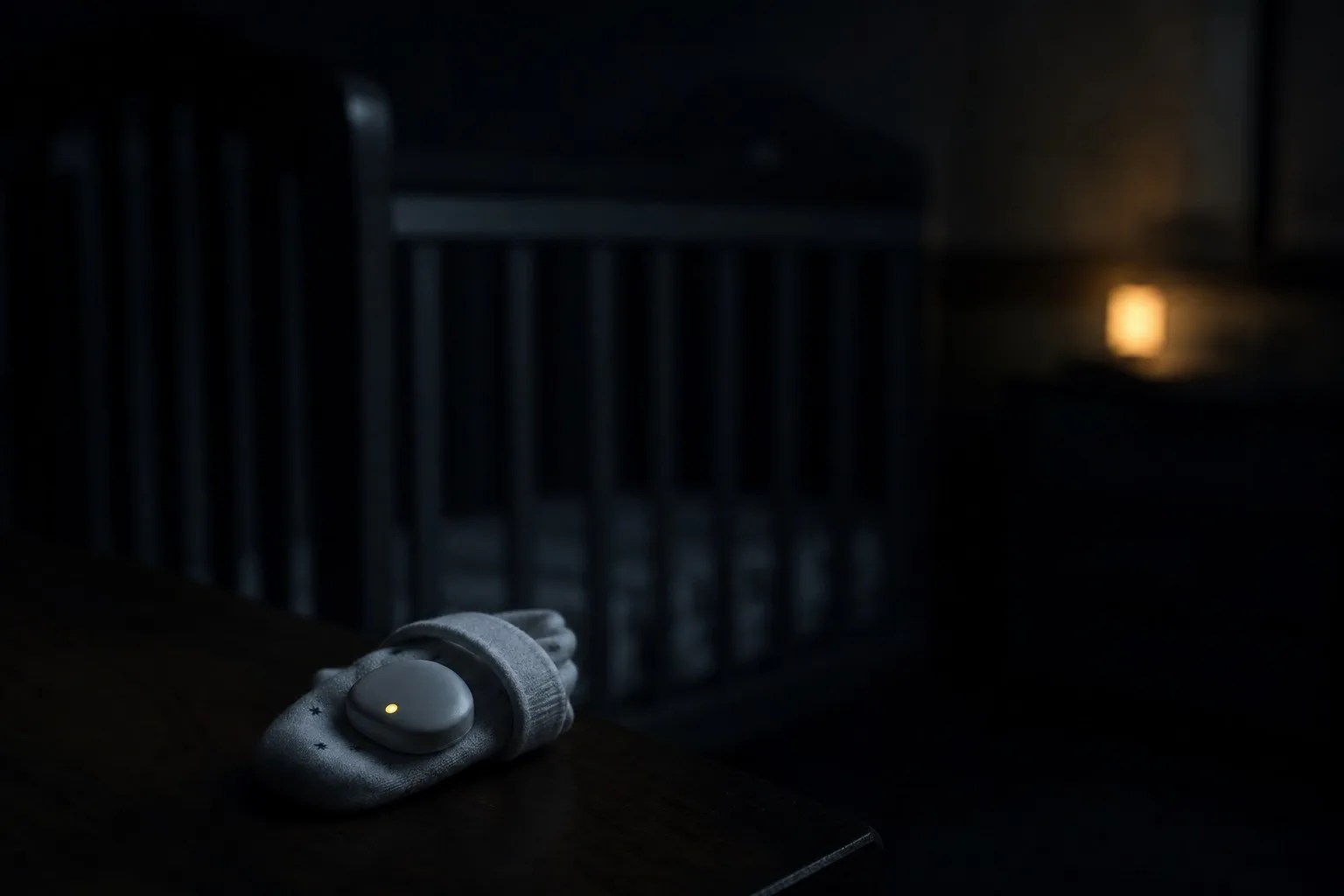
Peace of mind is the product. The infant pulse-oximetry sock — a soft fabric band that wraps around a baby’s foot and measures oxygen saturation and pulse rate while the child sleeps — is sold, at its heart, as an answer to the oldest fear in parenting: the silent night, the unobserved breath. Owlet’s Dream Sock is listed at $299.99 on the company’s store page, a price that is the company’s own current listing and may change, per Owlet. But the honest way to understand this category is not to start with the sock. It is to start with the alarm threshold — the number, set somewhere in the software, that decides when the device stops reassuring and starts shouting. That threshold is where peace of mind is manufactured, where anxiety can be amplified, and where the difference between a consumer product and a medical device becomes a question a parent actually has to answer at 3 a.m.
The Feeling First
Reassurance, Measured in Alerts
The first night with a newborn is a night of watching. Every parent has stood over a crib, hand on a small chest, waiting for the next breath to arrive on schedule. The pulse-oximetry sock speaks directly to that vigil: it promises to watch so the parent can rest, to hold the line on oxygen saturation so that sleep does not become a dereliction of duty. That promise has real emotional value. A device that quietly reports normal readings through the night can convert a parent’s anxious vigilance into something closer to rest, and the reassurance is not trivial — it is the entire point of the product, and it is legitimate.
But the same device can do the opposite. Every alert is a small emergency, and a threshold set too sensitively converts a peaceful night into a series of small emergencies. Alarm anxiety is the documented shadow of this category: the parent who sleeps less, not more, because the sock’s notifications keep interrupting the sleep the product was meant to protect. The emotional arithmetic is unforgiving — reassurance and anxiety are the same channel, and the product’s settings decide which one wins. That is why the buying decision is not about the sock. It is about the threshold, and about the parent’s honest knowledge of what they will do when it fires.
The Market
Two Products, One Company, Two Regulatory Languages
The category is defined by a distinction that marketing blurs and regulation insists upon: the consumer sock and the prescription device are different products. Owlet’s Dream Sock is the consumer product — available directly, listed at $299.99 including the FDA-cleared pulse-oximetry sensor, per the company’s store page. In September 2024, the American Academy of Sleep Medicine reported that the FDA cleared the Owlet Dream Sock for infant pulse-oximetry, citing the company’s monitoring claims, per AASM. The language matters: clearance, not approval, and for pulse-oximetry monitoring — measuring oxygen saturation and pulse rate — not for preventing or detecting any specific condition.
The company’s second product, BabySat, sits in a different regulatory room. Owlet states that BabySat is FDA-cleared for oxygen saturation and pulse rate at home, per its product page — a company claim that must be paired with the product’s indication and prescription status. As of June 2026, Owlet describes BabySat as prescription-only and US-only, per its guidance page, and the device alerts when heart rate or oxygen saturation leaves a prescribed range, per MobiHealthNews‘ 2023 reporting on the clearance. The word “prescribed” is the hinge: a clinician sets the range, and a clinician is in the loop. The consumer Dream Sock and the prescription BabySat are siblings, not twins — and the difference between them is the difference between a monitoring feature and a monitored patient.
The Pain
The Vigil, the Alarm, and the Ambiguous Reading
1. False alarms are part of the product. A sock that measures through the night will misfire — a loose fit, a kicked-off sensor, a cold foot, a movement artifact. Every misfire is a 3 a.m. cardiac event for the parent and a small erosion of trust in the device. The parent who learns to discount alerts has begun to defeat the product’s only purpose.
2. Monitoring is not prevention. The hardest sentence in this category: a device that measures oxygen saturation does not prevent the conditions parents fear most. FDA clearance for pulse-oximetry monitoring is not a statement that the device prevents SIDS or any other cause of infant death. The clearance documents the measurement; it does not promise the outcome — and no amount of sock technology replaces safe-sleep practice, pediatric care, or emergency services.
3. The alarm threshold is a decision someone else made. On the consumer product, the thresholds live in the software, configured by the manufacturer’s engineers with default settings that fit no specific baby. On the prescription product, a clinician sets the range — which is exactly why the prescription path exists, per MobiHealthNews. The parent buying the consumer sock should know they are taking over that decision by default.
4. The data lives in the account. The sock’s readings stream to a phone app and a company account. That is the infrastructure of the product — and it means the purchase includes an account, a data flow, and a relationship with the manufacturer that will outlast the baby’s first year. Account access, data retention and the ability to export or delete readings are part of the purchase whether the box says so or not.
The Numbers
Clearance, Price, and the Words Between Them
Three numbers define this purchase, and each needs its own label. First, the price: $299.99 for the Dream Sock including the FDA-cleared pulse-oximetry sensor — a company-listed price that may change, per Owlet’s store page. It is the manufacturer’s current listing, not a market consensus, and it is cited here as such. Second, the regulatory status: the Dream Sock received FDA clearance for infant pulse-oximetry, reported by the American Academy of Sleep Medicine in September 2024 — clearance for a measurement function, which is not the same as approval of a treatment, and not the same as a statement about preventing any condition.
Third, the prescription path: BabySat is FDA-cleared for oxygen saturation and pulse rate at home, described by Owlet as prescription-only and US-only as of June 2026, per the company’s guidance page, with alerts when readings leave a prescribed range, per MobiHealthNews. The company’s BabySat page makes the clearance claim in its own words, and this article presents it as a company claim paired with the indication — because the indication, not the marketing, is what a parent should verify.
And the number that is not a number: the FDA’s medical-device database. Before any purchase, the current clearance status and indications of any device can be checked in the FDA’s public database. Clearances change, indications are amended, and the marketing page is not the regulatory record. The database is free, public, and five minutes away — which makes it the most important purchase aid in this entire category.
“Clearance documents the measurement. It does not promise the outcome.”
The Buy
Seven Steps Before the First Night
If the purchase is peace of mind, then the preparation is the product. Work through this list before the sock goes on the foot.
1. Know which product you are buying. The consumer Dream Sock and the prescription-only BabySat are different products with different regulatory paths, per Owlet and MobiHealthNews. If the need is medical — a condition, a concern, a clinician’s recommendation — the prescription product is the conversation to have, not the consumer box to order.
2. Ask the pediatrician first, not after. The device measures; the pediatrician interprets. Bring the question to the clinician before the purchase: is monitoring indicated for this baby, and what would an alert mean in this household’s circumstances? The answer shapes everything downstream, including whether the product should be bought at all.
3. Treat safe-sleep practice as the non-negotiable layer. A sock is an addition to safe-sleep practice, never a replacement for it. Back to sleep, firm surface, no loose bedding, room-sharing without bed-sharing — these remain the foundation, and no FDA clearance changes that, per the AASM‘s framing of what the clearance covers.
4. Write the alert escalation plan before the first alarm. Decide now what a real alert means: check the baby, re-check the reading, call the pediatrician, call emergency services — in what order, at what point. An escalation plan written in daylight is the difference between a 3 a.m. decision and a 3 a.m. crisis.
5. Fit it properly, and know the misfire modes. The sock’s accuracy depends on fit, and the false-alarm modes — loose sensor, kicked-off sock, cold foot, movement — should be known before they happen. The parent who knows the misfire modes will discount fewer real alerts.
6. Accept the false-alarm reality. A night-waking parent is the product’s operating condition. If the household’s anxiety would be amplified rather than soothed by alerts, the honest answer may be that the product is not for this family — the reassurance and the anxiety run on the same channel.
7. Audit the account. The readings stream to an app and an account. Know what is stored, how long it is kept, whether it can be exported to a clinician or deleted, and what happens to the data when the subscription or the account ends.
The Fine Print
What Every Parent Should Read Twice
1. Nothing here replaces medical care. Not the sock, not the app, not the alerts. FDA clearance for pulse-oximetry is not a statement that the device prevents SIDS or replaces safe-sleep practice, pediatric care or emergency services — and no sentence in this article should be read as suggesting otherwise.
2. Clearance is not approval. The Dream Sock’s FDA clearance for infant pulse-oximetry, per the AASM‘s 2024 report, covers a measurement function. It is not approval of a treatment, and it is not an endorsement of any claimed health outcome. The two words are not interchangeable, and marketing copy that blurs them is the thing to distrust.
3. Prescription and consumer are different doors. BabySat is prescription-only and US-only per Owlet; the Dream Sock is sold directly. The prescription product exists because a clinician should set the range, per MobiHealthNews. Buying the consumer product to approximate the prescription product is not a workaround; it is a different product with different thresholds.
4. The price is a listing, not a contract. $299.99 is the company’s current store price for the Dream Sock and may change, per Owlet. And the current regulatory record — clearance status, indications — should be verified in the FDA database before purchase, because the marketing page is not the legal record.
The Last Word
The infant pulse-oximetry sock is an honest product with an honest function: it measures oxygen saturation and pulse rate at home, and it tells the parents what it measures. That function has real value — the vigil at the crib is real, and a quiet reading through the night is a genuine gift. But peace of mind is not manufactured by the sensor. It is manufactured by the threshold, the escalation plan, the fit, and the family’s honest relationship with alarms. The consumer sock and the prescription device, the clearance and the approval, the monitoring and the prevention — each distinction is a sentence a parent should be able to recite, because each one will be tested at 3 a.m. Clearance documents the measurement; it does not promise the outcome. Buy the measurement if the household needs it. Build the plan around it. And never let the sock replace the two things that actually watch over a sleeping child: the practice of safe sleep, and the judgment of the people who love the baby enough to ask a doctor when the number looks wrong.
— THE SMARTS DESK
Sources
Research Appendix
Every statistic in this article links to its primary source. Full list, as of 26 August 2026:
| Data point | Institution | Date | Source |
|---|---|---|---|
| Dream Sock listed at $299.99 including FDA-cleared pulse-oximetry sensor (company-listed price, may change) | Owlet (manufacturer) | Current listing | Store page |
| FDA cleared Owlet Dream Sock for infant pulse-oximetry, citing company’s monitoring claims | American Academy of Sleep Medicine | 24 Sep 2024 | Report |
| BabySat is FDA-cleared for oxygen saturation and pulse rate at home (company claim; pair with indication and prescription status) | Owlet (manufacturer) | — | Product page |
| BabySat is prescription-only and US-only | Owlet (manufacturer) | 1 Jun 2026 | Guidance |
| BabySat alerts when heart rate or oxygen saturation leaves a prescribed range | MobiHealthNews | 20 Jun 2023 | Report |
| FDA De Novo record for Dream Sock (DEN220091) | US FDA | Ongoing | Database |
 Independent Intelligence on Ambient Technology
Leave a comment