Indoor Air · Wildfire · Monitoring
The Smoke Is Outside. The Decision Is Happening on Your Kitchen Counter.
SMARTS · 26 August 2026 · 12 min read
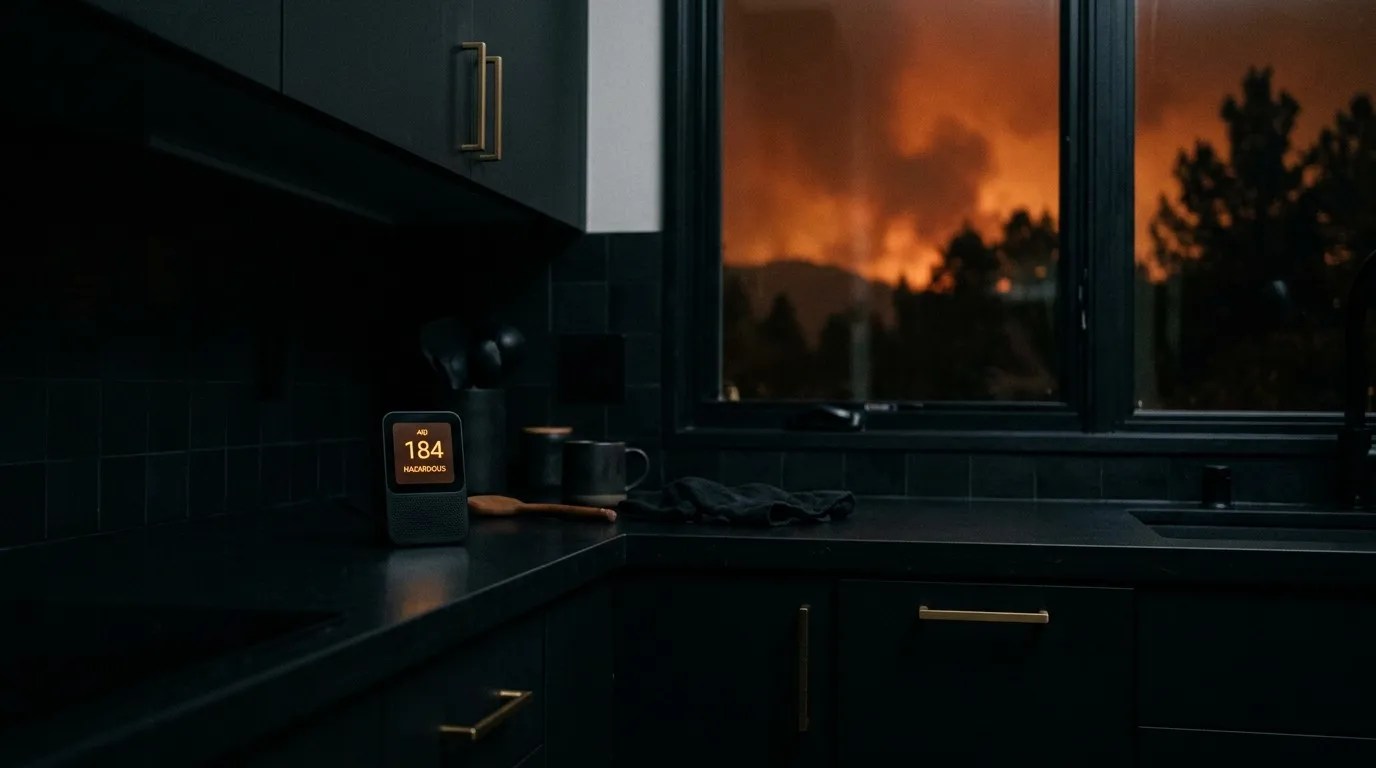
The first sign is not visual. It arrives as a smell — a low, sweet, campfire note that finds its way indoors through gaps you never noticed: the range hood, the mail slot, the door the dog came in by. By the time the horizon turns the colour of a bruise, the question has already migrated to the kitchen counter, and it is no longer a question about the sky. It is a question about whether to shut the windows, whether to run the purifier, whether to send the children to school, whether to stay. In wildfire season, the most consequential instrument in the house is not the machine that cleans the air. It is the small device that measures it — because a measurement, unlike a smell, can be acted upon. This article is about treating that monitor as what it actually is: a decision instrument, not a talisman, and certainly not a substitute for a purifier.
The Feeling First
The Anxiety of Air You Cannot See
There is a particular helplessness in breathing something you cannot see. Smoke is the visible fraction; the particles that matter most are not. Fine particulate matter — PM2.5, particles smaller than a red blood cell — settles in rooms the way dusk settles, silently, and the body registers it as a dry throat, a headache, a sleeping child who coughs at 2 a.m. The dread is real, and it is the reason the market for these devices exists. The emotional transaction is simple: the monitor converts an invisible threat into a number, and a number is something a household can argue with, plan around, and act upon.
But there is a second, quieter emotion in the room, and it is worth naming before we talk about sensors. It is the fear of being the parent who did not check. The monitor promises to end that fear — yet a number on a screen can also manufacture a false peace, a green readout that lets a family relax while the outdoor index climbs. The honest way to use these devices is to understand what each reading means and what it cannot mean. A monitor does not clean the air. It does not protect the lungs. It informs the decisions that do. That is the whole discipline, and it is harder than it sounds, because the device in your kitchen is telling you three different stories at once.
The Market
A Sensor Market, a Fire Season, and a Bill in Washington
The category is growing for a reason that has nothing to do with gadget enthusiasm. On 29 July 2026, Senators Jacky Rosen, Michael Bennet, Amy Klobuchar and Jeff Merkley introduced the Wildfire Air Quality Sensor Expansion Act of 2026, legislation that would direct the Environmental Protection Agency to create and expand grant and loan programs for state, local and Tribal agencies to buy portable air-quality sensors, according to the official Senate press release. The bill is a proposal, not a law — but its existence is a statement about where the market is heading: from specialty tool toward household staple, with public agencies as an accelerant.
The context is a fire season that had already produced staggering numbers by early August. According to National Interagency Fire Center data cited by Clarity, a sensor vendor covering the bill and therefore a commercial source, 45,184 wildfires had burned more than 5.4 million acres in the United States as of 5 August 2026. The vendor’s summary is useful for context, but the load-bearing claims in this article come from the linked government material wherever possible.
The commercial numbers behind the category are equally emphatic, with one caveat about scope. Fortune Business Insights projects the global indoor air quality monitoring system market — a category that includes commercial and industrial instruments, not only consumer counters — will grow from $2.47 billion in 2026 to $4.32 billion by 2034, a compound annual growth rate of 7.27%, per its market report. The consumer slice is smaller than the headline, but it is the fastest-moving part, and it is the part that shows up on kitchen counters. The direction of travel is unmistakable: in a year when the federal government is proposing to buy sensors for communities, the individual household is quietly buying its own.
The Pain
Three Readings, Three Questions, One Confused Buyer
1. The neighborhood number is not your house. The outdoor Air Quality Index that the weather app displays is a regional measurement, taken at a monitoring station that may be miles away. Smoke travels long distances and affects indoor air even when the local station reads moderate, as Consumer Reports advised via WSLS on 17 July 2026. Your living room has its own microclimate: its own windows, its own drafts, its own cooking. The gap between the neighborhood number and the indoor number is not an error. It is the entire reason to own a monitor.
2. PM2.5, VOC and CO2 are not interchangeable. The single most common buyer error is treating a multi-sensor device as one number. PM2.5 is the wildfire metric — fine particles from combustion — and it is the reading that should drive smoke decisions. Volatile organic compounds are a different family of chemicals, emitted by paint, cleaning products and cooking; a VOC spike during a smoke event can be a red herring. Carbon dioxide is a proxy for ventilation and occupancy, not combustion. Consumer Reports’ product guide, dated 30 April 2026, notes that indoor-air monitors can detect VOCs and particulate matter from wildfires — but detecting several things at once means the buyer must know which number answers which question.
3. Consumer sensors are indicative, not regulatory-grade. The third pain is the calibration gap. Lawrence Berkeley National Laboratory, which has studied low-cost home air-quality monitors in real homes, found them useful for tracking wildfire smoke — while noting that calibration and adjustment factors matter, per LBNL’s research summary. In plain terms: the device can tell you whether the air is getting better or worse, and roughly where it sits. It cannot certify the air to EPA standards. The pain arrives when a household treats a consumer readout as a medical or regulatory verdict. It is a compass, not a survey.
The Numbers
A Season Measured in Acres, a Problem Measured in Microns
The scale of the 2026 season is the backdrop for every purchase decision in this category. As of 5 August 2026, NIFC data cited by Clarity — a sensor vendor, again, not an independent authority — counted 45,184 wildfires and more than 5.4 million acres burned across the United States. Those figures are a season in motion, not a final toll; the calendar still had months of fire weather ahead when they were compiled. What matters for the buyer is the pattern: smoke events are now a recurring feature of the American year, and they reach homes that never see a flame.
The problem the monitor is measuring is small in the literal sense. PM2.5 refers to particles 2.5 micrometres and smaller — roughly one-thirtieth the width of a human hair — small enough to penetrate deep into the respiratory system. This is why the EPA’s AirNow program, which operates the Fire and Smoke Map combining official monitors and sensor data, has become the reference tool for smoke-aware households. The map is the free, government-maintained baseline against which any consumer monitor should be compared. If your kitchen counter disagrees with AirNow by a factor of three, the disagreement itself is information — about your house, your placement, or your sensor’s calibration.
The institutional verdict on the devices is more favourable than gadget journalism usually admits. LBNL’s work found low-cost home air-quality monitors genuinely useful for wildfire smoke, with the caveat that calibration and adjustment factors matter, per its research summary. Consumer Reports’ guide treats them as legitimate tools for detecting VOCs and wildfire particulate. The market agrees: Fortune Business Insights’ forecast of 7.27% annual growth through 2034 includes the consumer segment’s expansion from novelty to fixture. The devices are no longer a question of whether they work. They are a question of how honestly they are used.
“The monitor does not clean the air. It informs the decisions that do.”
The Buy
How to Buy a Number You Can Trust Enough to Act On
The purchase criteria follow from the science, and they are refreshingly non-glamorous.
1. Buy the PM2.5 channel first; treat everything else as a bonus. For wildfire smoke, fine particulate is the load-bearing metric. Consumer Reports’ guide confirms these monitors can detect wildfire particulate; the sensor that does that is the one you are paying for. VOC and CO2 channels are useful for other seasons and other questions, but they are secondary — and a device that displays all three without teaching the difference is a device that will mislead you in August.
2. Place it where the decision happens, and compare it to AirNow. Position the monitor in the room where the household actually lives — the kitchen counter, the living room, the child’s room — not the garage. On smoky days, open the EPA’s Fire and Smoke Map alongside your device. The outdoor number and the indoor number will differ; that difference is your leak test. If indoor readings track outdoor readings closely, your envelope is porous and your purifier is fighting a losing battle.
3. Ask about calibration before you ask about Wi-Fi. LBNL’s findings are the buyer’s brief here: low-cost monitors are useful, but calibration and adjustment factors matter. Prefer devices that allow baseline adjustment or factory recalibration, and re-check the device against AirNow after every major smoke event. A sensor that cannot be re-anchored to reality is a sensor that drifts into fiction.
4. Buy before the smoke, and practise with cooking. The worst time to learn your monitor is the day the air turns orange. In clear weather, run the device through a normal week: frying, cleaning, the bathroom fan, the range hood. Learn what a VOC spike from dinner looks like so that a smoke event does not panic you into closing windows when ventilation is exactly what you need. The monitor is a decision instrument; like any instrument, it rewards rehearsal.
5. Budget the action, not just the device. A monitor is only half of a smoke response. The other half is a purifier with a HEPA filter sized for the room, window-sealing tape, and N95 masks for outdoor errands. Consumer Reports’ wildfire guidance is blunt about the fundamentals: smoke travels far, and fine particles affect indoor air — which means the household that measures without a response plan has bought a thermometer and no medicine.
The Fine Print
What the Readout Will Not Tell You
1. A monitor does not clean air, and no monitor prevents illness. This is the sentence every manufacturer dances around: the device measures. It does not protect. A green number in a smoky week is a statement about your room, not about your lungs. Nothing in this article, or in the marketing, should be read as a claim that a monitor prevents disease. It does not.
2. Consumer-grade readings are indicative, not certified. LBNL’s research is encouraging about usefulness and explicit about limits: calibration and adjustment factors matter. Unless a device is specifically certified to regulatory standards, treat its number as a trend and a threshold indicator — not a laboratory verdict.
3. Indoor and outdoor numbers will disagree, and that is the point. The neighborhood AQI from the weather app is a different measurement from your kitchen counter’s reading. The gap is not a malfunction; it is the signal. Learn to read both — the government map for the regional picture, the indoor device for your actual exposure — before an emergency asks you to.
4. Vendor context has a price tag. The wildfire statistics cited in coverage of the Senate bill come from NIFC data, but the summary was written by Clarity, a sensor company with a commercial interest in the category it describes. Its numbers are attributed to the government source; its enthusiasm is its own.
5. The bill is not law. The Wildfire Air Quality Sensor Expansion Act of 2026 is a proposal introduced by four senators, per the Senate release. Grant programs, if they arrive, will change how agencies buy sensors — not what your kitchen counter needs this season.
The Last Word
The smoke will keep arriving. The seasons will keep burning, the acres will keep counting themselves, and the neighbourhood numbers will keep describing a sky that is not quite the sky over your house. What changed in 2026 is that the response is no longer a mystery: measure the room you live in, compare it to the region, act on the difference, and re-anchor the instrument when it drifts. The monitor on the kitchen counter is not a cure, not a talisman, and not a toy. It is a compass for a season of bad air — and a compass is only as honest as the hands that read it.
— THE SMARTS DESK
Sources
Research Appendix
Every statistic in this article links to its primary source. Full list, as of 26 August 2026:
| Data point | Institution | Date | Source |
|---|---|---|---|
| Wildfire Air Quality Sensor Expansion Act of 2026 introduced; would direct EPA to create and expand grants/loans for portable air-quality sensors | Office of Sen. Jacky Rosen | 29 Jul 2026 | Senate release |
| 45,184 wildfires; 5.4+ million acres burned (NIFC data; summarized by vendor Clarity) | NIFC via Clarity (vendor) | 5 Aug 2026 | Clarity summary |
| Indoor air quality monitoring system market: $2.47B (2026) to $4.32B (2034), CAGR 7.27% | Fortune Business Insights | — | Market report |
| Indoor-air monitors can detect VOCs and particulate matter from wildfires | Consumer Reports | 30 Apr 2026 | Product guide |
| Smoke and fine particles can affect indoor air and travel long distances | Consumer Reports via WSLS | 17 Jul 2026 | Wildfire guidance |
| Low-cost home air-quality monitors useful for wildfire smoke; calibration and adjustment factors matter | Lawrence Berkeley National Laboratory | — | LBNL research |
| Reference map combining official monitors and sensor data for fire smoke | EPA AirNow | Live | Fire and Smoke Map |
 Independent Intelligence on Ambient Technology
Leave a comment