Light · Sleep · Schedule
You Do Not Need a Smarter Bulb. You Need a Better Clock.
SMARTS · 26 August 2026 · 13 min read
You do not need a smarter bulb. You need a better clock — and the clock in question is the one inside your body, the circadian system that has been telling living things when to wake and when to sleep for hundreds of millions of years. The smart-lighting industry has noticed, and it now sells “circadian” bulbs: fixtures that shift color and intensity through the day, bright and cool in the morning, warm and dim at night, following a script that mimics the sun. The products are real, the science behind them is real, and yet most buyers will get the relationship backwards. The bulb is not the treatment. The schedule is. Timing, intensity, daylight, and consistency do more work than any feature list — and a 2026 review in the JMIR journals found that adequate daytime sunlight exposure strengthens circadian entrainment and is associated with earlier sleep onset and longer total sleep time, per JMIR. Read that finding once more: the strongest light-based intervention in the research is not a bulb. It is the sun, used at the right time of day.
The Feeling First
The Hope That a Purchase Fixes the Night
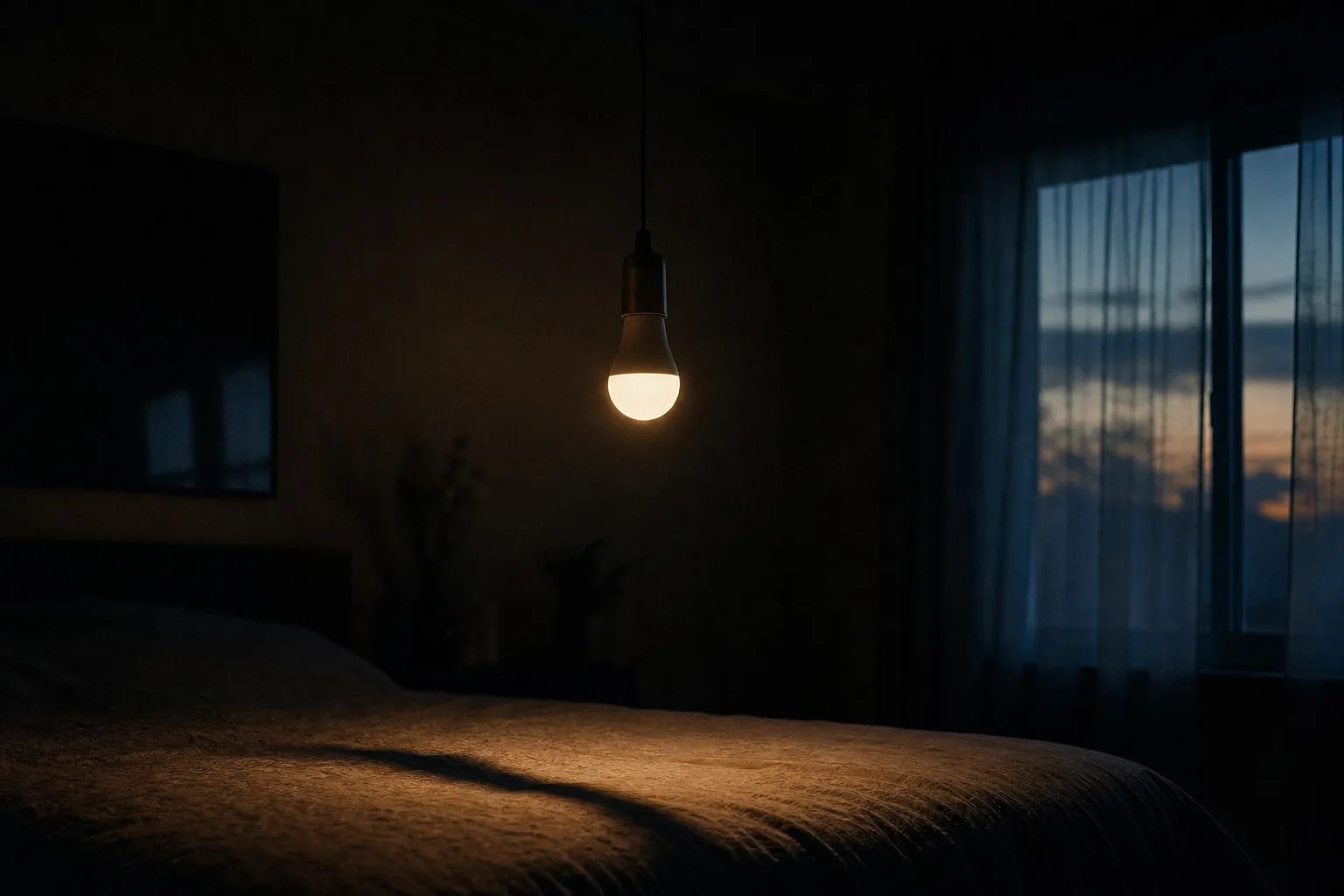
There is a particular sadness to buying sleep. The bedside table accumulates the evidence: the app, the tea, the mask, the white-noise machine, and now the lamp that promises to wind the day down in amber. Each purchase is an act of hope that the night can be bought back — that the restlessness, the 2 a.m. wakings, the fog of the following afternoon, are a problem with a product-shaped solution. The circadian bulb is the most sophisticated version of this hope yet: a lamp that knows the time of day, dims itself in the evening, and warms itself like a sunset you can schedule. It is a lovely object, and the emotion it sells — that light, of all things, can fix sleep — is one of the most defensible in consumer technology, because light genuinely does drive the body’s clock.
But the hope outruns the hardware. A bulb cannot rescue a schedule that does not exist. If the household’s evenings run from 11 p.m. to midnight on a phone screen in a fully lit room, no amber glow at 9 p.m. will hold the line. If the morning begins in darkness with the curtains shut, no “sunrise simulation” will substitute for the real thing streaming through a window. The circadian system responds to light’s timing and intensity across the whole day — not to a feature count. The bulb is the instrument; the clock is the musician. Buying the instrument while ignoring the clock is how the bedside table fills up with hopes that never quite played. The households that benefit are not the ones with the most expensive lamps; they are the ones that fixed the morning and the evening and let the hardware hold the middle.
The Market
A Category Built on Two Kinds of Authority
The category rests on two very different kinds of authority, and a buyer should be able to tell them apart at a glance. The first is the manufacturer’s. Signify — the lighting company behind Philips — describes tunable connected lighting and “evidence-based lighting recipes” for circadian support, per its innovation pages. That is a company’s description of its own product line: real, useful for understanding what the products do, and not independent evidence of health outcomes. The second authority is the retailer’s. A medical-supply retailer’s overview of circadian lighting’s 2026 use cases, published in April 2026, is exactly what it appears to be — retailer commentary, useful for orientation and not clinical guidance, per 1800MedicalSupply. Between manufacturer claims and retailer summaries, the buyer is surrounded by enthusiasm with commercial incentives attached.
The steadying voice in the middle is the testing organization. Consumer Reports‘ buying guidance on smart bulbs for sleep looks for circadian-lighting and bedtime/wake features — a practical checklist that treats the features as useful tools rather than cures. That is the correct altitude for a purchase: features matter, the schedule matters more, and no feature list is a medical claim. The industry will sell you the sunset in a socket; the research says the day is the product.
The Pain
The Feature Count That Masks the Schedule
1. Color-changing is not circadian. A bulb that cycles through sixteen million colors at the tap of an app is a light show, not a schedule. Circadian benefit comes from the right light at the right time — bright and cool in the day, dim and warm in the evening — sustained day after day. The feature that matters is not the palette; it is the timing.
2. The schedule must survive real life. The beautiful routine — dawn ramp at 6:30, dimming at 9:00 — lives or dies on household participation. A visitor flips the switch and the routine breaks. A teenager’s homework needs full light at 10 p.m. and the routine breaks. The bulb cannot enforce the schedule; it can only offer it, and households are inconsistent employers.
3. Evening dimming is half the story. The popular imagination of circadian lighting stops at the amber sunset, but the research points the other way too: the day’s light matters as much as the evening’s. Adequate daytime sunlight strengthens circadian entrainment and is associated with earlier sleep onset and longer total sleep time, per JMIR‘s 2026 review. A household that sleeps late in a dark room will not be rescued by an evening lamp; it needs morning light, and the cheapest source is the window.
4. The cloud can eat the schedule. A circadian routine that depends on a phone app, a hub, and a manufacturer’s cloud is a routine with a single point of failure. When the app updates, the account lapses, or the service is discontinued, the household’s carefully tuned sunset vanishes — and the bulb, if it cannot run its routines locally, reverts to being a very expensive light switch.
The Numbers
The Science Says Daytime First
The load-bearing finding for anyone considering this category is in a 2026 review published in the JMIR journals: adequate daytime sunlight exposure strengthens circadian entrainment and is associated with earlier sleep onset and longer total sleep time, per JMIR. Two things about this finding deserve emphasis. First, it is about daylight — the free, ancient, pre-installed light source that arrives every morning. Second, it links light timing to measurable sleep outcomes: entrainment, onset, duration. That is the causal chain the entire smart-lighting category is trying to bottle, and the research names the original and best container: the sun, used at the right hour.
What the numbers do not say is equally important. No published study shows that a specific consumer bulb fixes insomnia, and no credible source makes that claim. The manufacturer literature describes tunable lighting and evidence-based recipes — a company’s design philosophy, per Signify — not a clinical result. The retailer overview describing 2026 use cases is commentary with a catalog attached. And the Consumer Reports guidance treats circadian and bedtime/wake features as purchase criteria — sensible, practical, and deliberately short of any promise about sleep quality. Three sources, three altitudes, one conclusion: the features are worth buying, and the schedule is the science.
“The bulb is the instrument. The clock is the musician.”
The Buy
Six Steps to Buy a Schedule, Not a Bulb
The purchase order is wrong in the showroom and right in the planning: schedule first, hardware second.
1. Map the household’s real wake and sleep schedule first. Write down when the household actually wakes, when it dims, when it sleeps — not when it wishes it did. The bulb’s routines should automate the existing reality, or the household will fight the automation every night.
2. Daylight first. The strongest light intervention in the research is daytime sunlight, associated with earlier sleep onset and longer sleep, per JMIR. Before buying anything, open the curtains in the morning, walk outside at midday, and treat the window as the primary circadian fixture in the house.
3. Program the evening dimming as a fixed appointment. Choose a dimming time and let it be boring — the same time every night, including weekends. Consistency is the mechanism, and the Consumer Reports checklist of circadian and bedtime/wake features is the right shopping list for finding a bulb that can hold that routine.
4. Check the minimum brightness. The evening setting is only as good as its lowest step. Test the bulb at its warmest color and lowest supported brightness before committing to a roomful of them. A schedule designed to create a dark evening fails when its hardware remains visibly bright.
5. Prefer local automation. Routines that run on the device or the local hub survive app updates, account lapses and service shutdowns. A circadian schedule is a daily commitment; it should not depend on a company’s continued goodwill.
6. Keep a manual fallback. The household will occasionally need full light at 10 p.m. — for work, for a sick child, for life. The bulb should make that possible with a plain switch or a simple command, without fighting the schedule’s memory. A schedule that cannot be interrupted is a schedule that will be abandoned.
The Fine Print
When the Light Is Not the Answer
1. A bulb is not a treatment. The peer-reviewed evidence supports light timing as part of healthy sleep hygiene, but no study shows that a consumer lamp cures insomnia or circadian-rhythm disorder. Persistent or severe sleep problems belong in a clinician’s office, not in a lighting aisle — and the honest retailer, like the honest review, will say the same.
2. Shift workers need professional guidance. The circadian system is trained by light timing, and shift work deliberately inverts that training. No consumer bulb resolves the physiology of night work; the planning belongs in a conversation with a clinician who understands shift-work schedules and light exposure.
3. Health conditions change the calculation. Eye conditions, mood disorders, and other health situations can alter how light affects an individual. The research that supports daylight exposure is about general populations; individual conditions deserve individual guidance, not a retail decision.
4. Label the sources. Signify’s description of tunable lighting and evidence-based recipes is a manufacturer claim; the medical-supply overview is retailer commentary. Both are useful; neither is clinical evidence. The peer-reviewed review in JMIR is the evidence — and it points at daylight, timing, and consistency, not at a feature list.
The Last Word
The circadian bulb is a thoughtful product with a true premise: light is the body’s clock, and a household that manages light manages sleep. But the premise works only when the household manages the whole day — the morning sun, the bright midday, the dim evening, the consistent bedtime — and that is a schedule, not a purchase. The research says the strongest light intervention is daytime sunlight; the manufacturer says its recipes are evidence-based; the retailer says the category is growing; the buyer’s own kitchen timer says the sun has been doing this for free since before the first bulb was dreamed of. Buy the bulb for what it can do — automate the dimming, hold the warm evening, make the dark hours darker — and keep the expectations honest. It is not a treatment for insomnia, it will not argue with the household about bedtime, and it cannot replace the two things the science keeps naming: daylight at the right time, and consistency every single day. The better clock was already in the body. The bulb is just the hand that sets it.
— THE SMARTS DESK
Sources
Research Appendix
Every statistic in this article links to its primary source. Full list, as of 26 August 2026:
| Data point | Institution | Date | Source |
|---|---|---|---|
| Adequate daytime sunlight strengthens circadian entrainment; associated with earlier sleep onset and longer total sleep time | JMIR (peer-reviewed) | 2026 | Review |
| Buying guide: look for smart bulbs with circadian-lighting and bedtime/wake features | Consumer Reports | 16 Mar 2023 | Guide |
| Tunable connected lighting and “evidence-based lighting recipes” (manufacturer claim) | Signify (manufacturer) | — | Company pages |
| Overview of circadian-lighting use cases for 2026 (retailer commentary, not clinical guidance) | 1800MedicalSupply (retailer) | 8 Apr 2026 | Overview |
 Independent Intelligence on Ambient Technology
Leave a comment