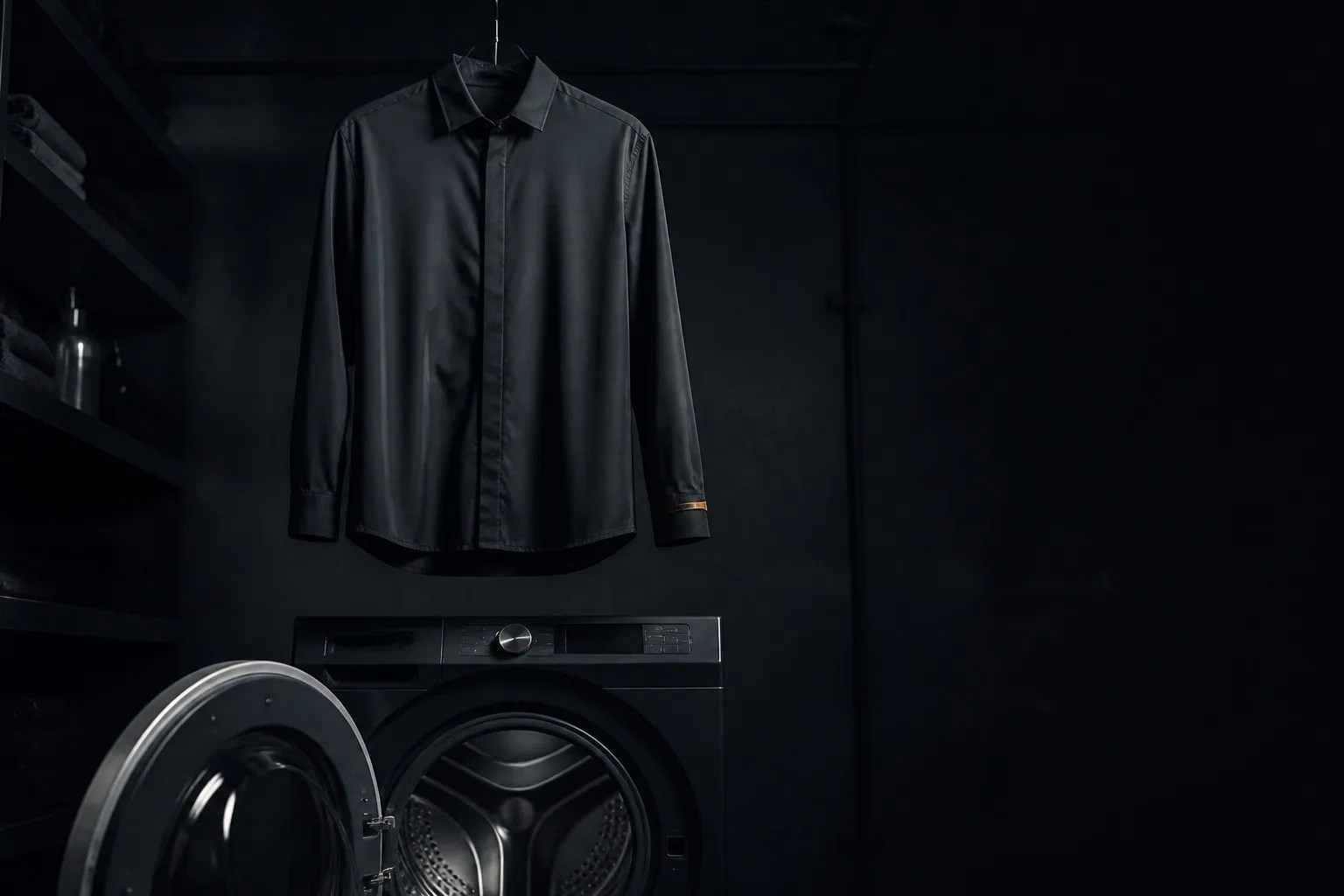
Wearables · Textiles · Durability
Laundry Day Is the Graveyard of Smart Clothing
SMARTS · 31 August 2026 · 11 min read
The care label says machine washable, and that is where the trouble begins. An ordinary cotton shirt is built to survive a hundred cycles of water, detergent and centrifugal violence; the thin conductive traces woven into a smart shirt are not. Every week, in millions of laundry rooms, the garment that was sold as a monitor of the body goes into the machine with the towels, and comes out with its nervous system quietly damaged — a circuit cracked here, an electrode delaminated there, a sensor that still reports, but no longer reliably. The gap between what the label promises and what the physics delivers is the central fact of the smart-clothing category in 2026, and it is a gap measured in wash cycles. Loomia, a materials company that makes e-textile components, puts the numbers plainly in its own guidance: ordinary garments are expected to survive fifty to one hundred washes, while e-textiles often manage only ten to fifty, and surface-printed conductive ink may last just one to five. Those figures are the manufacturer’s own — and they are still the most honest arithmetic the category has produced.
The Feeling First
The Promise That Comes Out of the Dryer
There is a particular disappointment that belongs to smart clothing, and it has nothing to do with the technology failing on the body. It fails in the machine. The buyer did everything right: chose the garment for a reason — a shirt that tracks the heart during exercise, a jacket with heated zones, a sock that watches the foot — wore it, charged it, synced it, and trusted it with the most intimate data a household produces. Then laundry day arrived, and the care protocol that came with the garment turned out to be a short essay on avoidance: cold water only, no fabric softener, no bleach, no dryer, no dry cleaning, gentle cycle, air dry, and pray.
The emotional transaction of smart clothing was supposed to be different from the wristband: the sensor disappears into the wardrobe, the body is free, the data arrives without a strap or a buckle. The hidden cost of that disappearance is that the garment enters a system — the laundry — that was engineered for cloth, not for circuits. The Conversation’s analysis of 5 August 2026 describes the scale of what happens downstream: textile waste already at 92 million tonnes a year and heading toward 134 million by 2030, with e-waste at 62 million tonnes in 2022, and smart clothing fusing the two into a hybrid waste stream that neither recycling system is built to accept. The shirt that watched your heart does not die gracefully. It dies in the wash, and then it dies again in the bin.
The Market
A Category Dressed for Growth, Undressed by Physics
The category’s ambition is not in question. Smart shirts have been studied for years as instruments of cardiorespiratory monitoring: a peer-reviewed scoping review published in JMIR mHealth in June 2020 catalogued the field of smart shirts measuring heart and breathing parameters, and the research line has only thickened since. That review remains a useful map of what the technology is trying to do. The commercial signal arrived in November 2025, when Hexoskin — the company behind one of the longest-running smart-shirt lines — announced that its medical system had received FDA 510(k) clearance for long-term ECG, respiratory and activity monitoring. The company’s announcement is a company source, and it marks the moment the smart shirt stopped being a fitness accessory in the eyes of regulators. It is context here, not the argument: this article is about what happens to that shirt in the washing machine, not about its medical status.
The market trend that matters for buyers is simpler and less glamorous: the garments are arriving in stores faster than the durability science has settled, and the standards that would let a shopper compare one shirt’s wash survival to another’s barely exist. The peer-reviewed literature is blunt about the gap. A study published in Advanced Functional Materials on 1 December 2024 ran textile circuits through one hundred wash cycles and found radically different failure rates among them, with no agreed thresholds in the field for what counts as washable; the researchers reference the IEC 63203-204-1 wash-testing standard as the framework that exists, and note how far the products still are from conforming to it in any comparable way. And a review in Nanomaterials (14 June 2022) concluded that stability and washability are major challenges for the materials involved, warning that degradation may release nano-compounds. The words “machine washable” are doing a lot of work in the marketing department, and almost none of it in the laboratory.
The Pain
The Cycle That Kills, and the Waste That Remains
The first pain is the wash-cycle mismatch, and the numbers come from two different kinds of sources that must be kept apart. On the manufacturer side, Loomia’s guidance — ordinary garments expected to survive 50–100 washes, e-textiles often 10–50, surface-printed conductive ink as few as 1–5 — is a company’s own statement about its own field, useful precisely because it is unusually candid. Loomia’s washing guide is the source, and it should be read as an industry insider’s estimate, not an independent test. On the research side, the peer-reviewed 100-cycle study in Advanced Functional Materials found failure rates that varied radically between different textile circuit designs, which means the honest answer to “how many washes will my smart shirt survive” is: it depends on the circuit, the construction and the chemistry, and no label currently tells you which you are buying.
The second pain is the degradation that the wearer cannot see. A shirt does not stop working all at once. The conductive path degrades cycle by cycle — resistance climbs, an electrode peels, a connection intermittently drops — and the data stream that looked trustworthy in week two is quietly less trustworthy in week twelve. The Nanomaterials review adds a harder edge: the same instability that breaks the circuit may release nano-compounds as materials degrade, a concern the review flags as a major challenge for the field. The wearer of a smart garment is not just losing a feature; they may be losing it into the wash water.
The third pain belongs to the bin, and it is the one nobody markets. When the shirt finally fails, it cannot be recycled as textile or as electronics, because it is both and neither. The Conversation’s analysis describes e-textiles as a hybrid waste stream that creates recycling difficulties and fire hazards in waste processing, and calls for disassembly design, product passports, repair guides and durability standards before the category scales. The garment that was sold as seamless integration ends its life as a problem nobody has a process for.
The Numbers
Washes, Tonnes and Thresholds
The numbers of the category sort into three ledgers, and the honest buyer keeps them separate. The wash ledger, from the manufacturer’s own guidance: 50–100 washes for ordinary garments, 10–50 for e-textiles, 1–5 for surface-printed conductive ink. Those are Loomia’s figures, company-stated. The waste ledger, from the academic press: 62 million tonnes of e-waste in 2022, 92 million tonnes of textile waste moving toward 134 million by 2030, and smart clothing positioned precisely at the intersection. The Conversation’s analysis carries both sets. The standards ledger is the thinnest: a peer-reviewed 100-cycle study in Advanced Functional Materials found radically different failure rates among textile circuits and no agreed thresholds, pointing to the IEC 63203-204-1 wash-testing standard as the reference framework that has yet to discipline the market.
01
50–100 washes
The lifetime ordinary garments are expected to survive, per e-textile materials company Loomia. Company guidance
02
10–50 washes
The typical e-textile range, and 1–5 washes for surface-printed conductive ink, by the same company source. Company guidance
03
62M / 92M tonnes
E-waste in 2022 and textile waste heading toward 134M tonnes by 2030, the two streams smart clothing fuses. The Conversation
04
100 cycles, no thresholds
The peer-reviewed wash study that found radically different failure rates among textile circuits, with no agreed standards. Advanced Functional Materials
“A garment is not a gadget, and no care label can turn a washing machine into a laboratory.”
The Buy
How to Buy a Shirt That Does Not Die in the Machine
The purchase rules follow from the failure modes above, and they all begin with one refusal: never accept “machine washable” as a complete sentence. It is a phrase, not a specification.
1. Demand a tested wash-cycle count. Ask the seller how many wash cycles the garment was tested to survive, and under what protocol. If the answer is a shrug or a marketing phrase, treat the garment as disposable. The peer-reviewed record shows failure rates vary radically by circuit design, and no label currently tells you which design you are buying. The Advanced Functional Materials study is the evidence; the IEC 63203-204-1 standard it references is the framework to ask about by name.
2. Demand the exact care protocol, in writing, before purchase. Cold gentle wash, no bleach, no fabric softener, no dry cleaning, air dry only — if those restrictions are part of ownership, the buyer should know before the box is opened, not after the first load. Loomia’s own guidance is a fair preview of what responsible manufacturers will say, and it is worth reading before any purchase.
3. Prefer detachable electronics and encapsulated circuits. A module that snaps out before the wash separates the garment’s fate from the circuit’s fate, and encapsulation protects what cannot be removed. Surface-printed conductive ink — the construction Loomia rates at 1–5 washes in its company guidance — should be treated as the weakest construction on the market until proven otherwise.
4. Check the take-back and repair policy before you check the fit. The hybrid waste problem is not hypothetical: e-textiles create recycling difficulties and fire hazards in waste streams, and the solutions proposed — disassembly, product passports, repair guides — only work if the manufacturer offers them. The Conversation’s analysis lays out the regulatory case. A garment without a disposal answer is a future problem wearing a present price.
5. Buy the garment for the data you will actually use. The smart-shirt category’s research base — including the JMIR scoping review of shirts measuring cardiorespiratory parameters in June 2020 — is real, and the Hexoskin FDA 510(k) clearance announced in November 2025 shows where the serious end of the market is heading. That announcement is a company source, and it describes a medical product, not a wardrobe upgrade. If the data the garment produces will not change a decision, the wash-cycle risk is not worth carrying.
The Fine Print
What the Care Label Will Not Tell You
1. “Machine washable” is not a standardized durability claim. The peer-reviewed record shows radically different failure rates among textile circuits and no agreed thresholds in the field; the IEC 63203-204-1 wash-testing standard exists as a reference framework, but it does not yet discipline the market. The Advanced Functional Materials study makes the point directly. Never equate the phrase with a lifetime.
2. The wash-lifetime figures are company-stated. The 50–100, 10–50 and 1–5 wash ranges come from Loomia’s own guidance, a materials company with an interest in the category. Read them as industry estimates, not independent test results — and keep them distinct from the peer-reviewed findings in this article, which measure failure variability rather than average lifetimes.
3. The waste problem is real and unsolved. E-textiles are a hybrid stream that is hard to recycle and can pose fire hazards in waste processing, against a backdrop of 62 million tonnes of e-waste and textile waste rising from 92 million toward 134 million tonnes. The Conversation’s analysis is the source, and its proposed fixes — disassembly design, passports, repair guides, durability standards — do not exist in most products yet.
4. Degradation may release nano-compounds. The peer-reviewed review in Nanomaterials flags the stability and washability of e-textile materials as major challenges and notes that degradation may release nano-compounds — an open research question, not a settled alarm, but one the industry has not answered.
5. The medical shirt is context, not a buying signal. Hexoskin’s FDA 510(k) clearance is a company announcement about a specific medical product line. It does not certify the wash survival of smart clothing generally, and it should not be read as one. The wash cycle waits for every smart garment, cleared or not.
The Last Word
Smart clothing is a category asking its customers to trust a garment with their body’s most sensitive signals while the garment’s own survival is measured in tens of wash cycles rather than hundreds. The science is honest about the gap — no agreed thresholds, stability unresolved, waste unmanaged — and the manufacturer’s own guidance concedes the arithmetic. Loomia’s numbers are the quiet confession of an industry that knows what its products endure. Until the labels carry tested cycle counts, until the circuits survive the dryer, until the recycling stream has a slot for the hybrid garment, the smartest clothing purchase is the one made with open eyes: expect the machine to win, buy accordingly, and never let a care label outrank a laboratory. The graveyard of smart clothing is not a landfill yet. It is the laundry room, and the machine is already running.
— THE SMARTS DESK
Sources
Research Appendix
Every statistic in this article links to its primary source. Full list, as of 31 August 2026:
| Data point | Institution | Date | Source |
|---|---|---|---|
| E-waste 62M tonnes (2022); textile waste 92M tonnes heading to 134M by 2030; hybrid waste, recycling and fire hazards; calls for disassembly, passports, repair guides, durability standards | The Conversation | 5 Aug 2026 | Analysis |
| Ordinary garments expected 50–100 washes; e-textiles often 10–50; surface-printed conductive ink 1–5 washes (company-stated) | Loomia | 4 Jan 2026 | Company guidance |
| 100-cycle study: radically different failure rates among textile circuits; no agreed thresholds; IEC 63203-204-1 wash-testing standard referenced | Advanced Functional Materials | 1 Dec 2024 | Peer-reviewed study |
| Stability and washability are major challenges; degradation may release nano-compounds | Nanomaterials | 14 Jun 2022 | Peer-reviewed review |
| FDA 510(k) clearance for smart-shirt ECG, respiratory and activity monitoring (company announcement; context only) | Hexoskin | 19 Nov 2025 | Company announcement |
| Scoping review of smart shirts measuring cardiorespiratory parameters | JMIR mHealth | Jun 2020 | Scoping review |
 Independent Intelligence on Ambient Technology
Leave a comment