Kitchen · Food Safety · Connected Cooking
The App Can Predict Dinner. It Cannot Change the Safe Temperature.
SMARTS · 31 August 2026 · 12 min read
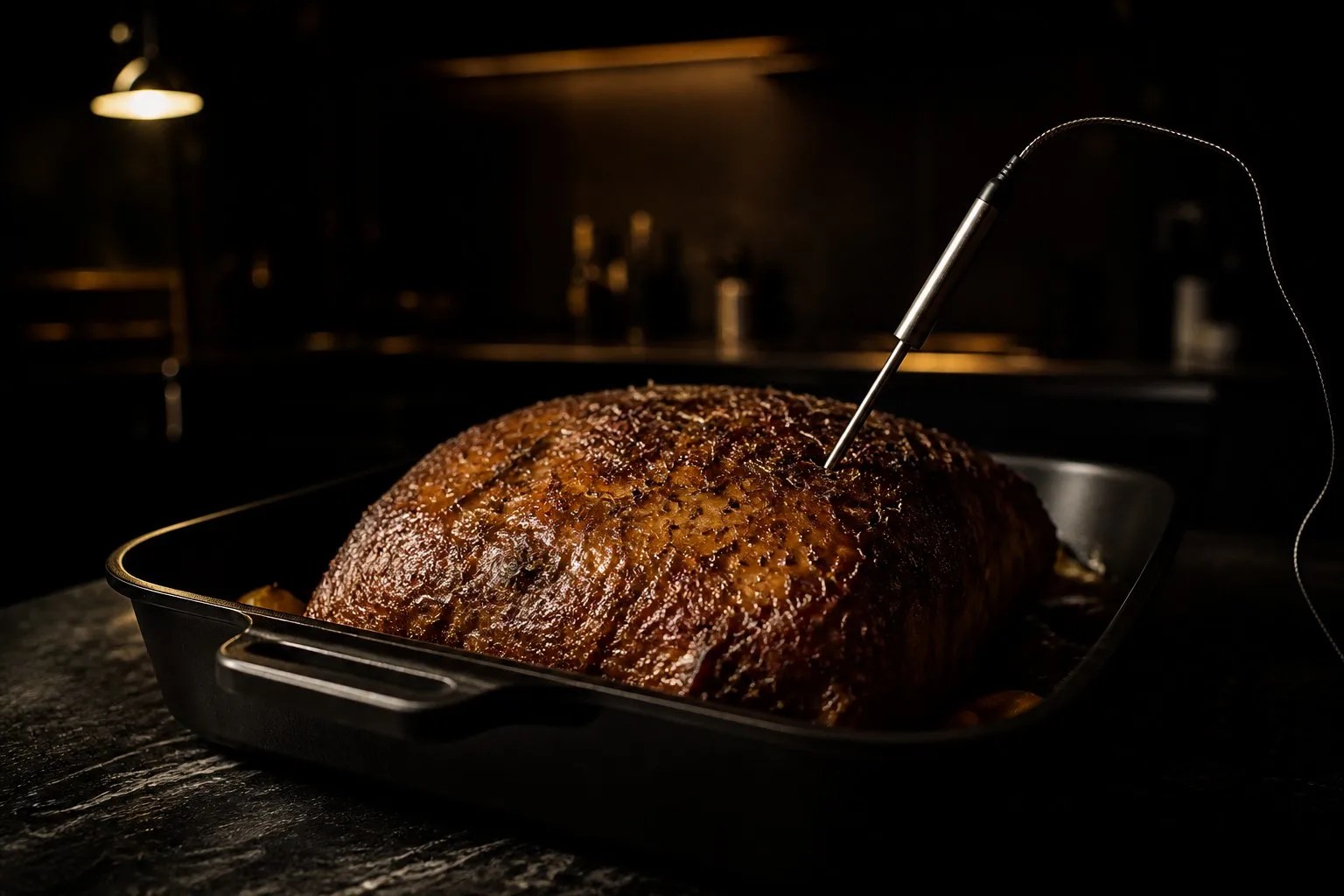
The roast is in the oven and the phone is on the counter, propped against the pepper mill, running a countdown in the app like a launch sequence. Somewhere inside the meat a probe sits wired to the cloud, and the app has promised a time: done at seven-forty, rest until eight, carve at eight-ten. This is the quiet confidence trick of the connected kitchen, and it is mostly honest. Leave-in thermometers are genuinely better than the old ritual of guessing, carving, checking and returning the meat to the oven. But the phone is the weak joint in the whole arrangement, and the app is the wrong place for the final word. Dinner can be predicted. Dinner cannot be certified by prediction. The safe temperature is not a preference the software negotiates; it is a number fixed by the United States Department of Agriculture, and no update, no firmware revision, no machine-learning model changes it.
The Feeling First
Confidence at the Head of the Table
Hosting is a performance of certainty. The plates are warm, the wine is breathing, the conversation has reached the moment when the roast comes out, and the host carries the carving knife with the particular stillness of someone who does not actually know what is inside. The old anxiety is specific: pink at the bone, dry at the edge, the polite guests pretending the chew is a choice. The connected probe does not merely measure the meat; it removes the host from the suspense. The countdown on the phone says the evening is under control, and the confidence is real, because the number is real. That is the emotional product of this category, and it is worth stating plainly: people buy these thermometers to buy back the head of the table.
The stakes are also financial, and that is the second feeling underneath the purchase. A prime rib or a holiday bird is not a casual ingredient; it is the most expensive object in the kitchen on that particular night, and the difference between a triumph and a tuition payment is a few degrees of internal temperature. The probe converts that gamble into a schedule. But the same dependence that produces the calm produces its shadow: when the app fails, the host does not simply lose a convenience. The host loses the evening, in front of the guests, at the moment the knife touches the meat. The confidence is only as strong as the weakest link between the probe and the table, and in too many kitchens that link is a Bluetooth radio with an opinion about when to disconnect.
The Market
From a Needle to a Network
The market has moved in a decade from a needle and a dial to a network appliance, and the price spread shows how wide the promise has become. Serious Eats, an affiliate commerce source that earns from purchases made through its links, tested seventeen leave-in probes priced from $20 to $257, updated 9 July 2026. The gap between those two numbers is not about stainless steel; it is about radios, apps, multi-probe support, ambient sensing and the software that claims to predict when dinner will be ready.
The testing record is more cautious than the marketing. Wirecutter, an affiliate testing source, updated its instant-read and wireless thermometer reviews on 17 March 2026, and its findings are a catalog of the category’s weaknesses: many wireless models it tested were inaccurate, slow or physically thick. In the United Kingdom, BBC Good Food’s hands-on review of 2 April 2026 covers UK prices and app features, a reminder that regional pricing and app availability vary and that a review written for one market does not automatically transfer to another.
The editorial direction of the category confirms where the money is. Bon Appétit, in its May 2026 recommendations, points buyers toward multi-sensor probes and app-based doneness targets — not single-purpose thermometers but systems that track several points in the meat and translate them into a prediction. That is the market’s real product: not measurement but prediction, an app that tells you when the brisket will be done while you are still peeling the potatoes. The trend is legible across every source in this article, and it carries a consequence the brochures do not mention: the more the category sells prediction, the more it depends on the fragile parts — the radio, the phone, the app — and the more it needs a fallback that does not.
The Pain
The Phone Is the Weak Joint
Every connected cook has a story that begins with the alarm not firing. The failure modes of this category are well documented, and they cluster around the same three components: the radio, the probe and the phone.
1. The connection drops. Serious Eats noted connection drops in its seventeen-probe test. The scenario is familiar to anyone who has cooked with one of these: the countdown freezes, the app greys out, the probe is still in the meat doing its job, but the number is trapped inside the hardware with no way to reach the person holding the tongs. For a steak this is an inconvenience. For a holiday roast, with guests seated and a schedule printed in the host’s head, it is the return of the old dread, at the worst possible moment.
2. The probe is thick. Wirecutter found many wireless models physically thick, and thickness is not a cosmetic complaint. A fat probe forced into a delicate fillet tears the structure of the meat; a probe driven through a bird leaves a channel for juices to escape; and a probe that will not seat properly reads air instead of flesh. The wireless models that solve the radio problem by housing a battery and antenna in the probe pay for it in diameter, and the cook pays for it at the table.
3. The phone becomes the whole system. If the probe has no display of its own, a dead phone, a lost phone or a phone left in the car turns the expensive instrument into an unreadable object. The design choice that puts everything on the app is also the design choice that makes the app a single point of failure, and it is the one spec buyers rarely check.
4. The low end of the range is where accuracy matters most. The same Serious Eats test flagged weak low-temperature performance in some models. Slow roasts, gentle smoke and long holds are precisely the cooks that run for hours below 200°F, and a probe that drifts in that band is not a minor error; it is the difference between a safe hold and an invitation to bacteria multiplying in the very zone the cook believes is under control.
The Numbers
Seventeen Probes and One Fixed Table of Numbers
Start with the hardware market as tested. Serious Eats’ seventeen leave-in probes spanned $20 to $257, and the stated accuracy of the better models clustered around 1.7 to 1.8°F. Those figures deserve their full label: stated accuracy, as published by the manufacturers and repeated by an affiliate commerce source — not an independently measured average, and not a guarantee at any given temperature in your particular oven. The range of the test is the real statistic: the category now asks a buyer to choose between a thermometer that costs less than a takeout meal and one that costs more than a countertop grill, with prediction features layered on top of the measurement at every price point.
Now set the fixed table. The USDA Food Safety and Inspection Service’s safe temperature chart, updated 14 April 2025, is not a recommendation and not a preference: whole cuts of meat must reach 145°F and rest; ground meat 160°F; poultry 165°F; fish 145°F; leftovers reheated to 165°F. These numbers are the product of food-safety science, they are enforced by the structure of the food supply, and they do not move when an app changes its prediction algorithm.
The gap between the two sets of numbers is the entire argument of this article. An app’s “done” forecast is a doneness estimate: a model of texture, carryover and preference, useful for planning a meal and worthless as a safety verdict. The USDA table is a safety floor: non-negotiable, temperature-specific, and the only number that matters when the guests are hungry and the meat is close. When the app’s prediction and the USDA minimum disagree, the USDA minimum governs. The app can be charming about it. The thermometer cannot be.
The Checklist
Seven Numbers on the Box Worth Reading
01
Stated accuracy
The 1.7–1.8°F figures in the test record are stated accuracy, not measured performance. Demand the number, then verify it yourself before an important cook.
02
Response speed
Wirecutter found some wireless models slow to report. A probe that lags behind the meat’s climb can miss the moment the USDA number is crossed.
03
Probe thickness
Many wireless models are physically thick. Match the probe to the cut: a delicate fillet will not forgive a probe the diameter of a pencil.
04
Ambient sensing
A second sensor at the handle reads the oven or smoker air. It is what separates a probe that tracks the cook from one that only tracks the meat.
05
On-device display
If the only readout lives in the app, a dead phone turns the instrument into a brick. A display on the base unit keeps the cook alive when the radio fails.
06
Wireless range
Serious Eats recorded connection drops in testing. Range claims are marketing; the geometry of your kitchen is the test that matters.
07
Dishwasher rating
A rating is a claim about a seal. Seals age, steam finds the gap, and the probe that survived the dishwasher dies in the smoker. Hand-wash when possible.
“An app can predict the minute dinner is done. Only a thermometer can certify that it is safe.”
The Buy
Buy the Pair, Trust the Second Thermometer
The buying rules follow directly from the failure record above. The category’s own testers have documented the weaknesses; the buyer’s job is to buy around them.
1. Buy the pair, not the gadget. A wireless leave-in probe handles the long cook and the schedule; a fast instant-read thermometer delivers the final verdict at the moment of carving. The two instruments cover each other’s failure modes: when the radio drops, the instant-read still answers the only question that matters. Wirecutter’s testing covers both classes for exactly this reason.
2. Calibrate before important cooks. Stated accuracy around 1.7–1.8°F is a manufacturer claim repeated by testers, not a verified property of your unit. The Serious Eats test record is explicit that accuracy is stated; an ice-water check before the holiday bird costs five minutes and removes one variable from the most expensive cook of the year.
3. Match probe thickness to the cut. A wireless probe’s battery lives in its shaft, and the shaft pays for it in diameter, as Wirecutter found. Choose the thinnest probe that reliably reports from your usual cuts, and accept that a single probe will not suit every cook in the repertoire.
4. Demand a display that is not the phone. The cook must survive the phone: its battery, its attention, its Bluetooth stack. An on-device readout on the base unit means the system keeps working when the app does not, and the app failing stops being a dinner emergency. Connection drops are documented in testing; plan for them by design.
5. Let the USDA table hold the final word. Treat the app’s “done” forecast as a doneness estimate — a model of carryover and preference — and confirm the safety verdict against the USDA safe minimums: 145°F for whole cuts with a rest, 160°F for ground meat, 165°F for poultry, 145°F for fish. No prediction changes the floor. The app schedules the evening; the thermometer certifies it.
The Fine Print
The Temperature Table Outranks the App
1. The app never certifies safety. An app’s “done” prediction is a doneness estimate, not a food-safety certification. The USDA safe minimums — 145°F whole cuts plus rest, 160°F ground meat, 165°F poultry, 145°F fish, 165°F leftovers — are the authority, and they do not move when the software is updated.
2. Connections drop, and testing says so. Serious Eats recorded connection drops across its seventeen probes. The question is not whether your unit will drop; it is what remains readable when it does. If the answer is nothing, the system is designed wrong for safety-critical cooking.
3. Stated accuracy is stated. The 1.7–1.8°F figures in the test record are stated accuracy from manufacturers, as reported by an affiliate commerce source. They are not a measured average across units, and they say nothing about drift after months of use. Calibration is not optional for the cooks that matter.
4. The low end of the range can be weak. The same test flagged weak low-temperature performance in some models — precisely the band where long, slow cooks live. A probe that drifts below 200°F undermines the cook that trusts it most.
5. Dishwasher ratings are claims about seals. A “dishwasher-safe” rating describes a seal’s design intent, not its lifespan. Steam and detergent age seals faster than any spec sheet suggests; hand-washing extends the probe’s life, and the rating is not a warranty against the second year.
6. Read the labels on the sources. Serious Eats is an affiliate commerce source that earns from purchases made through its links; Wirecutter is an affiliate testing source; BBC Good Food’s prices are UK regional. Its review is hands-on but local. Treat each source’s claims with its commercial position in mind.
The Last Word
The connected thermometer sells confidence, and the confidence is legitimate: a probe in the meat, a countdown on the phone, a host at the table instead of hovering over the oven door. That confidence should be built on the right foundation. The app is a planning tool, gifted at prediction and indifferent to certification; the USDA table is the law of the kitchen, fixed in place and immune to firmware. Buy the pair — the leave-in probe for the schedule, the instant-read for the verdict — calibrate before the expensive cook, and let the phone do what phones do well: schedule, remind, predict. The final decision belongs to a number that does not need a signal to exist.
— THE SMARTS DESK
Sources
Research Appendix
Every statistic in this article links to its primary source. Full list, as of 31 August 2026:
| Data point | Institution | Date | Source |
|---|---|---|---|
| Seventeen leave-in probes tested, $20–$257; stated accuracy around 1.7–1.8°F; connection drops and weak low-temperature performance noted (affiliate commerce source) | Serious Eats | Updated 9 Jul 2026 | Probe test |
| Many wireless thermometer models inaccurate, slow or physically thick (affiliate testing source) | NYT Wirecutter | Updated 17 Mar 2026 | Thermometer review |
| Hands-on UK prices and app features; regional pricing | BBC Good Food | 2 Apr 2026 | Hands-on review |
| Multi-sensor probes and app doneness targets (editorial recommendation) | Bon Appétit | May 2026 | Recommendations |
| Official safe minimums: whole cuts 145°F plus rest; ground meat 160°F; poultry 165°F; fish 145°F; leftovers 165°F | USDA FSIS | Updated 14 Apr 2025 | Safe temperature chart |
 Independent Intelligence on Ambient Technology
Leave a comment