Lawn Care · Robotics · RTK
The Last Boundary Wire Is Disappearing From the Lawn
SMARTS · 31 August 2026 · 13 min read
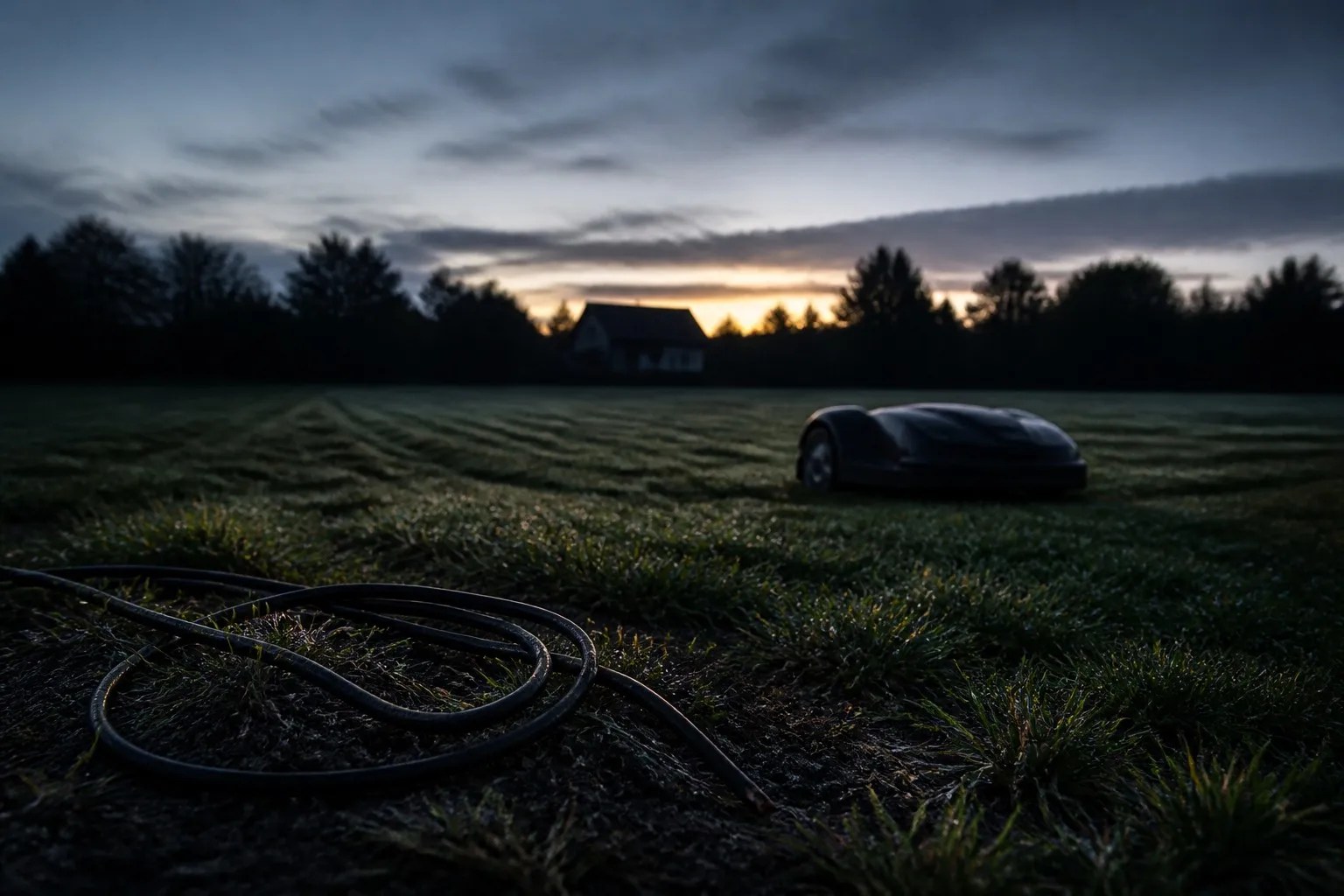
The wire is still there, in most yards: a thin black line buried a finger’s depth along the edge of the lawn, stapled at the corners, spliced where the snowplow or the dog or the hedge trimmer found it. For two decades it was the load-bearing structure of robotic mowing — the invisible fence that told a blind machine where its world ended and the flowerbed began. Laying it meant trenching, staking, splicing. Living with it meant rescues: a mower beached against a root, wheels spinning, an error code glowing, the boundary broken somewhere in wet grass. That wire is disappearing. In the summer of 2026 the machines that replace it navigate by satellites and cameras rather than buried copper, and the Saturday morning that once belonged to the lawn is being handed back to the person who used to spend it kneeling in the dew with a splice kit.
The Feeling First
The Saturday That Came Back
There is a specific memory attached to the old system, and it is not the mowing. It is the retrieval: the robot wedged against a root it could not see, wheels spinning in the wet grass; the wire cut by the aerator; the manual open to a diagram that never quite matches your yard. The machine that was supposed to remove a chore had quietly become a second chore — one that required a screwdriver, a multimeter and a tolerance for kneeling. The emotional promise of the wire-free generation is not a straighter stripe. It is the end of the rescue mission, and the return of the hours the rescue consumed.
The new transaction is quieter. The mower leaves its dock in the morning, and by the time the coffee is finished the lawn is done — no wire to inspect, no antenna to sight across the yard, no boundary to re-learn after every storm. Consumer Reports, which updated its robotic mower ratings on 14 July 2026, tested six machines that required no perimeter wire at all, with rated models running roughly $800 to $2,000. Its ratings describe a category that has stopped being a hobby. What the brochures do not say is that the anxiety has merely moved: from the ground to the sky, from a wire you can touch to a satellite signal you cannot, and from the mower’s wheels to the judgment of whoever has to match the machine to the yard.
The Market
From Buried Copper to Satellite Geometry
The commercial curve explains the shift in the showroom. Mordor Intelligence estimates the robotic lawn mower market at $2.40 billion in 2025, rising to $2.74 billion in 2026 and $5.32 billion by 2031 — a compound annual growth rate of 14.18% (a market-research estimate, not a government count). Its market report describes a category compounding at double digits, and the direction is consistent across every source in this article: wire-free is no longer the premium oddity; it is the category.
The technical change underneath the growth is real positioning. In a five-mower field test published by The Verge on 13 August 2026, every machine except the LiDAR-based Dreame navigated with RTK — real-time kinematic positioning that can provide centimeter-level accuracy. The same report makes the point that matters for buyers: NetRTK, the cloud version of the system, removes the need for the private base-station antenna — but only where cloud reference-station coverage exists. The antenna in the yard was the second wire, and it is the next to go.
The wire-free claim is now the testing baseline rather than the exception. Consumer Reports found all six mowers it tested required no perimeter wire; The Verge’s five-mower test was a test of wire-free machines, full stop. The old question — does the wire-free version work? — has been answered. The new question is about the conditions under which it works, and those conditions are the subject of the rest of this article.
The Pain
The Old Wire Had Four Failure Points. The New System Has Its Own.
The old system failed in predictable places. The wire snapped, the splice corroded, the boundary map drifted, and the base-station antenna lost its view of the sky. The new system has moved those failure points rather than eliminated them, and four of them deserve attention before money changes hands.
1. NetRTK is an address-level promise. The cloud reference-station coverage that lets a mower navigate without the private antenna does not exist everywhere. The Verge’s field test is explicit: NetRTK removes the antenna where coverage exists. A rural lot, a valley floor or a new development can sit outside the service envelope, and the buyer discovers it after installation, when the mower calmly asks for a base station that was supposed to be obsolete.
2. Trees and roofs are the new trenches. RTK locks onto satellite signals, and a mature canopy or a deep roof overhang can degrade that lock exactly where the mower needs it most — along the edges of the house. Camera-based navigation has its own weakness: Consumer Reports notes that camera navigation may perform worse at night, which is precisely when many owners schedule mowing to escape the heat and the children. Husqvarna’s answer is infrared night cameras on its seven 2026 AI Vision models — a manufacturer claim, not an independent test result, and worth labelling as such. Its announcement is the company’s own word.
3. Slope, area and the edge of the lawn. Manufacturer-stated coverage — Husqvarna lists 400 to 7,500 m² across its AI Vision range, with the 540 EPOS model reaching 8,000 m² — describes ideal conditions, not your grade. Those figures are company-stated. A bank that exceeds the machine’s slope rating is simply unmowed, and no robot tested by any source in this article string-trims: the strip along the fence and the patio still belongs to a human with a trimmer.
4. Theft is the quiet fourth item. A machine worth $1,000 to $3,000 sitting on an open lawn is a new kind of yard ornament. Theft controls — PIN locks, app-based geofencing, GPS recovery — vary sharply by model, and the price ladder below shows how much capability, and how much exposure, each tier carries.
The Numbers
A Price Ladder, a Coverage Map, a Garden of Caveats
The market’s price ladder is now legible. Manufacturer-sourced specifications reported by Electrek on 19 January 2026 put Segway’s Navimow line at $999 for the i206, $1,299 for the i210, $2,499 for the X430 and $2,999 for the X450. Those are manufacturer-sourced figures, published at pre-order time. Consumer Reports’ independently rated wire-free machines cluster roughly between $800 and $2,000. The overlap is the honest zone: capable wire-free mowing now starts below four figures and reaches three thousand only when area, slope or features demand it.
The coverage figures deserve the same scrutiny as the prices. Husqvarna’s 400–7,500 m² range, and the 8,000 m² ceiling on its 540 EPOS model, are company-stated numbers from its own press announcement. The company’s release is a marketing document, useful for the menu of models and useless as a guarantee of your lawn. Bob Vila’s 2026 roundup — an affiliate commerce source, which earns from purchases made through its links — tested seven wire-free models on real Florida grass, which is its own form of pressure testing: dense, sandy, fast-growing turf that punishes a mower’s navigation and battery equally. The pattern across sources is consistent: the machine matched to the lawn’s real area and slope, rather than to the brochure’s maximum, is the one that survives the season.
“The measure of progress is not a straighter stripe. It is the Saturday morning that no longer belongs to the wire.”
The Buy
How to Buy a Mower That Does Not Bring the Wire Back
The purchase rules follow from the failure points above. Work through them in order, on paper, before opening the browser tab.
1. Measure the lawn before you measure the price. Walk the property and map the real mowable area — the part the machine will actually be asked to cut, excluding flowerbeds, driveways and strips too narrow to turn around in. Compare that number against manufacturer coverage claims such as Husqvarna’s 400–7,500 m² range with the scepticism those claims deserve: they describe ideal conditions, not your grade. Company-stated figures are ceilings, not guarantees.
2. Verify NetRTK coverage at the address before ordering. The entire promise of the antenna-free install rests on cloud reference-station coverage existing at your specific address, per The Verge’s field test. Check the coverage map for the house itself, not the nearest city. If coverage is absent, budget for the base-station version and its placement requirements — the antenna you were trying to escape has a way of returning.
3. Inspect the sky the way you used to inspect the trench. Tall trees, roof overhangs and narrow side yards are the new failure points for RTK and camera systems alike. If the lawn wraps around a house with deep eaves, expect signal trouble at the worst moments. And if you plan to mow at night, take seriously Consumer Reports’ caution that camera navigation may perform worse after dark; infrared night cameras exist, but on Husqvarna’s 2026 models they are a company claim about capability. Company claims are not test results.
4. Decide who does the edges, and who holds the keys. Every wire-free mower leaves the border strip unmowed; the string trimmer stays in the shed for a reason. Budget that labour in time, if not in money. Then check the theft controls — PIN locks, geofencing, GPS recovery — and search the model’s battery and fire recall history before you buy, not after. A machine left on the lawn overnight is either a convenience or an invitation, depending on what the spec sheet says about locks.
5. Buy the machine for the season you have, not the season you fear. A $999 i206-class mower handles a modest flat lawn; the $2,999 X450-class machine earns its price on area, slope and features. The manufacturer-sourced ladder spans exactly that range. The right purchase is the smallest machine that reliably covers your real lawn — because every extra kilogram of capability is extra cost, extra theft exposure and another thing that can fail.
The Fine Print
What the Brochure Will Not Mow
1. Coverage and slope figures are manufacturer claims. Husqvarna’s 400–7,500 m² range and its 8,000 m² EPOS ceiling come from the company’s own announcement, as company statements, and the Segway prices are manufacturer-sourced specifications reported by Electrek. Electrek’s report says so itself. None of these have been independently verified by this article; treat them as ceilings, not promises.
2. NetRTK is a coverage-dependent promise. The antenna-free install exists only where cloud reference-station coverage exists, per The Verge. The address check is not optional; it is the single most important verification before purchase, and it cannot be done after the box arrives.
3. Night mowing is not guaranteed. Consumer Reports notes that camera navigation may perform worse at night; the infrared night cameras on Husqvarna’s AI Vision models are a company claim, not a tested result. The company’s word is the only word on that feature.
4. Market numbers are estimates. Mordor Intelligence’s $2.40B-to-$5.32B forecast and its 14.18% CAGR are market-research estimates, not audited figures. Its report is a research product, and Bob Vila’s seven-model roundup is an affiliate commerce source that earns from purchases made through its links. Read it as such.
5. The lawn still needs a human. Edging, string trimming, leaf cleanup and the occasional rescue remain part of ownership. The wire is gone; the weekend is not entirely free. It is simply freer than it was — which is, in the end, the whole argument for the category.
The Last Word
The boundary wire is becoming what the modem cord became: infrastructure you no longer see, because it is no longer there. What replaces it — a satellite lock, a camera’s memory of the lawn, a machine that returns to its dock before breakfast — is more capable and less forgiving. The mower will not know your property the way the wire did; it will know it better, or it will fail in ways the wire never did. The buyer’s job has not changed in two decades. It is still to match the machine to the ground it must hold, and to check the sky before you trust the ground.
— THE SMARTS DESK
Sources
Research Appendix
Every statistic in this article links to its primary source. Full list, as of 31 August 2026:
| Data point | Institution | Date | Source |
|---|---|---|---|
| Five-mower field test; all but LiDAR-based Dreame used RTK; NetRTK removes private antenna where cloud reference-station coverage exists; RTK centimeter-level positioning | The Verge | 13 Aug 2026 | Field test |
| Six tested mowers required no perimeter wire; rated models roughly $800–$2,000; camera navigation may perform worse at night | Consumer Reports | Updated 14 Jul 2026 | Ratings |
| Seven 2026 AI Vision models with infrared night cameras; coverage 400–7,500 m²; 540 EPOS to 8,000 m² (company claims) | Husqvarna Group | 17 Oct 2025 | Company release |
| Segway Navimow pricing: i206 $999, i210 $1,299, X430 $2,499, X450 $2,999 (manufacturer-sourced) | Electrek | 19 Jan 2026 | Price report |
| Robotic lawn mower market: $2.40B (2025), $2.74B (2026), $5.32B (2031), CAGR 14.18% (market-research estimate) | Mordor Intelligence | Aug 2026 | Market report |
| Seven wire-free models tested on Florida grass (affiliate commerce source) | Bob Vila | Accessed 31 Aug 2026 | Roundup |
 Independent Intelligence on Ambient Technology
Leave a comment