Delivery · Security · Logistics
The Last Ten Feet of Delivery Are Still Unsolved
SMARTS · 31 August 2026 · 12 min read
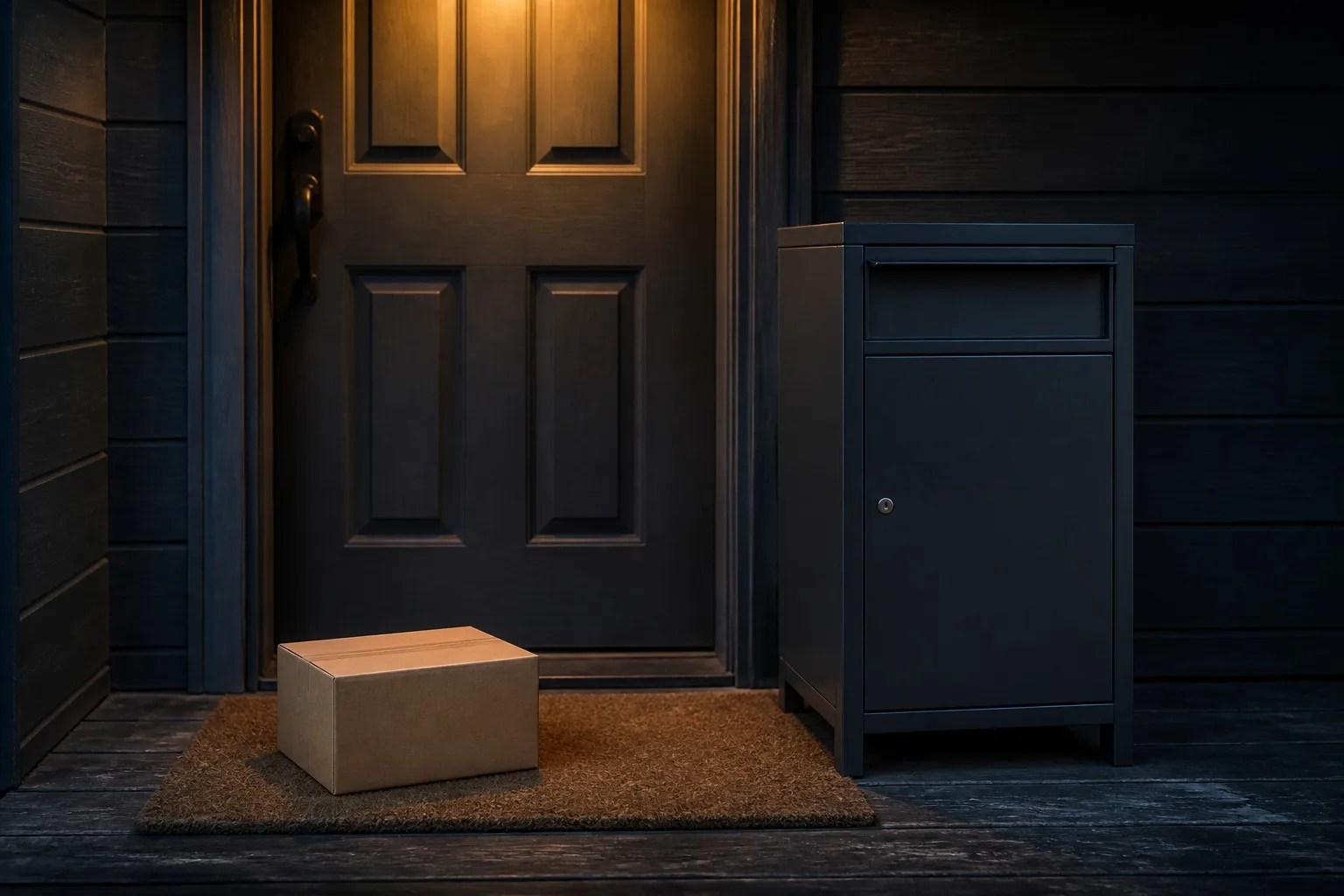
The notification arrives at 11:47 in the morning: delivered. For most of the package’s journey, that word is a triumph of logistics — a parcel that crossed a continent, cleared a sorting facility, rode in a truck and reached a street with your number on it. Then the journey stops at the last ten feet, and the system’s grip loosens. The package sits on the porch, visible from the sidewalk, in plain view of every person who walks past between 11:47 and 6:10, when you get home. The secure parcel box was invented for exactly this gap: a lockable steel container bolted beside the door, into which the driver drops the parcel and from which only you can retrieve it. It is a good idea, and the hands-on testing record says it fails in a way the marketing never mentions. The lock works. The electronics work. The box is not the problem. The problem is the carrier, the tired human with a hundred stops and a deadline, who looks at the box, looks at the mat, and leaves the package on the mat anyway.
The Feeling First
Dread After the Notification
There is a particular modern dread that arrives with the word “delivered,” and it is not the parcel’s fault. The package contains something specific — the birthday gift, the medication, the discontinued part, the thing that was hard to find and impossible to replace — and the moment it leaves the driver’s hand, it enters a period of exposure measured in hours, during which the owner is somewhere else. The porch is not a destination; it is a display case with a countdown. This is the emotional problem the parcel box is sold against, and the feeling it promises to remove is the specific vigilance of the working day: the checking of the camera feed, the mental map of the neighbour’s schedule, the calculation of whether anyone was home.
The purchase of a box is therefore a purchase of release — the permission to stop watching. And the specific insult of the category’s documented failure mode is that it does not happen at the level of locks or electronics. It happens when the driver, who has a key-code to the box or a QR code for it, chooses the mat anyway. The package is photographed on the mat, in front of the box, like a delivery worker’s note pinned to a locked door. The owners who tested these boxes describe the moment precisely, because the box did not fail them; it was never used. The release they paid for was not delivered, and the word “delivered” had never felt less accurate.
The Market
A Category That Competes With Its Own Customer
The parcel-box market is a solution in search of cooperation. Family Handyman’s comparison, updated 3 March 2026, an affiliate commerce source, surveys boxes from $87 to $280 — the practical range for a homeowner buying a locked container with a delivery opening. The category includes plain mechanical drop boxes, app-locked smart boxes, and boxes with cameras, and the price climbs with the electronics. The two most serious hands-on tests in the category agree on where the money should not go. Consumer Reports tested boxes priced $200 to $399, published 9 December 2022, and found the main failure was carriers not consistently using them; Wirecutter’s real-world test of 20 November 2023 reached the same conclusion independently: driver use was the dominant weakness.
Meanwhile, the market’s other half — the carriers themselves — has been building its own answer. USPS Smart Lockers, per the agency’s FAQ updated 28 July 2026, are free keyless lockers at Post Office locations, opened by QR code, with a five-day hold and 24/7 access at selected sites; Supply Chain Dive, a trade publication citing USPS, reported on 22 July 2026 that roughly 700 Post Offices had smart lockers as of October 2025 and that USPS’s Local XChange locker service costs $5.51 per package. The category’s real competition is not other boxes. It is the free infrastructure that already exists, waiting at a Post Office near the buyer’s commute.
The Pain
The Box Works. The Driver Does Not.
The pain of the category is coordination, not engineering. Every failure mode documented in the hands-on tests is a human one, and the electronics are, in a sense, beside the point.
1. The carrier does not use the box. Consumer Reports found the main failure was carriers not consistently using the boxes it tested, and Wirecutter’s real-world test found the same. The reasons are ordinary: a driver under time pressure, unfamiliar with the box, uncertain whether the code will work, afraid of the lid slamming on a hand — and a mat that requires zero interaction. The box cannot compel the behaviour it depends on, and no lock design fixes a delivery that never reaches it.
2. The parcel lands on top of the box. The most photographed insult in the category’s test records: the package placed on the box’s lid, or beside it, because the driver treated the box as a bench. The owners’ frustration is not theft at that moment; it is the demonstration that the expensive object’s entire premise — that a carrier will interact with it — is not shared by the carrier.
3. Coordination beats Wi-Fi. A smart box’s electronics — the app lock, the notification, the camera — solve the retrieval side of the problem perfectly and the delivery side not at all. The box can notify you the moment a parcel is placed inside; it cannot place the parcel inside. The entire value chain depends on a behaviour that no specification sheet can enforce, which is why the buying advice in this category is about logistics and behaviour, not firmware.
4. The alternatives already exist, and they are free. The same coordination problem has a public-sector answer that removes the carrier’s discretion entirely: a parcel placed in a locker by the carrier is a parcel placed in a locker, full stop. USPS Smart Lockers — free, keyless, QR-opened, five-day hold, 24/7 at selected sites — and the pickup-point, signature-required and ship-to-store options offered by carriers are the honest baseline against which a $200 to $400 box must justify itself.
The Numbers
Two Kinds of Evidence, Kept Apart Deliberately
The scale of package theft is documented by two very different instruments, and the difference matters. The USPS Office of Inspector General, a federal watchdog, reported on 15 May 2025 that at least 58 million packages were stolen in the United States in 2024 — a government-adjacent accounting based on the volume the postal system can observe. Separately, SafeWise, in proprietary sponsored survey research published 6 November 2025, estimated 104.3 million packages stolen over the preceding twelve months and losses in the region of $250,000 per day. Those two figures are different kinds of evidence — a federal watchdog’s floor estimate versus a security-industry-adjacent survey — and this article deliberately does not average, blend or reconcile them. The only honest statement is the one both support independently: package theft is a mass phenomenon, measured in the tens of millions of parcels a year.
The counter-numbers are the public alternatives. USPS Smart Lockers are free at the point of use: keyless, opened by QR code, holding parcels five days, available around the clock at selected sites. Supply Chain Dive, citing USPS, counted roughly 700 Post Offices with smart lockers as of October 2025 and priced the Local XChange locker service at $5.51 per package. Against that baseline, the homeowner’s hardware ladder looks different: Family Handyman’s affiliate comparison surveys parcel boxes from $87 to $280, and the tested smart boxes in Consumer Reports’ $200 to $399 test failed on a factor no price tier can buy: the driver’s willingness to use them.
The Checklist
The Free Alternatives, In Order
01
USPS Smart Lockers
Free keyless Post Office lockers with QR pickup, a five-day hold and 24/7 access at selected sites, per the USPS FAQ. Roughly 700 Post Offices had them as of October 2025, per Supply Chain Dive citing USPS.
02
Pickup points
Retail and carrier pickup locations hold parcels until the owner collects them. The trade is the trip: the package waits for you instead of you waiting for it.
03
Signature required
A signature requirement converts the delivery into a hand-to-hand transaction. It costs nothing at checkout on many shipments and removes the porch from the equation entirely.
04
Ship-to-store
The retailer’s own counter becomes the secure location, with the retrieval built into an errand. For expensive or irreplaceable items, it is the least glamorous and most reliable option.
“A lock keeps out thieves. It cannot make a carrier open it.”
The Buy
Verify the Driver Before You Buy the Box
The purchase rules of this category are unusual because the failure mode is behavioural. The order of operations matters more than the brand of lock.
1. Verify regular carrier behaviour before buying. The dominant failure in both major hands-on tests was carriers not using the boxes — Consumer Reports’ $200 to $399 test and Wirecutter’s real-world test. Ask the people who deliver to your address whether they will use a box; watch what they do with the parcels you already receive; and understand that a driver who does not read delivery notes will not read a box’s instructions either.
2. Prioritize the physical box over the electronics. Weight and anchoring decide whether the box can be carried off; opening size decides whether the parcel fits; weather sealing decides whether the contents survive the week; a mechanical key fallback decides whether you are locked out when the app dies. Family Handyman’s affiliate comparison spans $87 to $280 precisely because these physical properties cost money; the electronics are the least important part of the purchase.
3. Do not buy the box for its camera. Camera features document theft; they do not reliably prevent it, and the subscription attached to cloud video is a second product layered onto the first. The site’s camera-subscription economics are argued elsewhere; here the relevant point is that a box with a camera still fails at the same point every box fails — the driver’s decision — and the footage of the parcel on the mat is not a delivery.
4. Exhaust the free options first. USPS Smart Lockers, pickup points, signature requirements and ship-to-store cost nothing and fail at nothing except convenience. If a locker is on your commute, the $200 to $400 box has to justify itself against a five-day hold and a QR code, and usually it cannot.
5. Match the box to the parcel stream. A household that receives two small parcels a week needs a different box than one that receives tools, groceries or oversized deliveries. Measure the actual packages, count the actual frequency, and buy the box that fits the stream — the category’s failure record shows that an oversized box on a quiet porch becomes furniture, and an undersized one becomes a reason for the driver to choose the mat.
The Fine Print
The Mat Will Always Be Faster
1. The dominant failure is the human carrier. Both major hands-on tests — Consumer Reports, 9 December 2022, and Wirecutter, 20 November 2023 — found carriers not consistently using the boxes. Both are older hands-on sources, and the finding has not been overturned by any newer evidence in this article’s research record; it is the category’s defining fact.
2. The two theft figures are different kinds of evidence. The USPS Office of Inspector General’s “at least 58 million packages stolen in 2024” is a federal watchdog figure. SafeWise’s 104.3 million figure is proprietary sponsored survey research from 6 November 2025, an estimate with a commercial sponsor, not a federal count. They are presented separately here and must never be averaged or blended; the only shared conclusion is that theft is measured in tens of millions of parcels a year.
3. The free infrastructure has its own fine print. USPS Smart Lockers are free but conditional: keyless QR pickup, a five-day hold, 24/7 access only at selected sites, and roughly 700 Post Offices equipped as of October 2025 per Supply Chain Dive citing USPS. The $5.51 Local XChange price is a per-package fee for a commercial locker service, not the free consumer locker program. Read the FAQ before planning your week around a locker that is not at your Post Office.
4. Read the labels on the sources. Family Handyman’s $87 to $280 range comes from an affiliate commerce source that earns from purchases made through its links; its comparison is a commercial roundup. Wirecutter’s test is an affiliate testing source; Consumer Reports’ is subscription testing. The convergence of the two independent tests is what makes the carrier finding credible, not any single outlet.
5. Cameras document; they do not reliably prevent. The camera-equipped box records the theft it was meant to stop, and the footage’s value is retrospective. The prevention problem is behavioural, and no sensor on the box changes the driver’s arithmetic: the mat is always faster, and the box is only as good as the delivery culture that surrounds it.
The Last Word
The last ten feet of delivery remain the hardest problem in modern logistics because they are a human problem wearing a hardware costume. The parcel box is a good lock, a good container, a good idea; it is not a good delivery system, because delivery systems end with a person making a choice, and the choice has consistently been the mat. The buyers who solve this problem solve it with coordination: a carrier who knows the box, a locker on the commute, a signature on the shipment, a counter at the store. The boxes worth buying are the ones bought after the behaviour is verified, weighted and anchored against the physics of theft, and kept humble about their electronics. The package will still arrive at 11:47. The question is only whether the last ten feet are guarded by steel, by logistics — or by the habits of the person holding the parcel.
— THE SMARTS DESK
Sources
Research Appendix
Every statistic in this article links to its primary source. Full list, as of 31 August 2026:
| Data point | Institution | Date | Source |
|---|---|---|---|
| At least 58 million packages stolen in the US in 2024 (federal watchdog figure) | USPS Office of Inspector General | 15 May 2025 | White paper |
| Estimated 104.3M packages stolen in past 12 months; ~$250,000/day (proprietary sponsored survey research, not a federal count) | SafeWise | 6 Nov 2025 | Survey research |
| Tested $200–$399 boxes; main failure was carriers not consistently using them (older hands-on source) | Consumer Reports | 9 Dec 2022 | Box review |
| Real-world tests found driver use the dominant weakness (older affiliate test) | Wirecutter | 20 Nov 2023 | Delivery box test |
| Free keyless Post Office lockers, QR pickup, five-day hold, 24/7 access at selected sites | USPS Smart Locker FAQ | Updated 28 Jul 2026 | USPS FAQ |
| USPS Local XChange $5.51/package; about 700 Post Offices with smart lockers as of Oct 2025 (trade press citing USPS) | Supply Chain Dive | 22 Jul 2026 | Trade report |
| Parcel-box comparisons from $87 to $280 (affiliate commerce source) | Family Handyman | Updated 3 Mar 2026 | Box comparison |
 Independent Intelligence on Ambient Technology
Leave a comment