Health Tech · AI · Self-Tracking
The Mirror That Grades You Before Breakfast
SMARTS · 29 August 2026 · 12 min read
The mirror is the last analog surface in the connected house — and the most judgmental one, the object we have always used to check ourselves before the world does. The new health mirrors turn that judgment into a score. The NuraLogix Longevity Mirror, which launched in the first quarter of 2026 at $899, scans the blood flow in your face for 30 seconds and returns estimates of heart rate, blood pressure, cardiovascular and metabolic indicators, and a physiological age. The Verge’s January report on the CES announcement is the primary record. Stand in front of it in the morning and it grades you before breakfast. The question is not whether the technology works. It is whether you want the grade — and what the grade is actually worth.
The Feeling First
Graded Before Coffee
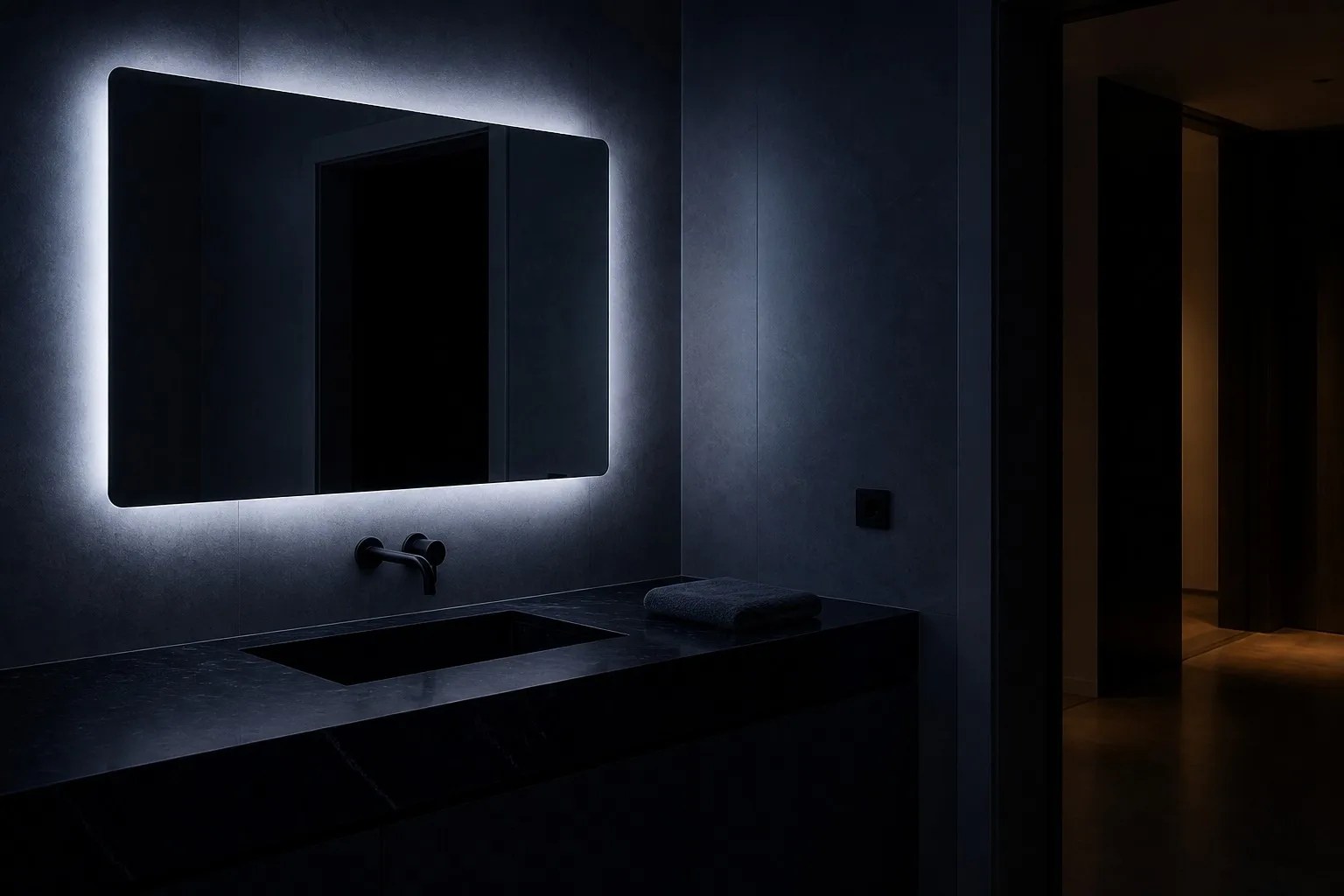
The emotional transaction is unlike a wearable’s. A ring or a watch is a tool you put on; the mirror is a surface you already stand before, in the bathroom or the bedroom, in the half-light of the morning, when the face is at its least defended. The Longevity Mirror asks nothing of you — no patch, no finger, no clasp. It simply watches the skin of your face flush with each heartbeat and returns a number, after a 30-second facial blood-flow scan, per The Verge. That passivity is the product’s power and its risk: the harshest critic in the house has been given a printer.
The risk is the score itself. A physiological age, a cardiovascular indicator, a metabolic number — rendered in the same frame as your reflection — is a verdict delivered to the least prepared audience in the household. Android Headlines’ hands-on coverage of the mirror at CES 2026 described the accuracy of its readings as mixed. A score you do not fully trust, delivered every morning by a surface that has always told you the truth about your hair, is a new kind of domestic anxiety — one the $899 price does not include a therapist for.
The ritual is the product. The mirror asks for thirty seconds a day — the company’s own scan spec, per The Verge — and what it returns is a number with a trend line and, in the six-profile configuration, a row of scores for every face that passes through the room. The company claims describe that configuration. It is the quiet transformation: a surface that once held one person’s reflection at a time now holds a household’s data at once, and the morning check becomes a domestic event with a leaderboard nobody agreed to join. The emotional cost is not the hardware. It is the habit.
The Market
From Research Prototype to Retail Mirror
The category arrived in three steps, and the steps matter. In 2021, peer-reviewed research in the journal Sensors described the SHAPES smart-mirror prototype, built for older adults and rehabilitation — a research instrument, not a product. The study is worth reading precisely because it shows the clinical origin of the idea. In January 2025, Withings showed the Omnia mirror at CES; Mashable noted it was a concept, not a purchasable product. In the first quarter of 2026, NuraLogix began selling the Longevity Mirror at $899. The Verge covered the launch. Prototype, concept, retail — that sequence is the whole story of the category in miniature.
The company’s claims about its mirror are expansive. NuraLogix describes 100-plus wellness indicators, models trained on hundreds of thousands of records, and support for six user profiles, per its CES coverage. Longevity.Technology’s report is the source, and every figure in it is company-derived — treat it as such. The mechanism, per The Verge: a 30-second facial blood-flow scan estimating heart rate, blood pressure, cardiovascular and metabolic indicators and physiological age — with the blood-pressure metric still undergoing FDA clearance at the time of the announcement.
The pricing model is where the category’s ambition shows. The mirror sells for $899, plus $99 per year after the first year, per Android Headlines; an optional concierge service runs $399 per year, per The Verge. A mirror with a subscription is a mirror with a revenue model — and the revenue model explains why the scores keep coming every morning, whether you asked for them or not.
The Pain
The Score You Did Not Ask For
Four pains come with the grade. They are not technical; they are domestic.
1. Self-scrutiny on a schedule. The mirror converts an occasional thought — “I should get more sleep” — into a daily reading with a trend line. That is the feature and the wound. A physiological age three years older than your calendar age, displayed beside your reflection at 6:40 a.m., is not information; it is a mood. The research lineage shows how far the consumer version has drifted from its origin: the peer-reviewed SHAPES prototype was built to support older adults and rehabilitation, not to grade them. The Sensors study is the record.
2. The clearance gap. The honest inventory of what is cleared versus what is scored is short and precise. NuraLogix’s own site describes only pulse and breathing rate as FDA-cleared; everything else is explicitly not intended to diagnose, treat, cure, mitigate, monitor or prevent disease. The company’s website says so in plain language. The blood-pressure estimate was still undergoing FDA clearance at the January announcement, per The Verge. The marketing implies a health dashboard; the regulatory record describes a wellness mirror with two cleared numbers and a long list of disclaimers.
3. Face data in the most private room. The mirror reads faces — up to six profiles, per company claims as reported by Longevity.Technology — which makes it a camera in the bathroom or bedroom that processes what it sees and retains it. The consent question is not about you; it is about everyone else in the house, including people who never agreed to be profiled by a mirror. Cloud processing, face-data retention and profile consent are questions the buyer must put to the vendor in writing, because the marketing will not volunteer them.
4. Mixed accuracy. Android Headlines’ hands-on found the accuracy mixed. In plain terms: the mirror will be right about some mornings and wrong about others, and you will not know which is which — because the one number you can check against a reference, your actual blood pressure, is the one that still required a cuff at clearance time.
The Numbers
Eight Hundred Ninety-Nine Dollars and a Footnote
The arithmetic of ownership is simple, and it should be done in the open. Desk arithmetic, as this article computes it: $899 for the mirror, plus three renewal years at $99 per year, comes to $899 + $297 = $1,196 over four years — excluding the optional $399-per-year concierge. Android Headlines’ pricing is the basis for the $99 renewal figure; The Verge is the basis for the $899 price and the concierge. That is arithmetic on listed prices — not a quote, and not a prediction of what renewal will cost in 2030.
The regulatory ledger is shorter than the marketing. FDA-cleared: pulse and breathing rate, per NuraLogix’s own site. Still undergoing FDA clearance at announcement: the blood-pressure metric, per The Verge. Everything else — cardiovascular and metabolic indicators, physiological age, the 100-plus wellness indicators and six profiles — is company-claimed per Longevity.Technology’s report and explicitly not intended to diagnose, treat, cure, mitigate, monitor or prevent disease. The gap between the scoreboard and the science is the real product spec.
“The mirror is the one surface in the house that has always told the truth. Now it tells a score.”
The Buy
How to Buy a Mirror Without Surrendering the Morning
Five rules separate a useful wellness mirror from an expensive source of six a.m. dread.
1. Separate the cleared from the scored before you buy. Make two lists. List one: pulse and breathing rate — the only functions NuraLogix describes as FDA-cleared. The company’s site is explicit. List two: blood pressure, longevity, metabolic and mental-health scores — not cleared, and explicitly not intended to diagnose, treat, cure, mitigate, monitor or prevent disease. Same site, same sentence. Buy the mirror for list one; treat list two as conversation material, or skip it.
2. Test the lighting before you trust the reading. Facial blood-flow scanning is a camera measurement, and cameras are slaves to light. The hands-on coverage described mixed accuracy, per Android Headlines; a dim bathroom at dawn is not a clinical lighting setup. Spend the first week comparing the mirror against a real cuff and a real pulse check, and recalibrate your trust accordingly.
3. Ask the privacy questions in writing. Cloud processing, face-data retention, profile consent — these must be put to the company, because the marketing will not volunteer them. Six profiles means six faces on file, per the company claims; ask who else in the house can be enrolled, what happens to the data, and whether a partner or child who never consented can be scanned anyway. A mirror cannot be uninstalled from a face.
4. Do the desk arithmetic before the romance. $899, plus $99 per year after the first year, plus an optional $399-per-year concierge. Android Headlines and The Verge between them supply the numbers. Four-year base cost, computed here: $1,196, excluding the concierge. If the score is not worth that much to your sleep, the mirror is not worth it either.
5. Keep a clinician in the loop. The mirror detects patterns; it does not diagnose. Nothing in its non-cleared output should change medication, diet or emergency decisions — the company’s own disclaimer says as much. Bring the trend lines to a doctor who can interpret them. The mirror’s job is to start the conversation, not to end it.
The Fine Print
What the Reflection Will Not Tell You
1. Cleared is a narrow word. Only pulse and breathing rate are described as FDA-cleared on NuraLogix’s site; all other insights are explicitly not intended to diagnose, treat, cure, mitigate, monitor or prevent disease. Those disclaimers are not boilerplate; they are the product’s legal spine.
2. The blood-pressure score is not a blood-pressure reading. The metric was still undergoing FDA clearance at the January announcement, per The Verge. Until and unless that changes, treat it as an estimate with an unknown error bar — and keep the cuff.
3. The big numbers are company claims. One hundred-plus wellness indicators, models trained on hundreds of thousands of records, six profiles — all company-derived, per Longevity.Technology’s report. They describe ambition, not validation.
4. Hands-on accuracy was mixed. Android Headlines said so, and lighting conditions shape camera-based readings. A mirror in a dark bathroom at dawn will not read like a mirror in a bright dressing room. Verify before you venerate.
5. The category is younger than its marketing. Withings’ Omnia was a concept, not a purchasable product, per Mashable, and the SHAPES mirror is a peer-reviewed research prototype for older adults and rehabilitation, per the Sensors study — not a consumer device. The Longevity Mirror is the first real retail entry, which means the first generation of buyers is, in effect, the beta test.
The Last Word
The mirror that grades you before breakfast is a mirror of the age: passive, visual, unblinking, and slightly more interested in your numbers than you are. It can measure your pulse and your breathing with clearance, and it can speculate about everything else with a disclaimer. The discipline is to hold the two apart — to use the cleared numbers as information, the scored numbers as conversation, and the reflection in between as the only truth the house has always trusted. Buy the mirror for what it can verify. Ignore what it cannot. And if the score makes the morning worse, unplug it — the reflection will still be there, and it will still be the one that matters.
— THE SMARTS DESK
Sources
Research Appendix
Every statistic in this article links to its primary source. Full list, as of 29 August 2026:
| Data point | Institution | Date | Source |
|---|---|---|---|
| Longevity Mirror $899; 30-second facial blood-flow scan; estimates heart rate, BP, cardiovascular/metabolic indicators, physiological age; BP metric still undergoing FDA clearance; concierge $399/year; Q1 2026 launch | The Verge | 5 Jan 2026 | CES report |
| 100+ wellness indicators; models trained on hundreds of thousands of records; six profiles (company-derived claims) | Longevity.Technology | 6 Jan 2026 | CES coverage |
| $899 plus $99/year after first year; hands-on accuracy described as mixed | Android Headlines | 8 Jan 2026 | Hands-on |
| Only pulse and breathing rate described as FDA-cleared; other insights not intended to diagnose, treat, cure, mitigate, monitor or prevent disease | NuraLogix | Accessed 31 Aug 2026 | Official site |
| SHAPES smart-mirror prototype for older adults and rehabilitation (peer-reviewed research) | Sensors (PMC) | 28 Nov 2021 | Study |
| Withings Omnia was a concept, not a purchasable product | Mashable | Jan 2025 | Report |
 Independent Intelligence on Ambient Technology
Leave a comment