Pool Care · Robotics · Cordless
The Pool Robot Finally Learned to Take Out Its Own Trash
SMARTS · 30 August 2026 · 12 min read
The moment that matters happens before anyone swims. It is the moment you open the screen door and the water is already clear — no skimmer net leaning against the coping, no hose vacuum coiled on the patio, no basket of wet leaves dumped in the flowerbed. For most pool owners that moment has always required a choreography: net the surface, brush the walls, run the vacuum, rinse the filter, repeat until the water forgives you. The cordless pool robot was supposed to end the choreography, and in 2026 it has largely done so. The labor it removed, though, has been replaced by a smaller, quieter labor that the marketing photographs carefully leave out of frame: hauling the machine out of the water, rinsing its filter, and deciding what to do with the debris it has learned to collect. This article is about the labor that remains — and the evidence that separates a real cleaner from a spec sheet.
The Feeling First
The Pool That Is Ready When You Are
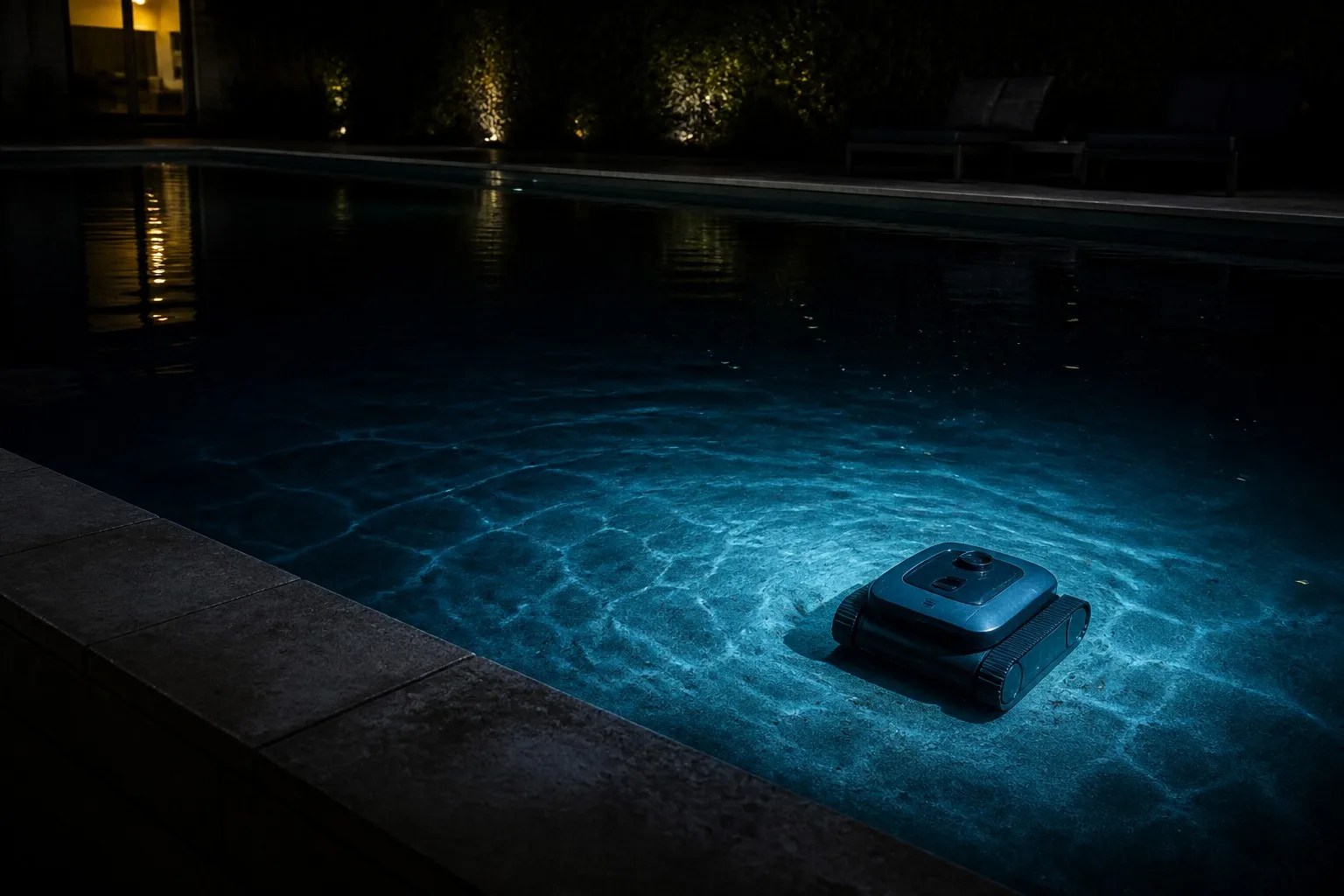
The emotional core of this category is not technology; it is readiness. A pool that is ready when the family is — the water swept, the leaves collected, the floor clean by the time the first child cannonballs in. CNET’s 2026 testing program, updated 27 August 2026, put robots through controlled leaf and pebble loads in a 14,000-gallon pool, and the results read like the end of a long argument: the Aiper Scuba V3, $800, retrieved every leaf it was given and left six pebbles behind, with up to three hours of runtime. The relief is real. The pool stops being a project that must be prepared and becomes a room that is ready — and the person who used to spend Friday evening with a skimmer net gets the evening back.
But there is a second feeling in the water, and it is the one the brochures do not photograph: the bend of the back. A cordless robot is a battery brick with wheels and a filter basket, and someone has to lift it out, carry it to the hose, rinse the basket, and return it to the water or set it on the dock. The emotional contract of the cordless category is honest about the cable it removes and silent about the labor it leaves behind. That silence is why the buying decision has to start with the labor — your labor, your back, your tolerance for wet filters — and only then move to the machine.
The Market
Twenty Robots in a Fourteen-Thousand-Gallon Pool
The commercial scale is unmistakable. Global Market Insights estimates the robotic pool cleaner market at $1.18 billion in 2025, $1.34 billion in 2026 and $9.11 billion by 2035 — a compound annual growth rate of 23.7% (a market-research estimate, not a government tally). Its industry analysis shows a category compounding faster than most consumer hardware, which tells you something about the size of the labor it replaces: pool cleaning was never a pleasant chore, and automation arrived late to it.
The testing that matters is independent and controlled. CNET’s program is the strongest evidence available: more than twenty robots, a 14,000-gallon pool, standardized leaf and pebble loads, and results measured in debris actually retrieved — all leaves retrieved, six pebbles left, in the case of the $800 Scuba V3. This is the antidote to the flow-rate numbers that dominate spec sheets, because a pump that moves water quickly can still leave a pebble in the deep end.
At the top of the market, the machines are becoming appliances with docks. Wired’s field testing, updated August 2026, covers premium cordless models including the Beatbot AquaSense 2 Ultra at $2,299 on deal against a $3,150 list price, and the AquaSense X at $3,825 with its self-cleaning dock. The self-emptying flagship went further at CES: CNET previewed the AquaSense X/AstroRinse at a $4,250 suggested retail price, with a manufacturer-claimed three-minute backflush and a 22-liter debris bin. The ladder from $800 to $4,250 is really a ladder of labor removed — and labor relocated.
The Pain
The Labor the Brochures Leave Underwater
The cordless robot removes a cable and introduces a battery. It removes netting and introduces a retrieval. Four pains survive the marketing, and the wise buyer prices them in before the first swim.
1. Retrieval weight and pool geometry. The machine lives underwater and must come out to be emptied or charged. Weight, handle design and the height of your coping determine how unpleasant that is — and pool geometry decides whether the robot can even reach the walls and waterline it is supposed to clean. A robot that cleans the floor beautifully and ignores the cove has moved the labor, not removed it.
2. Filter cleaning and micron rating. Every leaf the robot collects is a leaf that must be emptied by hand unless the dock does it for you. The filter’s micron rating decides what stays in the water: coarse debris and leaves, or the fine silt that turns clear water cloudy. The marketing shows the robot collecting; it does not show the second rinse, because there is no photograph of a wet basket that flatters anyone.
3. The dock and its standing water. Self-emptying docks are the category’s most seductive upgrade, and they carry their own upkeep. Wired’s testing warns that the standing water associated with dock systems may attract mosquitoes — a caution worth re-reading on a summer evening. And the flagship’s 22-liter bin and three-minute backflush are manufacturer claims from the CES announcement, not independent results. CNET’s preview says as much.
4. The battery horizon. Cordless removes the tether and introduces a consumable. Runtime is a ceiling — “up to three hours” in CNET’s testing is an up-to, not a guarantee — and battery ageing is a cost the spec sheet does not show. Any promise of three to five years of battery life should be ignored unless the manufacturer’s written warranty says the same thing.
5. The choreography of charging. The cordless promise is a pool free of cables, but the machine still lives on a schedule. Runtime is finite — up to three hours in CNET’s testing of the Scuba V3 — so the robot that cleaned the pool yesterday must be hauled out, charged and returned before it can clean it again today. In practice the dock becomes a fixture of the patio: a second piece of pool furniture that needs a power outlet, a dry position and a routine of its own. The family that bought the robot to escape pool chores has, quietly, adopted a new one — remembering when the machine last ate, and whether anyone lifted it out before the water got cold.
The Numbers
Leaves Retrieved, Pebbles Left, Prices Paid
The honest numbers come from the controlled test, not the flow-rate column. In CNET’s 14,000-gallon pool, the $800 Scuba V3 retrieved all leaves and left six pebbles, with up to three hours of runtime. The six pebbles are the footnote that separates a test from a testimonial: they are the debris you would otherwise be netting by hand, and the count tells you what the marketing will not. Across the twenty-plus robots tested, the result that matters is the one measured in debris left on the floor.
The price ladder runs from $800 to more than four thousand dollars. Maytronics’ official store lists the Nautilus EON 100 at $899 and the EON 120d at $1,199 — company listings, quoted as such. Wired’s field-tested premium tier sits at $2,299 on deal for the AquaSense 2 Ultra and $3,825 for the AquaSense X. The self-emptying AquaSense X/AstroRinse carries a $4,250 suggested retail price with manufacturer-claimed specs of a three-minute backflush and a 22-liter bin. CNET’s CES preview is the source, and it labels the specs as claims. Pool Magazine’s 2026 spring roundup catalogs ten cordless models with vendor-published specifications — useful as a menu, worthless as evidence, because every figure there is a company claim.
“The test that matters is not how much water the pump moves. It is how many pebbles are left on the floor.”
The Buy
How to Buy a Cleaner That Does Not Clean You Out
The buying rules follow from the pains. Run the list in order, and run it against your pool, not against the showroom.
1. Trust debris tests over flow-rate claims. When a spec sheet leads with gallons per minute, ask what the machine leaves behind. CNET’s controlled leaf-and-pebble protocol in a 14,000-gallon pool is the kind of evidence that should anchor the decision — the Scuba V3’s all-leaves, six-pebbles result says more than any pump curve ever printed.
2. Match the machine to the pool’s geometry and your back. Measure the pool: surface area, wall height, waterline, steps, cove. Then measure the human: robot weight and handle design decide who retrieves it. A premium machine that requires two people to lift is a premium machine that will be left in the pool with a full basket.
3. Decide on the dock before you fall for it. The self-emptying dock removes the basket rinse and adds standing-water upkeep — Wired’s mosquito caution applies here — plus a serious price step: from $3,825 for the AquaSense X to $4,250 for the self-emptying flagship, whose three-minute backflush and 22-liter bin remain manufacturer claims. CNET’s CES preview labels them as such. It is a labor trade, not a free upgrade.
4. Read the battery warranty as a contract. Runtime is an up-to: three hours in CNET’s testing of the Scuba V3. Battery ageing is inevitable, and any three-to-five-year life claim must appear in the manufacturer’s written warranty before you treat it as true. If it is not in writing, it is marketing.
5. Price the whole system, not the robot. Maytronics’ EON 100 at $899 and EON 120d at $1,199 are company listings for a reason: the true cost includes the dock, the spare filters, the charger and the time spent hauling the machine in and out of the water. The robot is often the cheapest part of owning a robot.
The Fine Print
The Fine Print at the Bottom of the Pool
1. Flow rates are marketing; debris results are evidence. Vendor-published specifications, including Pool Magazine’s ten-model roundup, are company claims. Independent tests like CNET’s controlled loads are the only numbers that should survive a purchase decision.
2. Battery life is a warranty question, not a promise. No article or brochure should be read as guaranteeing three to five years of battery life without the manufacturer’s written warranty to match. Runtime is an up-to figure: three hours in CNET’s testing, not forever.
3. Docks bring standing water. Wired’s warning that dock standing water may attract mosquitoes is the kind of caution that earns its place in the fine print. The self-emptying flagship’s three-minute backflush and 22-liter bin are manufacturer-claimed specs from the CES preview.
4. Prices move and lists lie. The AquaSense 2 Ultra’s $2,299 deal against a $3,150 list price shows the gap between ask and actual. Wired’s numbers are field observations; Maytronics’ figures are company store listings. Neither is a promise about tomorrow.
5. Market forecasts are estimates. Global Market Insights’ $9.11 billion projection for 2035 and its 23.7% CAGR are market-research estimates, not audited results. Its analysis describes a direction, not a guarantee.
The Last Word
The robot that takes out its own trash has changed the arithmetic of pool ownership: the net and the hose vacuum are retiring, and the water is ready when the family is. What has not changed is that a machine with a battery and a filter still needs a human — to lift it, rinse it, dock it and decide when its battery has had enough. The pool is easier. The judgment is not. Buy the machine that fits your back, your pool and your tolerance for wet filters, and the robot will keep its end of the bargain. It was always the other end that needed watching.
— THE SMARTS DESK
Sources
Research Appendix
Every statistic in this article links to its primary source. Full list, as of 30 August 2026:
| Data point | Institution | Date | Source |
|---|---|---|---|
| 20+ robots tested in 14,000-gallon pool; Aiper Scuba V3 $800, all leaves retrieved, six pebbles left, up to three-hour runtime | CNET | Updated 27 Aug 2026 | Debris test |
| Beatbot AquaSense 2 Ultra $2,299 deal/$3,150 list; AquaSense X $3,825 with self-cleaning dock; dock standing water may attract mosquitoes | Wired | Updated Aug 2026 | Field testing |
| Ten cordless models, vendor-published specifications (company claims) | Pool Magazine | Spring 2026 | Roundup |
| Nautilus EON 100 $899; EON 120d $1,199 (company listings) | Maytronics | Accessed 31 Aug 2026 | Official store |
| Self-emptying AquaSense X/AstroRinse $4,250 SRP; three-minute backflush and 22-liter bin (manufacturer-claimed) | CNET (CES preview) | 7 Jan 2026 | CES preview |
| Robotic pool cleaner market: $1.18B (2025), $1.34B (2026), $9.11B (2035), CAGR 23.7% (market-research estimate) | Global Market Insights | 2026 | Industry analysis |
 Independent Intelligence on Ambient Technology
Leave a comment