Home Energy · Backup Power · Resilience
The Quiet Battery and the Generator That Can Wait Out the Storm
SMARTS · 31 August 2026 · 12 min read
The storm is not the decision point. The decision happens months earlier, in daylight, when the power is on and the question sounds theoretical: battery or generator? It is the wrong question, because it treats the house as one load. A house is not one load. It is a refrigerator, a furnace, a well pump, a router, a chest freezer full of a summer’s work, a sump pump that runs every few minutes during the very storms that kill the grid, and a child on a ventilator in the worst case. The real question is which of those loads must survive an outage, for how long, and at what price — and the answer splits the decision into pieces that no single machine can carry alone. PowerOutage.us, which tracks more than 950 utilities, logged the practical stakes in the last severe season: Winter Storm Fern peaked at 1,005,641 customers without power at once. A million homes, each one discovering its loads in the dark. This article is about choosing before that moment arrives.
The Feeling First
The Argument in the Dark
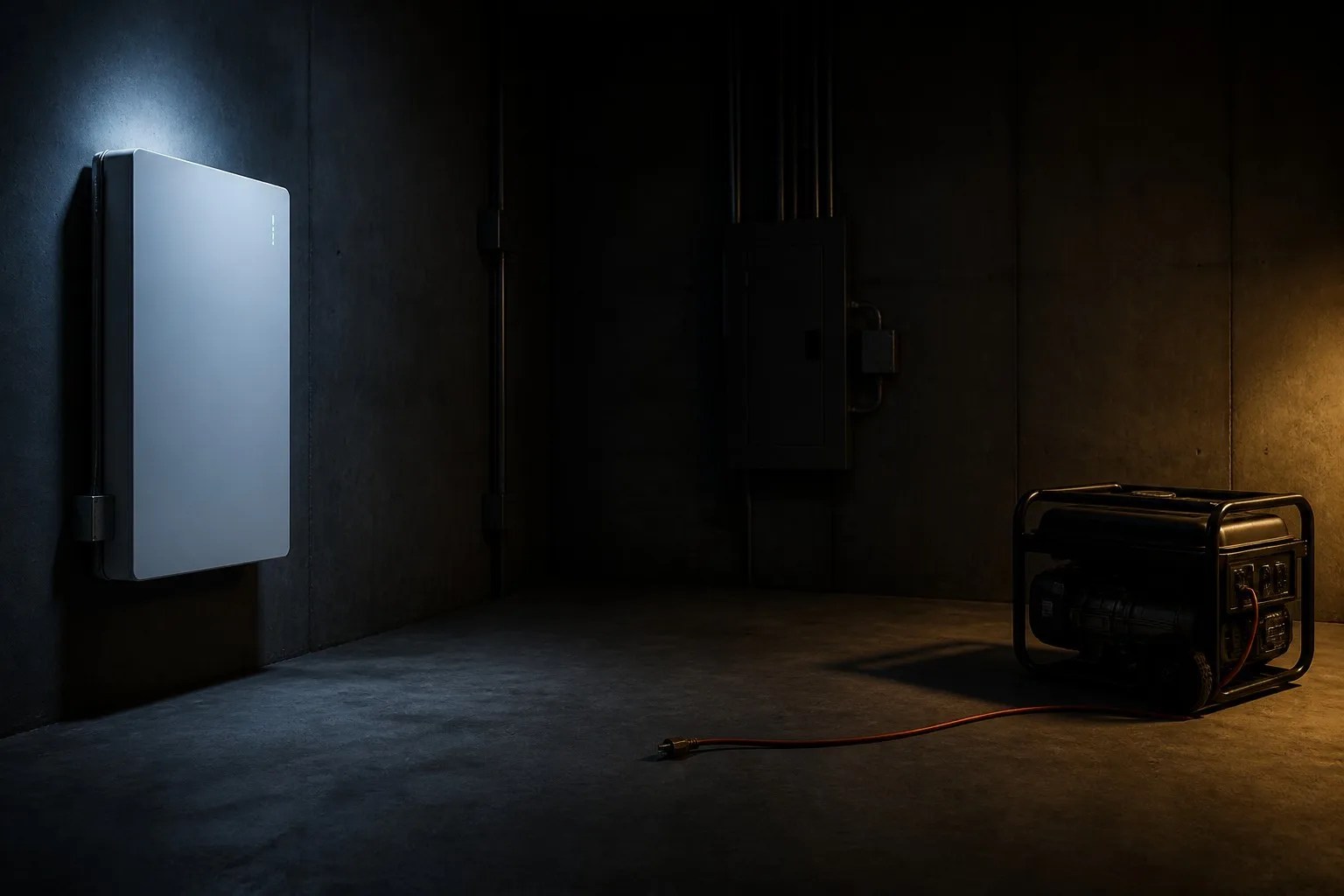
The two machines do not just differ in chemistry. They differ in the texture of the crisis they carry you through. The generator answers the outage with sound — a roar that announces to the whole street that this house is running, a sound that makes the dark feel managed but never quiet, and that keeps a small portion of the family’s attention on fuel, oil and the machine itself for as long as the outage lasts. The battery answers with silence. The lights come back the way they left: without explanation, without ceremony, as if the grid had simply decided to behave. That silence is a real luxury, and installers who sell batteries know it: Earthlight Technologies, an installer, describes a 13.5-kilowatt-hour battery running essential loads for 12 to 24 hours and puts generator noise at 65 to 75 decibels — a claim from a pro-battery commercial source, which is exactly how it should be read.
But the emotional case cuts both ways, and the honest homeowner hears both sides. The battery’s silence has a limit written in watt-hours; when it empties, the house goes dark again, quietly, at the hour of maximum need. The generator’s roar has a limit written in fuel; when the tank runs dry and the stations are dark too, the roar stops mid-sentence. The feeling of resilience is not the same as resilience. The household that plans for a two-hour outage and lives through a two-day one has purchased the wrong emotion, and the marketplace has done very little to help them tell the difference.
The Market
Two Machines, One Grid, Zero Certainty
The market context is a grid that keeps proving its fragility and a pair of technologies converging on the same job from opposite directions. PowerOutage.us — an independent tracker, not a seller — records Winter Storm Fern’s peak of 1,005,641 customers without power and monitors more than 950 utilities, which makes it the most neutral yardstick in this article. Against that backdrop, batteries have fallen in price and risen in capability until a wall-mounted unit with a transfer switch genuinely competes with a fueled machine for the same household budget. The competition is new, and the information ecosystem around it is not neutral: nearly every cost figure published about this decision comes from someone who sells one of the two machines.
Take the most cited numbers in the category, from EnergySage, a marketplace and lead-generation platform updated 13 July 2026. It presents illustrative United States averages: a generator installed for roughly $7,000, a 13.5-kilowatt-hour battery at about $15,650 before incentives, and a 20-year modeled cost of $62,335 for solar-plus-storage against $91,319 for a propane generator. Those figures are modeled illustrations from a commercial platform that earns when homeowners engage installers through it — useful for scale, useless as a quote. Aurora Solar, a solar-software vendor, publishes its own illustrative generator costs and maintenance and fuel ranges from the software side of the same industry. Both are commercial content. The honest conclusion is not that one machine is cheaper; it is that no universal payback figure exists, and any source claiming one is selling something.
The Pain
The Load That Decides
The pain begins with the mismatch between marketing and physics. The battery is sold as a house-sized solution and is, in reality, a load-sized one: Earthlight’s installer claim of 12 to 24 hours of essentials on a 13.5-kilowatt-hour unit assumes a disciplined list of loads — lights, refrigeration, a router, a furnace blower — and assumes the electric range, the dryer and the water heater stay off for the duration. Add an electric heat pump running continuously through a February outage and the hours collapse. The homeowner who bought the battery as an appliance and uses it as a lifestyle finds out in the dark that the machine was honest and the expectation was not.
The generator’s pain is fuel, and it is existential. The machine can wait out the storm only as long as its supply chain does. The outage that empties the grid also empties the fuel stations: pumps need electricity, delivery trucks need roads, and a multi-day regional event converts every gasoline generator in the county into a competitor for the same shrinking pool. The maintenance ledger runs alongside — oil changes, battery tenders, fuel stabilization, annual load tests — and the machine that is not maintained is a machine that fails at the exact moment it was bought to succeed. Aurora Solar’s illustrative figures cover the maintenance and fuel ranges; they are a software vendor’s model of the ledger, not a guarantee.
The third pain is the installation itself, and it is the same for both machines. A stationary battery or a whole-house generator both require a licensed electrician, a transfer switch or sub-panel, possibly a service panel upgrade, soft-start hardware for large motors, permits and an inspection — costs that the headline equipment price never includes and that no marketplace figure can predict for a specific house. Underline Energy Concepts, a Southern California contractor, publishes the kind of regional detail that matters — its comparison puts a 26-kilowatt generator at roughly 67 dB(A) measured at 23 feet and frames the choice inside local utility and rate context — but a contractor’s blog is a contractor’s perspective, and local context is exactly what it is: local.
The Numbers
Figures to Hold, Sources to Name
Every number in this decision comes with a provenance, and the buyer who does not sort them will be sorted by them. The tracker’s number is the cleanest: 1,005,641 customers without power at Winter Storm Fern’s peak, across the more than 950 utilities PowerOutage.us monitors. The marketplace’s numbers are next: about $7,000 for a generator installed, about $15,650 for a 13.5-kilowatt-hour battery before incentives, and the 20-year modeled comparison of $62,335 for solar-plus-storage against $91,319 for propane — all from EnergySage’s illustrative modeling, a commercial platform. Then come the installers’ claims: 12 to 24 hours of essentials from a 13.5-kilowatt-hour battery and 65 to 75 decibels of generator noise from Earthlight; roughly 67 dB(A) at 23 feet for a 26-kilowatt unit from Underline. The pattern is the point: the farther a figure is from an independent measurement, the more carefully it must be held.
01
1,005,641 customers
Winter Storm Fern’s peak outage count, tracked across 950+ utilities. PowerOutage.us
02
~$7,000 vs ~$15,650
Illustrative US averages: generator installed versus 13.5-kWh battery before incentives. EnergySage modeling
03
12–24 hours
Installer-claimed essentials runtime for a 13.5-kWh battery; 65–75 dB claimed generator noise. Earthlight claim
04
67 dB(A) at 23 ft
Contractor-reported noise for a 26-kW generator in Southern California context. Underline comparison
“Resilience is not a machine you buy. It is a list of loads you keep alive, in an order you chose in daylight.”
The Buy
A Decision Made Load by Load
The purchase rules form a sequence, and the sequence matters: the machine is the last decision, not the first.
1. Build the critical-load inventory before reading a single spec sheet. Walk the house and write down what must survive an outage: refrigeration, heating or cooling, well pump, sump pump, medical equipment, communications. Then measure or estimate each load’s draw and its hours of need. The 12-to-24-hour essentials claim from Earthlight’s installer content is only meaningful against your list, not against its own. A battery that covers the refrigerator, the router and the furnace blower is a different product from one that must also start a well pump or a heat pump — and the difference shows up in the quote.
2. Establish your outage history, not your fears. Look up the actual durations and frequencies of outages at your address — PowerOutage.us tracks the national picture across 950+ utilities, and your utility’s outage reports cover your street. A household that loses power for four hours twice a year and a household that loses it for four days once a year face different problems; the first is served by a battery, the second by fuel logistics. The outage history is the closest thing to an objective witness this decision has.
3. Get installed quotes, itemized to the bolt. The equipment price is the smallest number on the invoice. Demand line items for the transfer switch or sub-panel, any service panel upgrade, soft-start hardware for large motors, permits and inspection. EnergySage’s illustrative $7,000 and $15,650 figures are marketplace modeling; your quote is the only number that matters, and it should arrive itemized from at least three installers, each asked to price both technologies for the same load list.
4. If fuel is the question, the generator is the answer — and vice versa. The generator’s entire argument is sustained high load over long duration, and its entire vulnerability is the fuel supply chain. Aurora Solar’s illustrative maintenance and fuel ranges sketch the ongoing ledger. If propane delivery is reliable at your address and the loads are heavy, the generator earns its noise. If the outage risk is short, the loads are modest and silence matters, the battery earns its price. The hybrid option — a battery sized for the first hours plus a fueled generator for the long haul — is a legitimate third answer for households with the panel capacity to support both.
5. Verify incentives with the agencies that pay them, at purchase time. Federal and state incentive status is reported inconsistently across the commercial sources in this field, and the contradictions are not harmless. This article deliberately asserts no current credit percentage as settled fact. Before signing anything, check the current rules with the Internal Revenue Service for federal matters and with your state energy office for state programs — and get the answer in writing from the agency, not from the installer’s landing page.
The Fine Print
Who Paid for Every Number in This Article
1. Nearly every cost source sells installations. EnergySage is a marketplace and lead-generation platform; Earthlight Technologies and Underline Energy Concepts are installers; Aurora Solar is a solar-software vendor. Their figures are commercial content with commercial motives, and no universal payback figure exists. Treat every cost, runtime and noise claim accordingly.
2. Incentive claims conflict across sources. Some federal-credit statements in the installer literature contradict others, and this article repeats none of them as settled fact. Verify any credit with the IRS for federal programs and your state energy office for state programs at the time of purchase. Underline’s California comparison is an example of the genre, not a substitute for the agency.
3. Runtime and noise figures are claims, not measurements. The 12-to-24-hour battery runtime and 65-to-75 dB generator noise come from an installer’s blog; the 67 dB(A) at 23 feet comes from a contractor’s comparison. Neither has been independently verified here. Run times depend entirely on your load list, and noise depends on placement, enclosure and the specific unit.
4. The bill is bigger than the box. Panel upgrades, transfer switches, soft-start hardware, permits and inspection add to every installation, and maintenance continues afterward: fuel stabilization and oil changes for the generator, battery degradation and firmware for the battery. Aurora Solar’s illustrative ranges sketch the ledger; your installer’s itemized quote is the only authority.
5. This decision is not the other articles’ decisions. Vehicle-to-home power and thermostat demand response are separate strategies with separate hardware and separate trade-offs. The choice here is stationary: a wall-mounted battery, a fueled generator, or both, sized against your own critical loads. PowerOutage.us’s comparison is the one source in this field with no machine to sell, and it is worth reading for that reason alone.
The Last Word
The storm will not ask which machine you chose. It will ask which loads you kept alive, and for how long, and the answer was written months earlier, in the daylight of a decision most households never make deliberately. The tracker’s numbers say the grid will keep failing; the marketplace’s models say both machines are affordable enough to argue about; the installers’ claims say each one is the answer. The battery will carry the quiet first hours; the generator will roar through the long ones; a household that planned its loads in advance will know which it needs, and a household that did not will discover its answer at the worst possible time. Resilience is not a machine. It is a list, kept in order, and the machine that serves it. Write the list in daylight. The dark will do the rest.
— THE SMARTS DESK
Sources
Research Appendix
Every statistic in this article links to its primary source. Full list, as of 31 August 2026:
| Data point | Institution | Date | Source |
|---|---|---|---|
| Illustrative US averages: generator install ~$7,000; 13.5-kWh battery ~$15,650 before incentives; 20-year modeled $62,335 solar+storage vs $91,319 propane (marketplace modeling) | EnergySage | Updated 13 Jul 2026 | Comparison |
| 13.5-kWh battery runs essentials 12–24 hours; generator noise 65–75 dB (installer claims) | Earthlight Technologies | 20 Jul 2026 | Installer blog |
| 26-kW generator ~67 dB(A) at 23 ft; Southern California utility/rate context; some federal-credit claims conflict with other sources (contractor content) | Underline Energy Concepts | 13 Aug 2026 | Contractor comparison |
| Illustrative generator costs and maintenance/fuel ranges (solar-software vendor content) | Aurora Solar | 20 May 2026 | Vendor blog |
| Winter Storm Fern peaked at 1,005,641 customers without power; tracks 950+ utilities (independent tracker) | PowerOutage.us | Accessed Aug 2026 | Comparison |
 Independent Intelligence on Ambient Technology
Leave a comment