Diabetes · Sensors · FDA
The Sensor That Watches for the Emergency Glucose Cannot See
SMARTS · 31 August 2026 · 12 min read
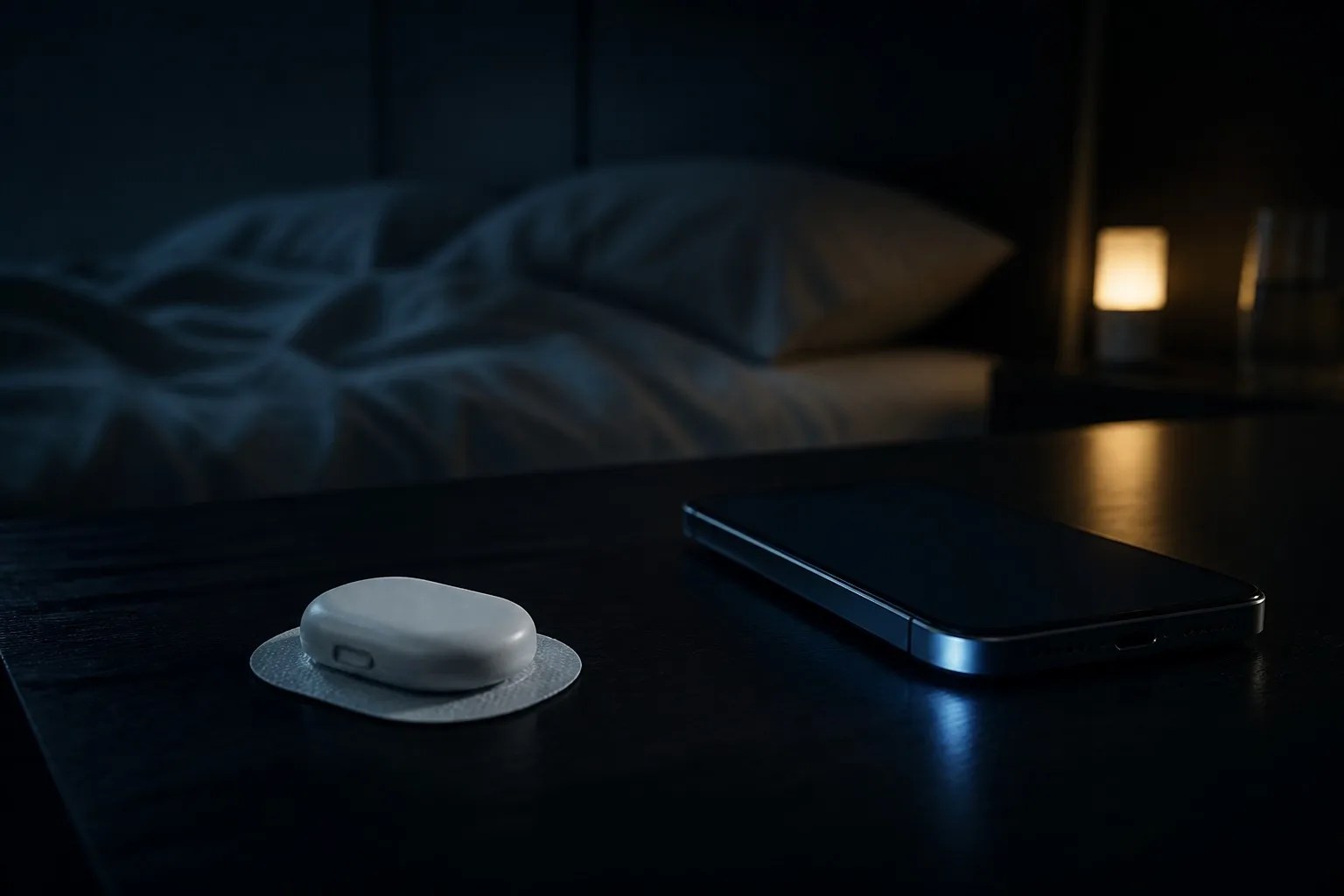
At two in the morning the number on the phone looks like a small victory: 96, steady, the flat line of a night that is going well. The parent who is awake for the third check knows better than to trust the picture. Diabetes has an emergency that arrives wearing a normal blood sugar reading. Euglycemic diabetic ketoacidosis — DKA with glucose in range — is the ambush the monitor was never built to photograph, and until this month the only way to see it coming was to test for ketones by hand, in the dark, on a schedule that no human being can actually keep, night after night, for years. On 25 August 2026 the United States Food and Drug Administration authorized the first wearable device that continuously monitors both ketone levels and blood sugar at once, cleared through the De Novo pathway for people with diabetes aged two and older. The agency’s announcement carries the same news in its final paragraphs as its first: the sensor exists, and it is not yet for sale in the United States. The waiting begins.
The Feeling First
The Watch Nobody Can Keep
For the parents and partners who live with type 1 diabetes, the emotional ledger of the disease is written in checks: the glucose check at midnight, the ketone check when the number climbs, the check that follows the check. Ketone testing is intermittent by design — a strip, a meter, a drop of blood or a breath, a result that is already minutes old by the time it appears on the screen. The promise of the new device is not a better number. It is the removal of a question that has to be asked by hand: is something happening that the glucose reading alone cannot show? Clinicians who treat this disease have long highlighted the specific danger in that blind spot — the euglycemic DKA risk that arrives without the usual warning signs. The physician perspective published by Healio on 26 August 2026 names it plainly.
What is being offered, in effect, is a background watcher that keeps working through the hours when nobody is strong enough to watch — the 2 a.m. reading taken while half asleep, the hotel-room night, the night after a stomach virus, when ketones can rise for reasons that have nothing to do with the number on the screen. Caregivers know that specific exhaustion: the body present, the attention gone. A sensor that reports ketones continuously does not cure anything, but it changes the texture of the night watch from vigilance to supervision. That is a real difference, and it is worth naming before anyone names a price. The FDA’s clearance describes a device that reads every minute — a density of information no finger-stick schedule can approach.
The Market
A De Novo Door Opens
The authorization of 25 August 2026 is a first in the literal sense: no wearable has previously been cleared to continuously monitor both ketones and glucose together. The FDA describes the device — Abbott’s Libre Duo 10 Day — as authorized through the De Novo pathway, the regulatory route for novel devices with no existing predicate, with readings delivered every minute and a stated intent for people with diabetes aged two and older, supported by six studies involving more than 600 participants. The FDA press announcement is the primary record of all of it. The clearance is the headline; the calendar is the fine print. Abbott, the manufacturer, states that a United States launch will follow later in 2026 and that price and insurance coverage have not been announced. The company’s announcement is a company document, and it should be read as one. Nothing here is buyable yet, and that is a fact, not an omission.
The context for the timing is the scale of the condition the device serves. The FDA’s announcement cites CDC figures: roughly 40.1 million Americans live with diabetes, and about 2.1 million of them have type 1 diabetes. The agency’s release puts both numbers in print. For that 2.1 million — and for the parents of the youngest among them — ketone monitoring is not a wellness ritual. It is a safety procedure with a known weak point: it only happens when someone remembers to do it.
The trade press confirms the boundary of the announcement rather than extending it. Medscape’s report of 26 August 2026 describes the authorization for people aged two and older with diabetes, and Pharmacy Times’ summary of 28 August 2026 walks the same ground for its clinical readership. No one covering the action describes it as a consumer novelty. It is a clinical tool that happens to be wearable, and it will enter the American market as a prescription device, priced and covered on terms that do not exist yet.
The Pain
The Number That Looks Fine
The pain this device addresses is the emergency that looks like a good day. In euglycemic DKA, blood glucose can sit in or near the normal range while ketones accumulate and the blood acidifies; the standard warning sign — the high glucose reading that triggers a ketone check — never fires, because the glucose never rises. Healio’s physician coverage highlights exactly this risk. The patient can be in serious trouble with a phone screen full of reassuring numbers, and the caregiver’s instinct to trust the flat line is precisely the instinct that fails.
The second layer of the pain is a delay that has already been scheduled. The automated insulin-delivery algorithms that many patients rely on will not understand ketone data when the sensor first arrives. Clinicians quoted in Healio’s report estimate that pump and AID algorithms may need six to twelve months to learn how to use continuous ketone data at all. In plain language: the sensor will see the emergency long before the pump knows what to do with the information. The gap between detection and response is the defining caution of the first year of ownership, and anyone who buys this device in 2026 will live inside that gap.
The older pain is the schedule itself. Ketone checks are intermittent — a strip, a meter, a moment of focus — and they fail most often exactly when they matter most: overnight, during illness, in the confusion of travel. The continuous readout answers that failure with a stream of readings, one per minute according to the FDA, but it replaces the missed check with a subtler discipline: the discipline of interpreting a number that arrives without the ritual that used to force attention to it. A stream of data is only as good as the attention paid downstream, and attention is the scarce resource in every diabetes household.
The Numbers
Ten Days, Every Minute, One First
The numbers attached to the authorization deserve to be held at arm’s length, because their provenance differs. From the FDA: readings every minute, six studies, more than 600 participants, ages two and older. The agency’s release carries all of them. From Abbott, the manufacturer: wear duration of up to ten days, with 84.1 percent of adult sensors and 68.8 percent of pediatric sensors completing the full ten days in its reported studies. Those figures are company-reported — the arithmetic of the failure rate is simple, and worth doing: roughly one in six adult sensors and nearly one in three pediatric sensors in those studies did not finish the ten-day course. A sensor that fails on day six is not a defective unit; it is the statistical tail of the company’s own data.
The population numbers come from the CDC, as cited in the FDA’s announcement: 40.1 million Americans with diabetes, and 2.1 million of them with type 1. The FDA’s release names the source itself. Put together, the picture is of a device arriving into a very large, very tired population: people whose disease has been managed with checks, and who are now being offered a continuous view of the second number that matters. The four facts below are the ones to hold when the launch marketing begins.
01
Every minute
The FDA describes readings delivered every minute, a density no finger-stick schedule can match. FDA release
02
Ten days
Abbott’s reported wear window, with 84.1 percent adult and 68.8 percent pediatric completion in company studies. Company announcement
03
Six studies, 600+ participants
The FDA’s stated evidence base for the De Novo clearance of the first dual glucose-ketone wearable. FDA release
04
Ages two and older
The authorization covers children and adults with diabetes, confirmed by both the FDA and Medscape’s report. Medscape
“A continuous number is not a decision. It is the beginning of one, delivered in time to matter.”
The Buy
Nothing to Buy Yet. Everything to Prepare.
The purchase advice for this device is unusual: there is no purchase yet, and the advice is therefore about preparation. Work through these rules in order, and treat them as the ground rules of the first year.
1. Treat the announcement as a start date, not a sale date. Abbott states that the United States launch will follow later in 2026, and that price and insurance coverage have not been announced. The company’s announcement is explicit on both points. Do not pre-order, do not price-shop, do not budget against a number that does not exist. Any figure circulating before the manufacturer states it is speculation.
2. Ask the endocrinologist before the launch, not after. Whether this device suits a particular patient — especially a child, or someone on an automated insulin-delivery system — is a clinical question, and clinicians are already noting that pump and AID algorithms may need six to twelve months to use ketone data. Healio’s physician coverage frames the question. The conversation to have now is about suitability and integration timing, so that the decision at launch is a decision rather than a purchase.
3. Plan for a watcher, not a rescuer. The device detects; it does not treat DKA. The FDA’s authorization covers monitoring, and the treatment decisions that follow a high ketone reading belong to the labeling, the clinician and the household protocol. The sensor shortens the time to a decision; it does not make the decision.
4. Keep the backup rituals. Sensors can fail before day ten — the company’s own reported data show completion rates below 100 percent in Abbott’s announcement — so intermittent checks remain part of the routine, especially during illness, when ketones can climb for reasons unrelated to glucose and euglycemic DKA is most often seen. The clinical coverage makes the same point from the other direction: the continuous number supplements the check; it does not retire it.
The Fine Print
What the Authorization Does Not Say
1. This is not a wellness product. It is a prescription clinical device for people with diabetes, cleared for ages two and older through the De Novo pathway. The FDA’s announcement is unambiguous about the intended population, and it should never be marketed, or read, as a keto-diet gadget or a general wellness accessory.
2. No price. No coverage. The United States launch is later in 2026; price and insurance coverage are unannounced. Abbott’s statement says so in as many words. Anyone quoting a retail price at this point is guessing.
3. The durability figures are company-reported. The 84.1 percent adult and 68.8 percent pediatric ten-day completion rates are Abbott’s reported study results, not an independent finding. They come from the manufacturer’s own announcement, and they imply that a meaningful share of sensors will not complete their full wear window.
4. Alarms can miss events. No monitoring system sees everything; alarms are limited by what they measure, when they sound and how they are configured. Treatment decisions should follow the device labeling and the clinician’s directions, and intermittent checks remain necessary. The FDA’s authorization establishes the monitoring claim — and nothing more than the monitoring claim.
5. Detection is not treatment, and integration will lag. The sensor reports; it does not stop DKA. Physicians cited by Healio estimate six to twelve months before automated insulin-delivery algorithms learn to use ketone data, which means the first months of ownership will be a period of seeing clearly and acting manually.
The Last Word
The 2 a.m. check was never really about the number. It was the price of love paid in sleep, and no sensor will ever refund it entirely. What the new device offers is different: an observer that never tires, that reads every minute through the hours when the household is weakest, and that watches for the emergency the glucose number cannot see. The FDA’s authorization is the beginning of that change, not its completion — the device is not for sale, the price is not set, the pumps have not caught up, and the sensor detects rather than rescues. When it does arrive, it will change the nature of the watch, not its existence. The emergency that the glucose cannot see will finally have an observer. It will still need someone awake enough to act, and that someone will still be a parent, a partner, a person who got up in the dark and checked, and checked again, and was never once wrong to do so.
— THE SMARTS DESK
Sources
Research Appendix
Every statistic in this article links to its primary source. Full list, as of 31 August 2026:
| Data point | Institution | Date | Source |
|---|---|---|---|
| First wearable continuously monitoring ketones and glucose; De Novo authorization; ages two and older; readings every minute; six studies, 600+ participants | FDA | 25 Aug 2026 | Press announcement |
| Up to ten-day wear; 84.1% adult and 68.8% pediatric sensors completed ten days; US launch later in 2026 (company-reported) | Abbott | 25 Aug 2026 | Company announcement |
| Pump/AID algorithms may need 6–12 months to use ketone data; euglycemic DKA risk highlighted | Healio | 26 Aug 2026 | Physician perspective |
| Authorization reported for people aged two and older with diabetes | Medscape | 26 Aug 2026 | News report |
| Medical-news summary of the FDA action | Pharmacy Times | 28 Aug 2026 | News summary |
| 40.1M Americans with diabetes; 2.1M with type 1 (CDC figures cited in FDA release) | CDC / FDA | 25 Aug 2026 | FDA release |
 Independent Intelligence on Ambient Technology
Leave a comment